The blog reviews 7 leading Shopify product variant apps: Globo Product Options, OPTIS Product Options & Variants, HA Product Options & Variants, AvisPlus Product Options & Variants, Color Swatch King, Variant Option Product Options, and APO Product Options & Variants. These apps were evaluated for variant limits, option flexibility, conditional logic, pricing logic, personalization capabilities, UX, ratings, and pricing tiers.
Shopify’s in-built product variant setup allows up to three option fields and a capped number of variants, which works for simple products but limits customization-heavy catalogs.
However, Shopify product variant apps remove the 3-option restriction by creating unlimited custom option fields, enabling price add-ons, conditional logic, and personalization inputs such as text fields and file uploads.
Some apps specialize in visual variant presentation (Color Swatch King), while others focus on complex configuration logic and advanced pricing models (OPTIS, APO).
Based on feature depth, pricing logic, scalability, and bulk management capabilities, Globo Product Options stands out as the strongest overall solution for complex and growing catalogs.
In this blog, I compare & evaluate the best Shopify product variant apps such as Globo Product Options, OPTIS Product Options, HA Product Options, AvisPlus Product Options, Color Swatch King, Variant Option Product Options, and APO Product Options.
I have assessed them for features like variant expansion, conditional logic, pricing controls, reviews, ratings, and pricing tiers.
Shopify’s native system limits merchants to three option fields and variant caps depending on eligibility. For stores selling customizable, made-to-order, or dimension-based products, this quickly becomes restrictive. Hence, we need dedicated Shopify product variant apps. The objective here is to do a clear side-by-side comparison and help you choose a product variant app that best fits your store’s needs. Let’s dive in.
Comparison Table: Best Shopify Product Variant Apps
OPTIS is a Shopify Product Variant App that focuses on infinite options and advanced logic, making it a strong contender for need-to-order businesses.
Key Features of OPTIS
Unlimited variant option sets
20+ option types
Conditional logic rules
Variant-specific images
Price add-ons
Cart editing
Pros
Affordable entry tier
Good for complex products
Variant image control
Strong support
Cons
UI can feel feature-dense
Higher tiers required for advanced uploads
Pricing
Advanced – $9.99/month
Platinum – $19.99/month
Unlimited – $49.99/month
3. HA Product Options & Variants
HA Product Options is a Shopify product variant app that enables unlimited options while supporting SQL linking for better inventory control.
Key Features of HA Product Options
Unlimited custom options
Conditional logic
SKU-based inventory linking
Percentage-based pricing
In-cart editing
Pros
Inventory-aware option mapping
Clean UI
Solid conditional engine
Cons
Enterprise features gated
Slight learning curve
Pricing
Basic – $10/month
Advanced – $20/month
Enterprise – $49.90/month
4. AvisPlus Product Options & Variants
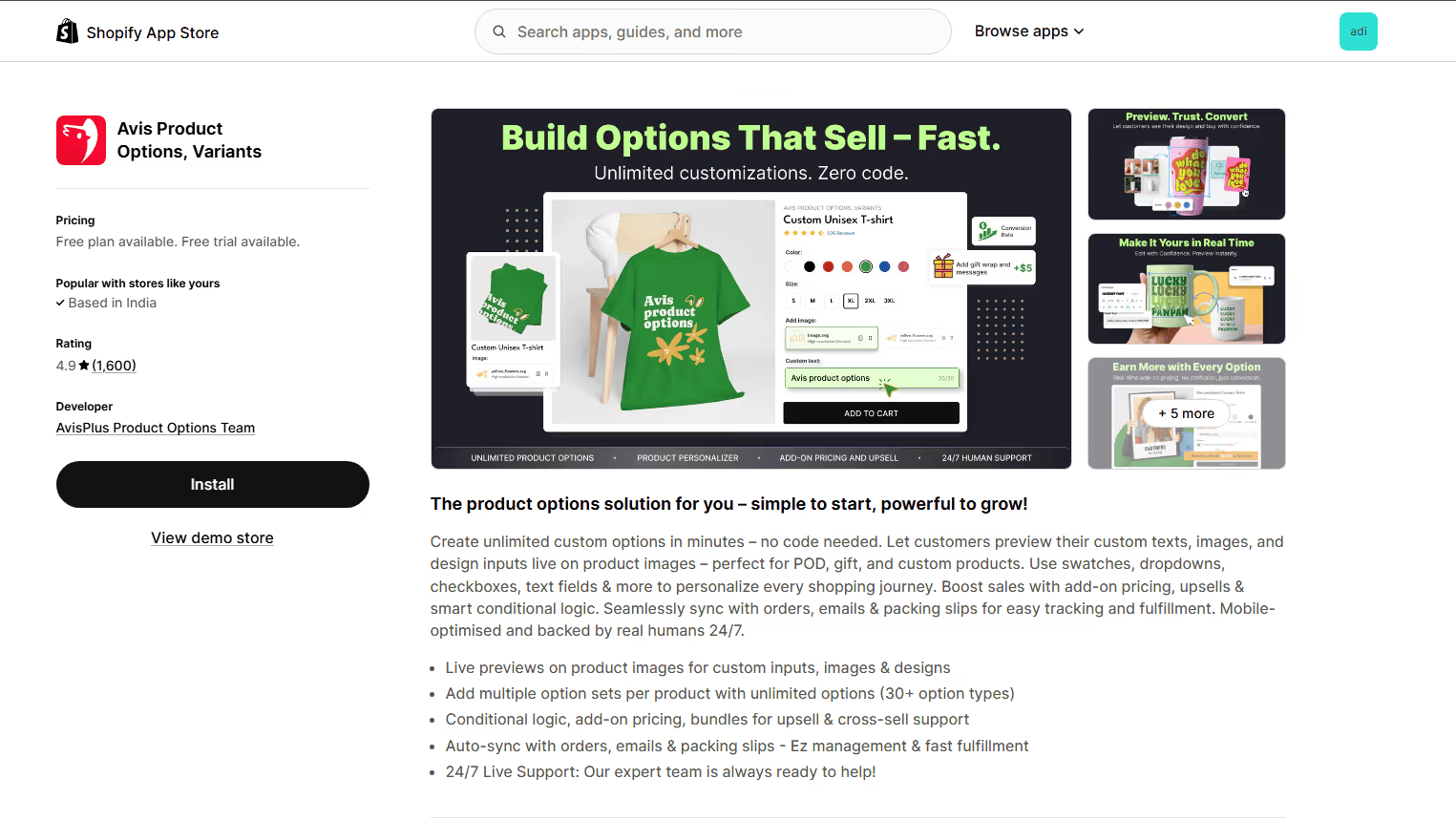
AvisPlus is a Shopify product variant app that provides one of the most feature-rich plans that include bundle variants & add-on pricing.
Key Features of AvisPlus
30+ option types
Live product preview
Conditional logic
Bundle variants
Add-on pricing
Pros
Strong free plan
Excellent for apparel
24/7 support
POS integration
Cons
Advanced personalization higher tier
UI customization limited
Pricing
Free
Pro – $12/month
Advanced – $24/month
Premium – $59/month
5. Color Swatch King
Color Swatch King is a Shopify product variant app that improves variant presentation rather than adding new variant fields.
Key Features of Color Swatch King
Image swatches
Color swatches
Variant grouping
Hide out-of-stock variants
Collection page swatches
Pros
Enhances UX instantly
Strong theme compatibility
Great visual merchandising
Cons
Does not add new option fields
Pricing scales with Shopify plan
Pricing
$5/month base
Scales up to $99.90/month
6. Variant Option Product Options
Variant Option Product Options is a Shopify product variant app that focuses on overcoming the three-option limit with unlimited custom add-ons. This app focuses on overcoming the 3-option limit with unlimited custom add-ons.
Key Features
Unlimited options
Image & button swatches
Conditional logic
Price surcharges
Dynamic image switching
Pros
Budget-friendly
Simple setup
Annual discount option
Cons
Free plan limited to 1 product
Advanced logic on higher tier
Pricing
Starter – Free
Basic – $9.99/month
Advanced – $19.99/month
7. APO Product Options & Variants
APO Product Options & Variants is a Shopify product variant app with one of the most advanced solutions for dimension-based or complex pricing products.
Key Features of APO Product Options
Unlimited product options
22+ input types
Formula-based pricing
Conditional rules engine
Multi-step configuration
Bulk option editing
Add-on products
Pros
Dimensional price calculator
Bulk catalog tools
Multi-currency support
Highly scalable
Cons
Higher price point
Advanced setup required
Pricing
Starter – $14.99/month
Growth – $29.99/month
Displaying Variants in Shopify without an App (Possibilities & Limitations)
Before choosing the best Shopify product variant app, it’s important to understand what Shopify already allows you to do natively.
For many simple catalogs, Shopify’s built-in variant system works perfectly fine. Shopify allows merchants to create product variants by combining option fields
How to Display Variants within Shopify without an App
This works for simple products. For example; T-shirts (Size + Color), Shoes (Size + Color) & Mugs (Size + Finish)
The native system is usually sufficient. However, complexity increases quickly once you introduce personalization, add-ons, conditional rules, or dimension-based pricing.
Why You Need a Shopify Product Variant App?
As your catalog grows, Shopify’s built-in system begins to show structural constraints.
1. Variant Structure Constraints
Maximum of 3 option fields
Cannot add a 4th attribute without custom code
Every combination must be manually created
No dynamic option dependencies
Example: If you sell customizable furniture with Fabric + Size + Leg Finish + Cushion Type, Shopify cannot support the 4th attribute.
2. Variant Volume Limits
Variant cap between 100–2048 variants
Many stores still limited to 100
Large variant matrices become difficult to manage
Themes may struggle with high variant counts
Example: If you sell 10 sizes, 12 colors, 5 materials; that is already 600 combinations.
3. No Conditional Logic
Shopify cannot:
Show/hide options based on previous selections
Disable incompatible combinations dynamically
Create logic rules between attributes
Example: If “Premium Fabric” should only appear when “Luxury Model” is selected this is not possible natively.
4. No Formula-Based Pricing
Shopify does not support:
Width × Height price calculations
Square foot pricing
Percentage-based option charges
Tiered pricing based on inputs
This is critical for:
Custom prints
Blinds & curtains
Flooring
Personalized signage
5. No Advanced Personalization Inputs
Native Shopify does not support:
Text engraving fields
File uploads
Image uploads
Date pickers
Font selectors
Live preview personalization
6. Limited UX & Display Controls
Default dropdown selectors
No advanced swatch styling
No multi-step configuration
No bundled add-on flows
For premium brands, this limits conversion optimization.
Shopify’s native variant system works for straightforward products. But once you need:
More than 3 option fields
Conditional logic
Dimension-based pricing
Custom personalization inputs
Advanced swatches
Scalable bulk configuration
That is why you need a good Shopify product variant app to remove these structural constraints while maintaining inventory accuracy and checkout compatibility.
Conclusion
In this article, I’ve reviewed seven Shopify product variant apps i.e. Globo Product Options, OPTIS Product Options, HA Product Options, AvisPlus Product Options, Color Swatch King, Variant Option Product Options, and APO Product Options.
While each app serves a different merchant need, Globo Product Options stands out as the strongest overall best Shopify product variant app due to its formula-based pricing, bulk editing tools, multi-step configuration flows, and scalability for complex catalogs.
If you need a generous free plan, AvisPlus is a good option. If visual UX improvement is your goal, Color Swatch King is ideal. For advanced configuration logic and dimension-based pricing, APO is the clear winner.
It is best if you shortlist and install a few apps to test them before picking a product variant app that suits you the most. Good luck!
Hurrify customers to buy within a given timeframe with a sales countdown timer & improve conversions
Another popular Shopify checkout app is Checkout Promotions. The app comes with the ability to leverage a collection of highly robust visibility rules that help show customers one-click post purchase upsell promotions after an order payment has been made. Some of its key features include:
Features
AI recommended and manual recommendations for upselling.
Complete branding control.
Checkout Upsell for increasing AOV.
AI recommended and manual recommendations for upselling.
Pricing
Development
Free
Monthly Plan
$99/ month
Plus Plan
$99/ month
Plus Plan
$99/ month
FAQs- Shopify Product Variant Apps
What Are Shopify Product Variants?
Why Use a Shopify Product Variant App?
How Do You Add Product Variants in Shopify?
What Is Shopify's Product Variant Limit?
How to Fix "Cannot Find Variant" Errors?
Best Practices for Product Variant Images?
Sid B
Sid is the founder of Skai Lama and The Indian Dream Podcast. He is passionate about building SaaS and talks about eCommerce Growth, 0-1 Startups, Building Businesses and Brands, and Shopify.

.svg)
.svg)

.svg)
.svg)


%20(1).jpg)
.jpg)

.svg)









.svg)




.avif)