.svg)
.svg)

.svg)
.svg)



Our Apps Have Driven
5X AOV | 2X Conversions | $30M+ Additional Revenue
5X AOV | 2X Conversions | $30M+ Additional Revenue
.svg)


5.0 (3000+ Reviews)


Shopify Apps





.svg)

• Product tier examples that convert use 2–4 tiers, not more: H&M, Skechers, and Sephora all use three-tier structures because three levels give shoppers a clear middle option to anchor on, pushing most customers to the middle or top tier.
• Tiered discounts work because of the goal gradient effect: Shoppers spend more as they approach the next tier, not because the discount is dramatically bigger, but because reaching the threshold feels like a win. Showing "you're £12 away from 20% off" in the cart directly triggers this.
• Threshold type determines who the campaign works for: Spend-based tiers suit catalogues with varied price points. Quantity-based tiers suit single-SKU or footwear brands. Item-mix tiers suit fashion stores where shoppers browse across categories.
• Gaps between tiers must feel meaningful: A 3–5 percentage point jump reads as noise. A 10–15 point jump reads as worth adding one more item. Calibrate gap size to your average order value.
• Users of discount apps like Kite Discount & Free Gift see an average 32% increase in AOV using tiered discount campaigns on Shopify. The biggest lifts come from combining spend thresholds with a visible cart progress bar.
Tiered discounts are one of the most reliable pricing strategies in ecommerce for increasing average order value (AOV). Also called tiered pricing, tiered promotions, tiered sales, and tiered offers, they work by dividing your discount into levels: the more a customer spends or buys, the bigger the reward they unlock.
The appeal for merchants is structural. Unlike a flat 15% off code that every shopper gets regardless of spend, a tiered discount creates a specific reason to keep adding to the cart. Instead of stopping at what they originally intended to buy, shoppers start calculating what it takes to reach the next tier. That shift from passive buyer to active planner is what drives AOV.
Threshold promotions consistently outperform flat-discount campaigns in basket size, with merchants reporting meaningful AOV improvements when spend-gated tiers replace blanket percentage-off codes.1 The psychology behind this is well-documented: the goal gradient effect shows that shoppers accelerate their purchasing behavior the closer they are to a reward, a finding that has been replicated consistently in consumer behavior research.2 Shopify stores using Kite's tiered discount feature see an average 32% increase in AOV.[3]
In this guide, we break down six real-world product tier examples from brands including H&M, Shein, Skechers, Bershka, Sephora, and Alexis Bittar, covering exactly what makes each structure work and what you can adapt for your own store.
A tiered pricing strategy divides your discount offer into levels. Each level has a threshold (a minimum spend amount, quantity, or item count) and a corresponding discount. Customers who hit higher thresholds unlock bigger savings.
The mechanism is similar to leveling up in a game. A shopper arrives intending to spend a fixed amount, sees they are £12 away from unlocking 20% off, and adds one more item to close the gap. That gap-closing behavior is the core engine of tiered pricing. See our guide to setting up volume discounts on Shopify for a full walkthrough of configuring this on your store.
Forever 21's Buy More, Save More promotion is a straightforward product tier example: buy 2 sale items and get 25% off, buy 3 and get 30% off, buy 4 and get 35% off. Shoppers who arrive to buy one sale item frequently end up buying three, because the math makes it hard to stop at just one.
This structure benefits both sides. The buyer saves more the more they spend. The merchant increases AOV and transaction size per visit without increasing traffic or acquisition cost.

Forever 21's buy more save more promotion is is a perfect tiered pricing example where if you buy 2 sale items, you get 25% off; if you buy 3 sale items, you get 30% off; and if you buy 4 sale items, you get 35% off.
On one hand, this tiered pricing example benefits the buyers by providing them with greater savings while on the other hand, the seller gets increased average order value (AOV) and larger transactions.
For more details on how tiered pricing works to boost your store's AOV, read more here.
In short, customers are motivated to buy more items so that they get the most out of the discounts, resulting in higher overall sales for the brand.
Explore the benefits of tiered discounts in detail.
The following product tier examples show how major brands implement tiered discount structures across different product categories, price points, and customer segments. Each one has something specific to steal.

H&M is a product tier example that shows how a clean spend-based structure works at scale across a large fast-fashion catalogue. The retailer uses a three-tier model where higher spending thresholds unlock progressively bigger discounts:
• Spend $60, get 15% off.
• Spend $100, get 20% off.
• Spend $125, get 25% off.
The simplicity is deliberate. H&M sells high-volume, low-to-mid price items across thousands of SKUs, so a complex structure would create unnecessary friction. Three clear thresholds give shoppers an obvious ladder: once a buyer is at $60, they can see exactly what it costs to reach 20% and then 25%. The gap from $100 to $125 is narrow enough that most shoppers in the 20% tier move up, because adding one more £12 item to save another 5% is easy math.
The structure also works because all three thresholds are achievable in a single browsing session. Buyers do not need to plan ahead or return. The entire discount ladder plays out in one visit, which maximises the chance of reaching the top tier..
Learn how to set up your e-commerce volume discounting structure

Shein's tiered discount approach is a product tier example that layers two separate mechanics: threshold-based savings for all shoppers, and exclusive ongoing benefits for Shein Club members.
The threshold structure rewards shoppers based on order value, with discount levels that increase as spend rises. On top of this, Shein Club membership unlocks an additional exclusive discount across over 100,000 products and provides a bundle of free shipping credits throughout the year.
What makes this structure effective is the combination of immediate savings (spend more today, save more today) with long-term compounding value (Club membership pays off across every future order). Shoppers who join Club have a financial incentive to return to Shein rather than comparison-shop elsewhere, because their membership accumulates value with each purchase. The tiered discount is the short-term hook. Club is the retention engine.
They use the opportunity to offer additional perks through their loyalty program, Shein Club.

Skechers' tiered discount structure is a product tier example built on item quantity rather than spend amount, which makes it a better fit for a footwear retailer where shoppers typically arrive with intent to buy one or two pairs:
• Buy 1 item, save 10%.
• Buy 2 items, save 20%.
• Buy 3 items, save 25%.
• VIP members receive an additional 5% off on top.
The quantity-based threshold suits Skechers' catalogue because footwear is naturally purchased in multiples. A training shoe, a casual shoe, and a sandal are distinct purchase occasions that often occur together in a single session. The tiered structure gives shoppers a reason to complete that mental shopping list in one transaction rather than returning for each pair separately.
The VIP layer at the top adds a loyalty dimension. Members know they are the only ones accessing the full 30% discount, which makes VIP status feel worth pursuing, not just for this visit but as a standing benefit. For a look at how brands combine these types of discounts into layered campaigns, see our breakdown of complementary discount strategies.
Also Read : Check out the ultimate guide to offering Buy X Get Y on Shopify

Bershka's tiered discount offer is a product tier example that uses an item-mix threshold targeting fashion shoppers who browse across categories rather than buying multiples of a single product:
• Buy 2 items, get 10% off each.
• Buy 3 or more items, get 15% off the entire purchase.
The auto-apply at checkout is a deliberate conversion decision. Requiring a code introduces a friction point that causes drop-off; automatic application removes the decision entirely. A shopper who adds a third item to trigger 15% off receives the reward without needing to remember a code or hunt for a discount field at checkout.
The low item threshold (just 3 items) also makes the best tier attainable for almost any fashion shopper. A customer buying a top, trousers, and a jacket triggers 15% without any additional prompting. The structure rewards normal purchase behavior rather than asking shoppers to buy unusually large baskets.

Sephora's tiered discount strategy is a product tier example that gates discount levels behind loyalty membership tier rather than a single transaction threshold. In Sephora's seasonal sales, the discount a customer receives depends entirely on their Beauty Insider membership level:
• Black and Gold Beauty Insider members receive 20% off.
• White (entry-level) members receive 15% off.
This structure serves a different objective than the previous examples. The goal is not only to increase the current transaction's AOV. It is to make reaching Gold or Black membership feel financially worth the investment. A customer who knows they are one tier below the 20% discount has a clear incentive to accumulate points and spend enough to upgrade before the next sale event.
The result is a tiered discount that drives both immediate purchase behavior and long-term loyalty investment simultaneously. For brands with an established loyalty programme, this is one of the highest-leverage product tier examples available. See how to build a Shopify loyalty programme that supports this kind of membership-gated structure.

Alexis Bittar's Buy More Save More event is a product tier example designed for a premium jewellery brand where average order values are naturally high and the spend thresholds can be set accordingly:
• Spend $100 or more: 15% off with a dedicated promo code.
• Spend $300 or more: 20% off with a dedicated promo code.
• Spend $500 or more: 25% off with a dedicated promo code.
The use of unique promo codes at each tier serves two purposes. First, it adds an interactive element: shoppers feel they are unlocking something exclusive rather than receiving an automatic reduction. Second, it allows Alexis Bittar to track precisely which tier drove the most conversions, providing clean data for future campaign planning.
The gap between tiers is also calibrated to the price point. A 5% increment might feel trivial on a $30 fast-fashion purchase, but on a $300 to $500 jewellery spend, a 5 to 10 percentage point increase represents a meaningful absolute saving. The structure respects the premium buyer's mentality: they are comfortable spending, but still respond to the logic of getting more value for a slightly larger commitment.
Product tier examples like this one highlight how the same tiered discount mechanism scales across very different price points, provided the thresholds and increments are calibrated correctly.
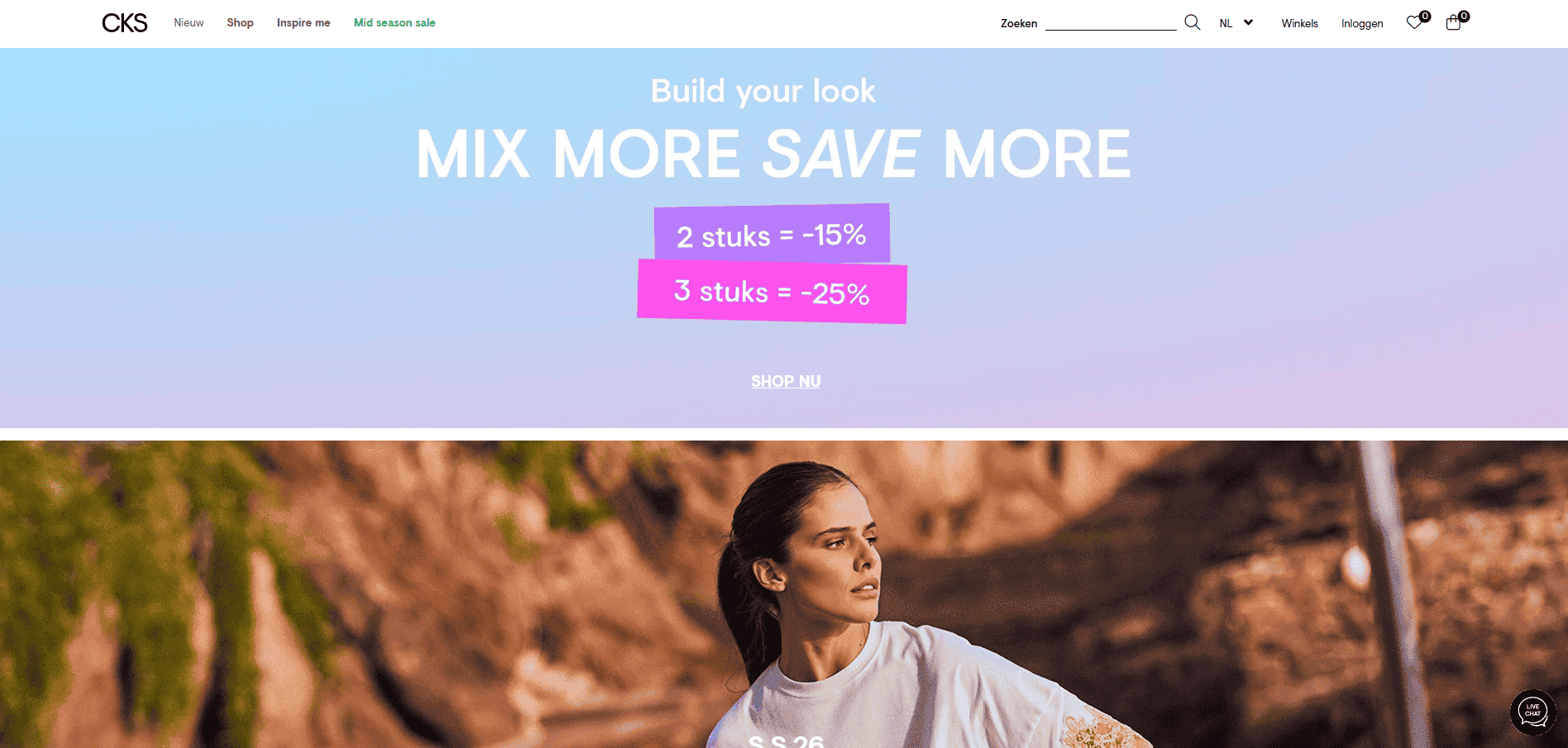
CKS is a product tier example from a 100% Belgian women's fashion label that connects its discount structure directly to its brand identity. Their "Mix More Save More" campaign uses item-count tiers during the mid-season sale:
• Buy 2 items, get 15% off.
• Buy 3 items, get 25% off.
What makes this structure worth studying is the campaign framing. The headline is not "Buy more, save more"; it is "Build your look. Mix More Save More." That choice is deliberate. CKS is a brand built on colorful, mix-and-match women's fashion, with an in-house styling philosophy centered on helping customers put together full looks rather than buying one-off pieces. The tiered discount reinforces that identity at a campaign level: the discount is not a sales mechanism, it is a styling encouragement. Buying three items at once is presented as completing an outfit, not as bulk purchasing.
The two-tier structure (rather than three) also reflects the brand's accessible positioning. CKS operates at bold-but-mainstream price points, not luxury, so a shopper buying two pieces already represents a meaningful basket. The jump from 15% to 25% for one additional item is aggressive enough to convert browsers who were already considering a second piece, without requiring a large upfront commitment.
For a fashion brand with strong seasonal collections and a "happy vibes" brand identity, this campaign shows how a tiered discount structure can do double duty: increase AOV while reinforcing what the brand stands for.

Soak & Sleep is a product tier example from the UK's leading online bedding retailer that takes a structurally different approach to tiered discounts: instead of percentage-off tiers, they use fixed monetary amounts that increase with spend.
• Spend over £85, get £10 off with code DA10.
• Spend over £140, get £30 off with code DA30.
• Spend over £200, get £50 off with code DA50.
The fixed-amount format matters here. Soak & Sleep sells mid-to-premium bedding: a quality duvet can cost £80–£150 on its own, and a full bed refresh (duvet, pillows, bed linen) lands naturally around £150–£250. At that price point, a percentage-off tier can feel abstract ("15% off a £180 order" requires mental arithmetic). A fixed amount feels concrete and tangible: "I will save £50" is easier to act on than "I will save 25%." This is a deliberate calibration to their buyer's psychology.
The gap structure between tiers is also notable. The jump from tier 1 to tier 2 triples the saving (£10 to £30) for an additional £55 of spend, which is an extremely strong incentive to move up. The jump from tier 2 to tier 3 adds another £20 saving for an additional £60 of spend — still compelling at a premium price point where one extra item (a pillow pair or a set of towels) closes the gap.
Layering time-limited urgency ("Final Day") on top of the tiered structure adds a second conversion lever. A shopper who was already considering the mid tier gets an additional push from scarcity, making the combination of tiered spend incentive plus deadline one of the most complete implementations in this list.
The brand's positioning as the #1 Duvet Brand also gives the discount credibility: shoppers are not compromising on quality to save money; they are being rewarded for buying quality in volume.
A tiered discount structure that moves AOV has three variables to get right: the number of tiers, the threshold type, and the gap between discount levels. Get these right and each tier pulls customers naturally toward the next.
Number of tiers (H3)
Two to four tiers is the practical range for most Shopify stores. Fewer than two is a flat discount. More than four creates decision paralysis, where customers see too many levels and disengage entirely.1 The H&M and Sephora product tier examples above both use three tiers, giving shoppers a clear middle option to anchor on.
Threshold type (H3)
Spend-based thresholds work best when your products vary in price. Quantity-based thresholds suit single-SKU or tight product ranges. Item-mix thresholds suit fashion and beauty brands, where shoppers browse across categories.
Pick one threshold type per campaign. Mixing spend and quantity thresholds in the same structure adds complexity that reduces conversion.
Discount gap between tiers (H3)
The jump between levels has to feel meaningful or shoppers will not move up. A 3 to 5 percentage point increment reads as noise at checkout. A 10 to 15 point jump reads as genuinely worth adding one more item. Alexis Bittar's 10-point gaps work because the absolute dollar saving at their price point is substantial. At lower price points, wider percentage gaps are needed to produce the same motivating effect.
Tier labelling (H3)
Name your tiers where possible. Bronze, Silver, Gold or Good, Better, Best anchors each level in the shopper's mind and makes the structure feel like a progression rather than a discount table. Labelled tiers perform better than unnamed ones because they create an identity to aspire toward, not just a number to calculate.2
Where to surface the structure (H3)
Show the full tier breakdown on the product page, in the cart, and at checkout. A progress bar ("You're £12 away from 20% off") converts significantly better than showing only the current discount level, because it keeps the goal visible at every decision point. If shoppers can only see the tier they are already in, they have no reason to move higher.
For a step-by-step setup guide, see how to set up tiered pricing on Shopify.
Four psychological mechanisms explain why tiered discounts increase AOV more reliably than flat-percentage-off codes.
The goal gradient effect describes how people intensify their effort as they approach a goal. In ecommerce, shoppers add more items as they get closer to the next discount tier, not because the saving is dramatically larger, but because reaching the threshold feels like a win in itself. A progress bar showing "you're £12 away from 20% off" in the cart turns passive browsing into active pursuit.2 This one element alone can be the difference between a shopper exiting at their original basket value or exceeding it.
When a customer sees three tiers, the highest tier anchors their sense of what is possible. The middle tier feels reasonable by comparison. Most shoppers land in the middle, which is typically the tier that maximises both customer satisfaction and merchant AOV. This is why almost every one of the product tier examples in this guide uses exactly three levels.
Framing a tiered discount as something that can be missed ("You're £15 away from 20% off — don't leave it behind") consistently outperforms framing it as something to earn ("Earn 20% off when you spend £100"). Loss aversion is a stronger motivator than gain expectancy for the majority of shoppers.
Unlike a loyalty points system where the reward feels distant and abstract, tiered discounts give customers agency. They can see exactly what they need to do to unlock each level. That transparency builds trust and reduces cart abandonment, because shoppers feel in control of the outcome rather than dependent on future behavior to collect a reward. For more on building this kind of progression into long-term retention, see how to increase average order value on Shopify.
If done right, tiered discounts are one of the most cost-efficient ways to increase AOV without spending more on acquisition. Merchants using Kite's tiered discount feature see an average 32% increase in AOV.[3] Heat Hot Sauce used the same mechanic to lift AOV by 28%.
Kite is a Shopify app built for tiered promotions: create spend-based tiers, quantity breaks, BOGO campaigns, and free gift offers without touching code. Install Kite from the Shopify App Store and set up your first tiered campaign in under 10 minutes.


.avif)