.svg)
.svg)

.svg)
.svg)






Our Apps Have Driven
5X AOV | 2X Conversions | $30M+ Additional Revenue
5X AOV | 2X Conversions | $30M+ Additional Revenue
.svg)


5.0 (3000+ Reviews)


Shopify Apps





.svg)

In the competitive world of eCommerce, understanding and optimizing Return on Investment (ROI) is essential for business success. ROI is a key metric that helps eCommerce stores evaluate how efficiently they are spending their marketing budgets and resources.
Generally, a good ROI is considered to be 200% to 300%, meaning for every $1 spent, you should be earning $2 to $3 in revenue.
This blog will guide you through the process of calculating eCommerce ROI, how to track it, and proven strategies to boost your store's profitability.
Plus, we’ll show you how tools like Skai Lama's suite of apps can help you optimize your store and maximize ROI.
Return on Investment (ROI) in eCommerce refers to the percentage of profit a business earns in relation to the amount spent on marketing, advertising, and other business investments.
Essentially, it helps you measure how effective your investments are in generating revenue.
By tracking your ROI, you can make data-driven decisions on where to allocate resources—whether that’s improving your website, running better ad campaigns, or enhancing your customer experience.
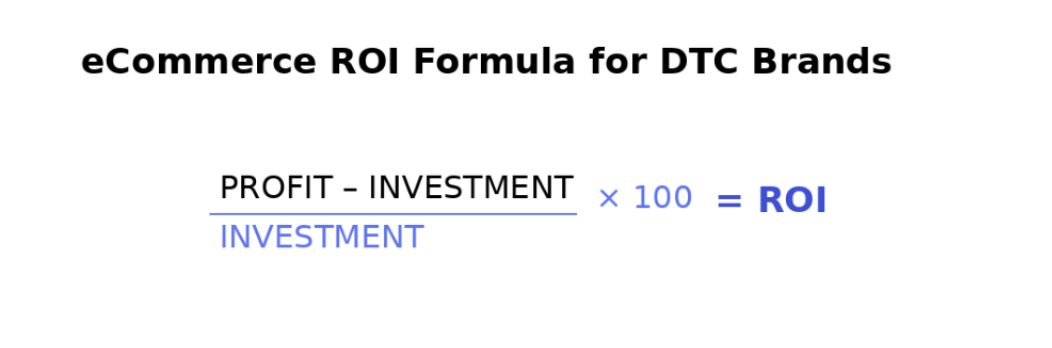
To calculate eCommerce ROI, you can use the formula:
ROI = ((Revenue – Investment) / Investment) × 100
Where:
For example, if you spent $500 on a Facebook ad campaign and generated $1,500 in sales, then:
ROI = ((1,500 – 500) / 500) × 100 = (1,000 / 500) × 100 = 2 × 100 = 200%
This means you earned a 200% return, or $2 in profit for every $1 spent. This percentage-based ROI formula is the standard for evaluating the performance of your eCommerce campaigns.
A good ROI for eCommerce typically ranges from 200% to 300%, meaning you should aim to generate at least $2 to $3 for every $1 spent on marketing and operational costs. However, this varies by industry, business model, and the stage of your business.
For instance, businesses that focus on customer retention and lifetime value (CLV) will have different ROI expectations compared to those heavily investing in customer acquisition.
| Industry | Avg. ROI (%) | Notes |
|---|---|---|
| Fashion & Apparel | 250% – 400% | High repeat purchases and strong brand loyalty. |
| Beauty & Personal Care | 300% – 500% | Subscription potential and influencer marketing impact. |
| Health & Wellness | 200% – 350% | Varying ROI based on product type (e.g., supplements vs. gear). |
| Consumer Electronics | 150% – 300% | Higher AOV but high returns and support costs. |
| Home & Living | 200% – 400% | Strong ROI with bundling and visual merchandising. |
| Food & Beverage (DTC) | 150% – 250% | Subscription and upselling strategies improve margins. |
| Toys & Games | 200% – 300% | Holiday spikes and gifting influence returns. |
| Books & Media | 100% – 200% | Lower margins; SEO and volume are key to ROI. |
| Pet Products | 250% – 400% | High loyalty and recurring purchase behavior. |
| Jewelry & Accessories | 300% – 600% | High margins and strong emotional purchasing drivers. |
Several factors contribute to eCommerce ROI, and improving these areas can significantly boost your returns:
Here are some proven strategies that can increase your eCommerce ROI:
Accurately tracking ROI is critical for making data-driven decisions in your eCommerce business. Here are five powerful tools that help you monitor ROI across marketing, sales, and customer behavior:
Google Analytics provides deep insights into user behavior, traffic sources, and conversion events—helping you assess how well your campaigns are performing in terms of ROI.
If you run a Shopify store, its built-in analytics dashboard tracks sales, traffic, and customer behaviors directly within your admin panel.
Triple Whale connects ad platforms, Shopify, and customer data to give you a unified view of your marketing ROI, CAC, and CLV in real time.
Supermetrics pulls marketing data from multiple platforms (Google Ads, Meta, Klaviyo) into spreadsheets or dashboards, helping you calculate ROI per channel.
From improving AOV with Easy Bundle Builder to tracking gift card performance with Giftkart, Skai Lama apps provide actionable data within your store to measure performance and boost ROI.
Optimizing eCommerce ROI is essential for long-term success in any online business. By understanding how to calculate ROI and implementing strategies to improve it, you can make more informed decisions, reduce costs, and increase profitability.
Tools like Skai Lama's suite of apps can help you optimize every part of your business, from customer acquisition to checkout optimization.


.avif)