.svg)
.svg)
.svg)
.svg)
.svg)


.svg)
%20(1).png)

Our Apps Have Driven
5X AOV | 2X Conversions | $30M+ Additional Revenue
5X AOV | 2X Conversions | $30M+ Additional Revenue
.svg)


5.0 (3000+ Reviews)


Shopify Apps





.svg)


“If you’re not testing, you’re guessing.”
This isn’t just a catchy phrase - it’s the hard truth in the world of eCommerce. Conversion Rate Optimization testing (CRO testing) has become a core strategy for high-performing Shopify and DTC brands. It’s not about doing more marketing. It’s about making the marketing you’re already doing work better.
CRO testing allows you to experiment with different elements of your site and see how they affect customer behavior. From product pages to checkout flows, small tweaks, when done methodically, can lead to massive improvements in your revenue, without spending more on ads.
In this guide, you’ll learn what CRO testing actually is, the different types of tests you can run, tools to use (including Shopify-friendly ones), and real-world test ideas.
CRO, or Conversion Rate Optimization, refers to the process of systematically improving your eCommerce website's ability to convert visitors into customers. This can mean anything from increasing product purchases to getting more email signups or reducing cart abandonment.
CRO testing is how you validate which changes actually work. Instead of relying on gut feelings or copying what competitors are doing, you test changes with real users in real time and let the data decide.
It's about identifying friction points in your customer journey and optimizing them for better outcomes. The beauty of CRO testing is that it doesn’t require you to get more traffic, you’re simply making better use of the traffic you already have.
Let’s say your current conversion rate is 2%. That means out of every 100 visitors, only 2 buy. If you can improve that to just 3%, you’ve increased revenue by 50% without touching your ad budget.
CRO testing isn’t one-size-fits-all. Depending on factors like traffic volume, business objectives, and testing experience, you can explore various test types. Here’s a breakdown of the core ones:
A/B testing involves showing two versions (Version A and Version B) of a single element to your users to determine which performs better. The goal? Isolate one variable and test its impact on a key conversion metric.
Real-world Example:
Imagine testing your CTA button on a product page. One version says “Buy Now,” the other says “Add to Cart.” After two weeks of testing, you find that “Add to Cart” gets 17% more clicks. That’s a clear win.
Unlike A/B testing, which changes one element at a time, multivariate testing involves modifying multiple elements on a page and seeing which combination yields the best results.
Use Case:
Let’s say you change a hero image, headline, and CTA all at once. Multivariate testing allows you to measure the impact of each change and how they interact with one another.
Important:
You’ll need significantly more traffic to run multivariate tests accurately, as the number of combinations increases fast.
A/B/n testing is an extension of A/B testing that involves testing multiple variants (e.g., A vs. B vs. C). It lets you evaluate several ideas simultaneously.
This test compares two entirely different versions of a page, each hosted on separate URLs. It’s useful when you're doing large-scale layout changes or redesigns.
Ideal For:
Shopify Tip:
Use Shopify’s duplicate page feature or landing page builders like Shogun to create test versions of product pages for CRO testing.
Multi-Armed Bandit Testing is a type of CRO testing that dynamically adjusts the distribution of traffic between different variations based on real-time performance. Unlike traditional A/B testing, which splits traffic evenly, Multi-Armed Bandit continuously shifts more visitors to the higher-performing variations, optimizing for conversions as the test runs. This method allows for quicker insights and maximizes conversions during the test itself. It's especially useful when testing multiple versions of a page or offer without risking long periods of underperformance.
Your CRO results are only as good as the tools you use. Whether you're testing button copy or full checkout experiences, the right stack makes CRO testing smoother and insights more accurate.
For Shopify merchants, these platforms work best for CRO testing:
Running a CRO test isn’t just about flipping a switch. It’s a structured process that helps you get reliable results and actionable insights.
Here’s a step-by-step guide to do it right:
Start with data. Use tools like Google Analytics, Hotjar, or Microsoft Clarity to understand:
Before running any test, ask: “What do I want to improve?”
Some common eCommerce CRO goals:
A hypothesis connects your change to your expected result. It's crucial for effective CRO testing.
You probably have dozens of ideas but not all are worth running. Use a prioritization framework like ICE:
Use tools like Google Optimize, Optimizely, or VWO to launch your test. Ensure the test runs long enough to achieve statistical significance.
Make sure to:
Did the test move the metric you set out to improve?
Even experienced eCommerce teams make these missteps. Avoid them to get cleaner, more reliable results:
Multivariate tests are complex. For most Shopify stores, it’s better to test one element at a time unless you have enterprise-level traffic.
Big sales, holidays, ad campaigns can skew your CRO testing results. Track external influences and consider pausing if they’re too disruptive.
User behavior evolves. What works today might flop 6 months from now. Retest winning variations every 6–12 months to stay ahead.
Let’s get tactical. Here are some high-impact, real-world CRO tests Shopify and DTC brands should try:
Your homepage hero image is often the first thing visitors see, it sets the tone for your brand and influences whether someone keeps browsing or bounces. Try CRO testing testing:
What to measure: Bounce rate, click-through rate (CTR) on CTAs, scroll depth.
Your “Add to Cart” button is one of the most critical conversion points. Test variations like:
What to measure: Add-to-cart ratio, cart abandonment ratio, and total conversion rate.
Social proof builds trust, but where and how you show it can make a big difference. Try testing:
What to measure: Engagement rate, time on page, conversion rate.
Free shipping can be a strong motivator, especially when used strategically. Test:
What to measure: Average order value (AOV), checkout completion rate, cart abandonment.
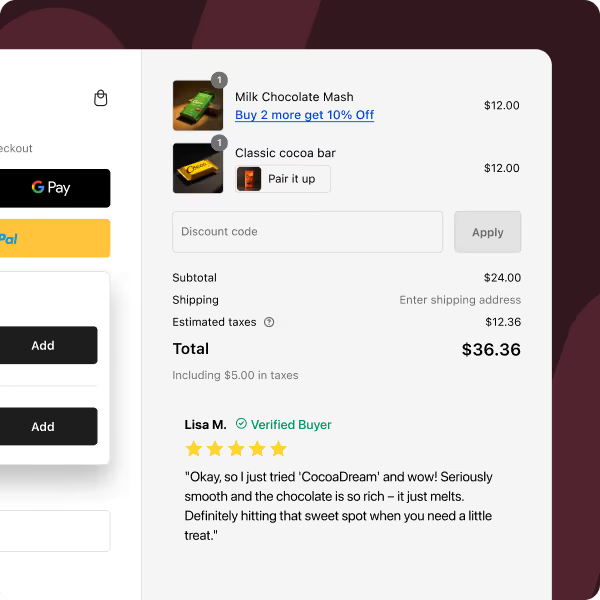
You can create Shopify checkout A/B tests. You may test the following & many more:
What to measure: Checkout drop-off rate, conversion rate, and time to complete checkout.
We have created the most extensive Checkout A/B Testing Library. Check it out now!
The Checkout Wiz app has a powerful A/B testing feature that helps you make data-driven decisions about your Shopify checkout. Try Checkout Wiz now!
Bundling is a powerful tool to drive higher average order value (AOV). Easy Bundle Builder offers a flexible approach to creating customizable product bundles that are tailored to your store's needs. By offering customers curated product sets, you can increase both AOV and conversions.
Bundling Formats to Experiment With:
Metrics to Track: Keep an eye on conversion rate, AOV, and bundle attachment rate to evaluate the effectiveness of your bundling strategy.
If there’s one thing to take away from this guide, it’s this: eCommerce CRO testing is not a nice-to-have, it’s a growth essential for modern eCommerce brands. Every click, scroll, and hesitation from your visitors is feedback. And testing turns that feedback into action.
Whether you’re optimizing your homepage hero, tweaking product page CTAs, or experimenting with bundling formats, the goal remains the same: convert more of your existing traffic into revenue without spending more on ads.
As competition in eCommerce grows and acquisition costs rise, the brands that win won’t be the ones spending more, they’ll be the ones optimizing smarter.


.avif)