.svg)
.svg)

.svg)
.svg)



%20(1).jpg)
Our Apps Have Driven
5X AOV | 2X Conversions | $30M+ Additional Revenue
5X AOV | 2X Conversions | $30M+ Additional Revenue
.svg)


5.0 (3000+ Reviews)


Shopify Apps





.svg)

Every successful Shopify store owner knows the secret to sustainable growth lies not just in acquiring new customers, but in maximizing revenue from existing ones.
Cross-selling has emerged as one of the most powerful strategies to achieve this goal, with leading ecommerce brands reporting average order value increases of up to 40% through strategic product recommendations.
Acquiring a new customer costs five times more than retaining an existing one, yet most Shopify merchants focus heavily on customer acquisition while leaving money on the table with their current shoppers.
These Shopify cross-selling examples showcase real stores that implemented strategic techniques and achieved remarkable results.
Cross-selling on Shopify is a strategic sales technique where merchants recommend complementary or related products to customers based on their current selections or purchase history.
Unlike traditional retail environments where sales associates make these suggestions, Shopify cross-selling leverages automated systems, apps, and strategic placement to present relevant product recommendations throughout the customer journey.

Cross-selling works particularly well on Shopify because of the platform's robust ecosystem of apps and customization options.
Modern cross-selling strategies utilize customer behavior data, purchase history, and artificial intelligence to present personalized recommendations at optimal moments.
This approach has proven highly effective, with studies showing that 35% of Amazon's revenue comes from cross-selling and upselling techniques.
| Strategy | Purpose | Example | Impact on AOV |
|---|---|---|---|
| Cross-selling | Add complementary products | Camera + memory card + case | Moderate increase |
| Upselling | Upgrade to premium version | Basic plan → Premium plan | Higher increase |
| Bundle selling | Package related items together | Skincare routine bundle | Significant increase |
Discover proven cross-selling strategies from real Shopify stores across industries - from CBD brands generating 81 orders weekly through accessory bundles to personal care companies boosting sales by $17,000+ monthly using strategic product recommendations and checkout optimization techniques.
A CBD vape brand successfully implemented cross-selling by offering discounted batteries when customers purchased vape cartridges. Using CheckoutWiz, they displayed the battery offer directly at checkout, addressing an immediate customer need while creating clear value through discount pricing.

Results:
81 orders generated in just one week, demonstrating how essential accessories can drive immediate cross-selling success.
Key Takeaway:
Offer necessary accessories at checkout with clear discounts to solve customer problems while boosting average order value.
Jasper Caven, a German health and supplement brand, implemented time-sensitive cross-selling by offering their premium formula at special discounts during checkout. The strategy created urgency while introducing customers to higher-value products they might not have initially considered.

Results:
€14,000 generated in 35 days through 154 orders, proving that urgency-driven cross-selling can significantly boost revenue.
Key Takeaway: Create time-sensitive offers on premium products to encourage customers to upgrade their purchase during checkout.
Lathr leveraged product bundling to help customers create complete personal care routines. Using Easy Bundle Builder, they allowed customers to mix and match complementary products while offering attractive bundle pricing that encouraged larger purchases.

Results:
$17,221.79 sales boost in just 30 days, demonstrating the power of letting customers create their own product combinations.
Key Takeaway: Enable customers to build their own bundles with complementary products to increase average order value naturally.
A fashion retailer implemented "complete the look" cross-selling by suggesting accessories like belts, shoes, and jewelry when customers added clothing items to their cart. The visual approach helped customers envision complete outfits while increasing purchase value.

Results:
27% increase in average order value through strategic accessory recommendations.
Key Takeaway: Help customers visualize complete outfits by cross-selling accessories that complement their main clothing purchases.
An electronics retailer successfully cross-sold protection products and accessories by bundling smartphone cases, screen protectors, and charging cables with phone purchases. The strategy focused on device protection and enhanced functionality.

Results:
40%+ conversion rate on accessory offers, showing high customer acceptance of protection products.
Key Takeaway: Sell peace of mind by bundling protection and essential accessories with high-value electronics purchases.
A premium meat brand implemented a cashback system where customers earned store credit for future purchases when buying premium cuts. This strategy encouraged exploration of different product categories while building customer loyalty.

Results:
Increased in-store revenue and improved customer retention through cross-category purchasing incentives.
Key Takeaway: Use cashback rewards to encourage customers to explore different product categories while building long-term loyalty.
Arbor Made enhanced their candle sales by offering gift wrapping, premium packaging, and personalized messages at checkout. This strategy transformed simple product purchases into premium gift experiences.

Results:
$66,000 additional revenue with 16% conversion rate increase, proving the value of gift enhancement options.
Key Takeaway: Transform regular purchases into premium gift experiences by offering wrapping and personalization services.
A fitness supplement brand converted one-time buyers into subscribers by offering subscription discounts at checkout. The strategy focused on convenience and cost savings for regularly consumed products.

Results:
2X increase in repeat purchases through successful subscription conversions at checkout.
Key Takeaway: Convert one-time supplement buyers into subscribers by emphasizing convenience and savings benefits.
A home goods retailer implemented site-wide volume discounts encouraging customers to explore multiple product categories. The "buy any 3 items, get 15% off" strategy increased cross-category shopping significantly.

Results:
2X increase in items per order, demonstrating effective cross-category exploration incentives.
Key Takeaway: Encourage exploration across product categories with volume discounts that reward diverse shopping behavior.
A specialty bookstore enhanced single book purchases by recommending related titles, bookmarks, and reading accessories. The strategy focused on enriching the reading experience through complementary products.

Results:
3X increase in items per order through strategic recommendation of reading-related products.
Key Takeaway: Enhance the core product experience by suggesting items that complement and enrich the main purchase.
The most successful Shopify cross-selling examples demonstrate that timing plays a crucial role in conversion rates.
Checkout placement consistently outperforms product page recommendations, with brands reporting 2-3X higher acceptance rates when offers appear during the final purchase stages.
Post-purchase cross-selling also shows strong performance, particularly for complementary items that enhance the original purchase experience.
| Placement | Conversion Rate | Best Use Cases |
|---|---|---|
| Checkout page | Highest (15-25%) | Essential accessories, upgrades |
| Product page | Medium (8-15%) | Related products, bundles |
| Post-purchase | Medium (10-18%) | Add-on services, subscriptions |
| Cart page | Lower (5-12%) | Volume discounts, free shipping |
The most effective cross-selling examples follow the 25% pricing rule, keeping cross-sell items under 25% of the main product's cost.
This psychological pricing threshold ensures customers perceive cross-sells as affordable add-ons rather than significant additional investments.
Real examples demonstrate this rule in action: when the CBD brand offered batteries with vape cartridges, the battery price remained well below 25% of the cartridge cost.
Similarly, fashion accessories like belts and jewelry typically price at 15-20% of the main clothing item's value.
Modern Shopify cross-selling relies heavily on specialized apps that integrate seamlessly with the platform's checkout extensions.
The most successful implementations combine multiple tools to create comprehensive cross-selling ecosystems rather than relying on single-purpose solutions.
Essential app categories include bundle builders for product combinations, checkout optimizers for strategic offer placement, and analytics tools for performance tracking.
The top-performing stores typically use 2-3 specialized cross-selling apps working together rather than attempting to handle everything through basic Shopify features.
Successful cross-selling examples prioritize clean, non-intrusive presentation that enhances rather than disrupts the shopping experience.
The most effective designs use minimal text, clear product images, and obvious pricing to enable quick decision-making without cognitive overload.
Trust elements such as customer reviews, security badges, and clear return policies significantly impact cross-sell acceptance rates.
Brands that include social proof alongside cross-sell offers report 20-30% higher conversion rates compared to basic product recommendations without supporting evidence.
The biggest mistake in Shopify cross-selling is presenting too many choices simultaneously.
Research shows that offering more than three cross-sell options decreases conversion rates by up to 40% due to decision paralysis. Successful stores limit checkout offers to 1-2 highly relevant products that directly complement the main purchase.
| Number of Options | Conversion Rate | Customer Response |
|---|---|---|
| 1 option | 18-22% | Clear decision |
| 2-3 options | 15-18% | Manageable choice |
| 4-6 options | 8-12% | Analysis paralysis |
| 7+ options | 3-7% | Overwhelmed abandonment |
Many merchants make the mistake of interrupting the checkout flow with poorly timed cross-sell popups or redirects. Successful cross-selling integrates seamlessly into the existing purchase process without forcing customers to navigate away from their intended transaction.
Generic product recommendations based solely on popularity rather than actual relevance represent another common failure. The CBD brand's success with battery cross-sells worked because batteries are essential for using vape cartridges, creating obvious value for customers.
Technical implementation mistakes that disrupt Shopify's native checkout process cause significant conversion losses. Outdated apps or custom code that redirects customers away from secure checkout pages creates friction and abandonment opportunities.
.svg)
.webp)

Rating

4.9
(
362
)
Easy Bundles is one of the best Shopify apps for cross-selling. The app enables your online store to build different types of product bundles that can be promoted to online shoppers in lieu of custom savings, discounts and offers. The bundles encourage the shopper to explore other items that can be bought with the product of their interest, enabling the business to sell more during the session - a cross-sell strategy that is proven to work across industries!
This Shopify product bundles app seamlessly integrates with your store UI, giving you the ability to promote the product bundles more naturally to your store visitors.
Features

Bundle Builder: Customizable layouts for unique bundle and box builder
Gifting bundles: Add personal touch with greeting cards, gift boxes, and videos.
Upsell & Cross-sell : Boosts sales via bundle and gift box creation.
Build your own bundles allows customers to discover new products and collections
Customizable UI for bundles: Integrated with your store for consistent branding.
Pricing
Free to install
Paid plans start at $9 per month


Rating
5.0
(
92
)
Fly is the ultimate solution for creating customizable product bundles that drive sales and enhance your store’s shopping experience. From showcasing curated combinations with Fixed Bundles to increasing order values with Frequently Bought Together recommendations and Volume Bundles, Fly empowers you to offer flexible, mix-and-match options without limits. Built with Shopify’s latest technology, it features real-time inventory sync, easy-to-use templates, and reliable 24/7 support. Created by the makers of Easy Bundle Builder, Fly seamlessly transforms your product pages into high-performing, conversion-focused assets.
Features
Customizable Bundle Upsells, Volume Bundles, & Fixed bundles on Product page
Using latest Shopify Bundles Tech for inventory management of individual SKU's
Set offers like '%' & '$' Off on Bundle, BOGO, Tiered Volume discounts and more
Customizable Widget UI, Branding & Messaging to match with your store's design
Round-the-clock chat support, video-based FAQs & 1-on-1 Onboarding
Pricing
Free to install. Free trial available.


Rating
4.7
(
26
)
Checkout Wiz helps you enhance your checkout experience with engaging Thank You and Order Status pages featuring surveys, upsells, and post-purchase offers. Collect customer insights, display social links, and customize shipping/payment rules by renaming or hiding them.
Features
Increase AOV with upsells at every stage of checkout and post-purchase.
Display high-converting content on Checkout, Thank You, and Order Status pages.
Gather survey responses, incentivize upsells, and engage customers after purchase.
Run A/B tests on extensions to optimize store performance and boost conversions.
Use a dynamic rules engine to conditionally show or hide extensions as needed.
Pricing
Free to install. Free trial available.


Rating
5.0
(
331
)
Using Kite Free Gift you can provide customers with free gifts based on customisable rules. You may encourage higher-value purchases and improve the shopping experience by automatically adding gift items to the customer's cart. You can even offer a free gift when a customer’s cart hits a certain value
Features
Customizable UI in store.
Offer Buy X Get Y (BOGO), free gift with purchase & tiered gift progress bar
Create volume discounts (buy 2 get 10% off) & tiered discounts ($400 - 20% off)
Display a progress bar for shipping, gift & discounts based on cart goals.
Customize discount widgets seamlessly.
Pricing
From $9/month. Free trial available.


Rating
4.9
(
139
)
Next on the list of Shopify apps to increase sales and Shopify average order value is GiftKart. While Gift Cards are the easiest to offer as gifts, they can serve as a powerful marketing tool if used correctly. GiftKart allows you to send bulk discounted Gift Cards or run automated cashback campaigns to encourage more spend and increase AOV. The app also allows Gift Cards to be offered as store credit or run rule based campaigns where credit can be used at a future date ensuring a returning customer with larger AOV.
Features
Creating brand-themed gift cards and greeting cards.
Personalized experience with video message, greeting card, scheduled delivery and an interactive redemption experience.
Run automated bulk gift card campaigns for corporate gifting, cashback campaigns or running marketing campaigns.
Integrated with Klaviyo.
Issue refund as store credit.
Pricing
From $39/month. Free trial available.
Best Shopify Cross Selling Apps
Successful Shopify cross-selling requires tracking specific metrics that directly correlate with revenue impact and customer behavior. The most important indicators focus on purchase behavior changes rather than vanity metrics that don't reflect actual business value.
Effective cross-selling analytics require integration between Shopify's native analytics and specialized app reporting. Most successful merchants combine Shopify's built-in reports with app-specific dashboards to get comprehensive performance insights.
Google Analytics 4 integration provides deeper customer journey insights, showing how cross-selling affects overall site engagement and conversion paths. Enhanced ecommerce tracking reveals which product combinations perform best and identifies optimization opportunities.
The most successful cross-selling strategies track customer segments separately, recognizing that new customers respond differently to cross-sell offers compared to returning buyers. This segmentation enables targeted optimization that improves overall performance.
When cross-selling campaigns underperform, systematic testing identifies improvement opportunities. A/B testing different product combinations, pricing strategies, and placement options reveals what resonates with specific customer segments.
Common optimization focuses include adjusting offer timing, refining product relevance, and improving visual presentation. The CBD brand's success with battery cross-sells demonstrates how obvious product relationships drive higher conversion rates than loosely related suggestions.
Price sensitivity testing helps identify optimal discount levels that maximize both conversion rates and profit margins. Many successful merchants find that moderate discounts (10-20%) often outperform deep discounts (30%+) in terms of overall profitability.
Cross-selling ROI calculations must account for both immediate revenue impact and long-term customer value changes. Simple revenue attribution often understates cross-selling benefits by ignoring increased customer loyalty and repeat purchase behavior.
Basic ROI Formula: (Cross-sell Revenue - Implementation Costs) ÷ Implementation Costs × 100
Example Calculation: If monthly cross-sell revenue increases by $5,000 and app costs total $200 monthly, the ROI equals 2,400% annually.
However, comprehensive ROI analysis includes customer lifetime value improvements, inventory movement benefits, and reduced customer acquisition costs through increased satisfaction rates. These factors often double or triple the apparent ROI from cross-selling initiatives.
The Shopify cross-selling examples demonstrated throughout this guide prove that strategic product recommendations can deliver substantial revenue increases when implemented correctly.
From the CBD brand's 81 weekly orders through simple accessory bundling to Lathr's $17,221.79 monthly boost via product combinations, these real-world results show the tangible impact of well-executed cross-selling strategies.
The key to replicating these successes lies in starting with one focused strategy rather than attempting to implement multiple complex systems simultaneously.
Choose the cross-selling approach that best matches your product relationships and customer behavior patterns, then optimize based on performance data before expanding to additional techniques.
Whether you begin with checkout offers, product bundles, or loyalty-based cross-selling, consistent implementation and measurement will drive meaningful results for your Shopify store.


.avif)

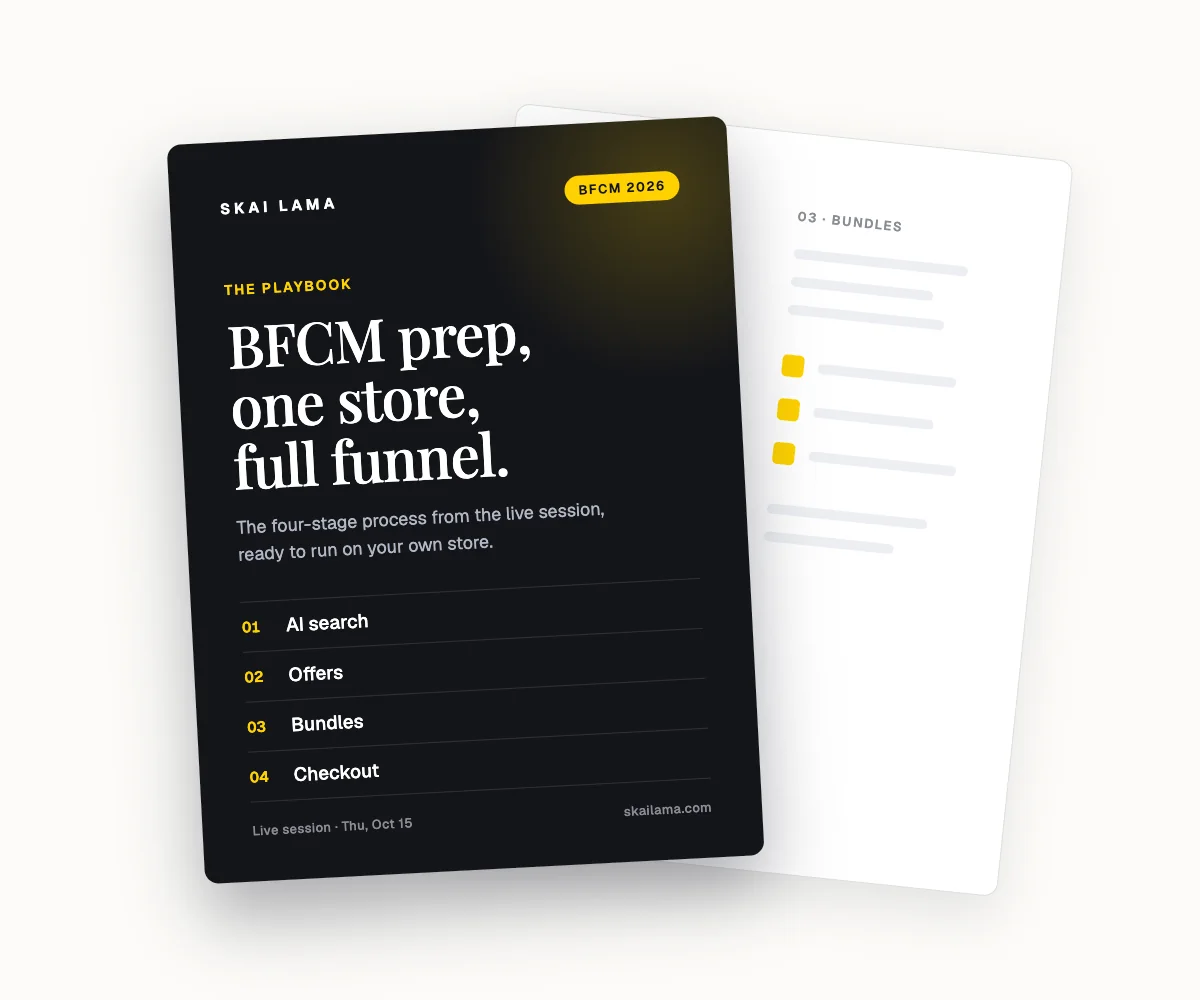
Free webinar
BFCM prep, live on one store.
We take one Shopify store through the whole BFCM funnel on screen, from AI search to checkout. You leave with the playbook to run the same on yours.
Thu, Oct 15
1 PM ET · 10 AM PT
60 minutes
Can't make it live? Register anyway. The recording and the playbook go to everyone who signs up.
Save your free seat
BFCM Prep Live. Thu, Oct 15 at 1 PM ET, 10 AM PT, 6 PM UK. 60 minutes.