How Remedy Science Generated $128K with a Skincare Protocol Bundle Builder

This is some text inside of a div block.
Share article

Most brands build bundles the same way: look at what customers buy together, package them with a discount, watch the AOV climb. It is a data-driven bet on existing behaviour, harvesting intent that was already there. Remedy Science took a fundamentally different approach.

The brand, founded by Dr. Muneeb Shah, a board-certified dermatologist, does not bundle products just because purchase data says customers buy them together. It also bundles them to encourage discoverability.

This distinction shaped their entire bundle builder strategy. The goal was to use skincare education to convert a "relatively unaware single product purchaser" to a "loyal & aware bundle purchaser". This goal determined products showcased in the builder, the name (Protocol Builder), the bundle UI, the copy for each step, and more.

The result? $128,640 in bundle revenue in just a few months with a 43% higher AOV on bundle orders. What was the unique strategy that this skincare brand used? Let's dive in.

About Remedy Science

Remedy Science is a skincare brand built around Dr. Muneeb Shah's central belief: a complete skincare routine does not need to be complicated. One cleanser, one targeted serum, one moisturizer. Simple in principle, but the right combination is different for everyone.

Dr. Shah is one of the most-followed dermatologists on the internet, with an audience built across TikTok and Instagram on a steady diet of ingredient breakdowns, routine teardowns, and quiet myth-busting.

The range is deliberately tight, addressing specific concerns (dark spots, healthy aging, pore size, daily defence). Every formula is built around a hero ingredient. Otherwise, it's mainly a dermatologist telling you what works for you. That clarity is the brand's biggest asset. It is also where the interesting commerce problem starts.

The Funnel with a Missing Middle

For a brand built around the belief that everyone needs a cleanser, a treatment, and a moisturizer, getting customers to buy all three was always the goal.

At the funnel top, Remedy had an "identify your concern & product" quiz for first-time visitors who did not yet know what their skin needed. At the bottom, they had a growing range of fixed protocol bundles (the Dark Spot Protocol, the Healthy Aging Protocol, the Pore Minimizing Protocol), priced between $60-$90 for committed customers who already knew their routine and just wanted to reorder it in one click.

The middle was empty, i.e. customers who could be encouraged to purchase a whole bundle with the flexibility to choose the products within. This is where the need for a bundle builder came up.

Most brands build bundles the same way: look at what customers buy together, package them with a discount, watch the AOV climb. It is a data-driven bet on existing behaviour, harvesting intent that was already there. Remedy Science took a fundamentally different approach.

The brand, founded by Dr. Muneeb Shah, a board-certified dermatologist, does not bundle products just because purchase data says customers buy them together. It also bundles them to encourage discoverability.

This distinction shaped their entire bundle builder strategy. The goal was to use skincare education to convert a "relatively unaware single product purchaser" to a "loyal & aware bundle purchaser". This goal determined products showcased in the builder, the name (Protocol Builder), the bundle UI, the copy for each step, and more.

The result? $128,640 in bundle revenue in just a few months with a 43% higher AOV on bundle orders. What was the unique strategy that this skincare brand used? Let's dive in.

About Remedy Science

Remedy Science is a skincare brand built around Dr. Muneeb Shah's central belief: a complete skincare routine does not need to be complicated. One cleanser, one targeted serum, one moisturizer. Simple in principle, but the right combination is different for everyone.

Dr. Shah is one of the most-followed dermatologists on the internet, with an audience built across TikTok and Instagram on a steady diet of ingredient breakdowns, routine teardowns, and quiet myth-busting.

The range is deliberately tight, addressing specific concerns (dark spots, healthy aging, pore size, daily defence). Every formula is built around a hero ingredient. Otherwise, it's mainly a dermatologist telling you what works for you. That clarity is the brand's biggest asset. It is also where the interesting commerce problem starts.

The Funnel with a Missing Middle

For a brand built around the belief that everyone needs a cleanser, a treatment, and a moisturizer, getting customers to buy all three was always the goal.

At the funnel top, Remedy had an "identify your concern & product" quiz for first-time visitors who did not yet know what their skin needed. At the bottom, they had a growing range of fixed protocol bundles (the Dark Spot Protocol, the Healthy Aging Protocol, the Pore Minimizing Protocol), priced between $60-$90 for committed customers who already knew their routine and just wanted to reorder it in one click.

The middle was empty, i.e. customers who could be encouraged to purchase a whole bundle with the flexibility to choose the products within. This is where the need for a bundle builder came up.

Share article

How Remedy Science Generated $128K with a Skincare Protocol Bundle Builder

Bundle Revenue

$128,640

Bundle Revenue

$128,640

Industry

Beauty & Skincare

Apps Used

Challenges

Bundle Revenue

$128,640

Bundle Orders

2,209

Industry

Beauty & Skincare

Apps Used
No items found.
No items found.

Introduction

Most brands build bundles the same way: look at what customers buy together, package them with a discount, watch the AOV climb. It is a data-driven bet on existing behaviour, harvesting intent that was already there. Remedy Science took a fundamentally different approach.

The brand, founded by Dr. Muneeb Shah, a board-certified dermatologist, does not bundle products just because purchase data says customers buy them together. It also bundles them to encourage discoverability.

This distinction shaped their entire bundle builder strategy. The goal was to use skincare education to convert a "relatively unaware single product purchaser" to a "loyal & aware bundle purchaser". This goal determined products showcased in the builder, the name (Protocol Builder), the bundle UI, the copy for each step, and more.

The result? $128,640 in bundle revenue in just a few months with a 43% higher AOV on bundle orders. What was the unique strategy that this skincare brand used? Let's dive in.

About Remedy Science

Remedy Science is a skincare brand built around Dr. Muneeb Shah's central belief: a complete skincare routine does not need to be complicated. One cleanser, one targeted serum, one moisturizer. Simple in principle, but the right combination is different for everyone.

Dr. Shah is one of the most-followed dermatologists on the internet, with an audience built across TikTok and Instagram on a steady diet of ingredient breakdowns, routine teardowns, and quiet myth-busting.

The range is deliberately tight, addressing specific concerns (dark spots, healthy aging, pore size, daily defence). Every formula is built around a hero ingredient. Otherwise, it's mainly a dermatologist telling you what works for you. That clarity is the brand's biggest asset. It is also where the interesting commerce problem starts.

The Funnel with a Missing Middle

For a brand built around the belief that everyone needs a cleanser, a treatment, and a moisturizer, getting customers to buy all three was always the goal.

At the funnel top, Remedy had an "identify your concern & product" quiz for first-time visitors who did not yet know what their skin needed. At the bottom, they had a growing range of fixed protocol bundles (the Dark Spot Protocol, the Healthy Aging Protocol, the Pore Minimizing Protocol), priced between $60-$90 for committed customers who already knew their routine and just wanted to reorder it in one click.

The middle was empty, i.e. customers who could be encouraged to purchase a whole bundle with the flexibility to choose the products within. This is where the need for a bundle builder came up.

Challenges

Let's look at the challenges Remedy faced before building the Protocol Builder.

Trying to Create a Builder In-House

Remedy tried building a custom solution using Shopify's product variant system, creating a single product where every possible cleanser-treatment-moisturizer combination existed as a hardcoded variant. It wasn't scalable. Two cleansers, four treatments, two moisturizers: 16+ SKU variants at launch, with every new product requiring a full rebuild of the variant matrix. "There was massive maintenance to doing it that way. It got messy," said Marina Zitser, VP of DTC at Remedy. The approach was abandoned.

Limitations of Fixed Bundles

The feedback from middle-of-funnel customers was consistent: "I like this routine, but I want a different moisturizer because it works better with my makeup." Fixed combinations could not accommodate the individual texture preferences, ingredient sensitivities, and overlapping concerns that made skincare personal in the first place. Customers who did not find an exact fit either bought around them or abandoned the journey.

The gap was leaving Remedy's most valuable customer segment (those who were educated enough to know what they needed but not yet committed enough to lock into a fixed routine) without a structured path forward.

Solution

Data That Guided the Bundling Strategy

Very early on, the brand conducted a co-purchase analysis of its order history, which revealed what customers were already doing naturally. Distinct purchase clusters emerged consistently, such as the oily/pore-focused route or the dry/barrier route, all with a high product co-purchase rate.

These combinations were later formalised into fixed bundles. The purchase data and the dermatological logic were arriving at the same product groupings through entirely separate paths.

The Protocol Builder took a slightly different route: rather than bundling what customers already bought together, it built a guided system to help customers discover the right combination for their specific skin.

Building the Protocol Builder

Remedy literally came to Easy Bundle Builder with a Figma file. This was not a case of using our default templates. It was a well-thought-out page, built to express a clinical philosophy as much as a brand aesthetic.

The name was the first signal. Calling it the Protocol Builder rather than the Bundle Builder reframed the entire experience: not a discount mechanism, but a guided routine-building system.

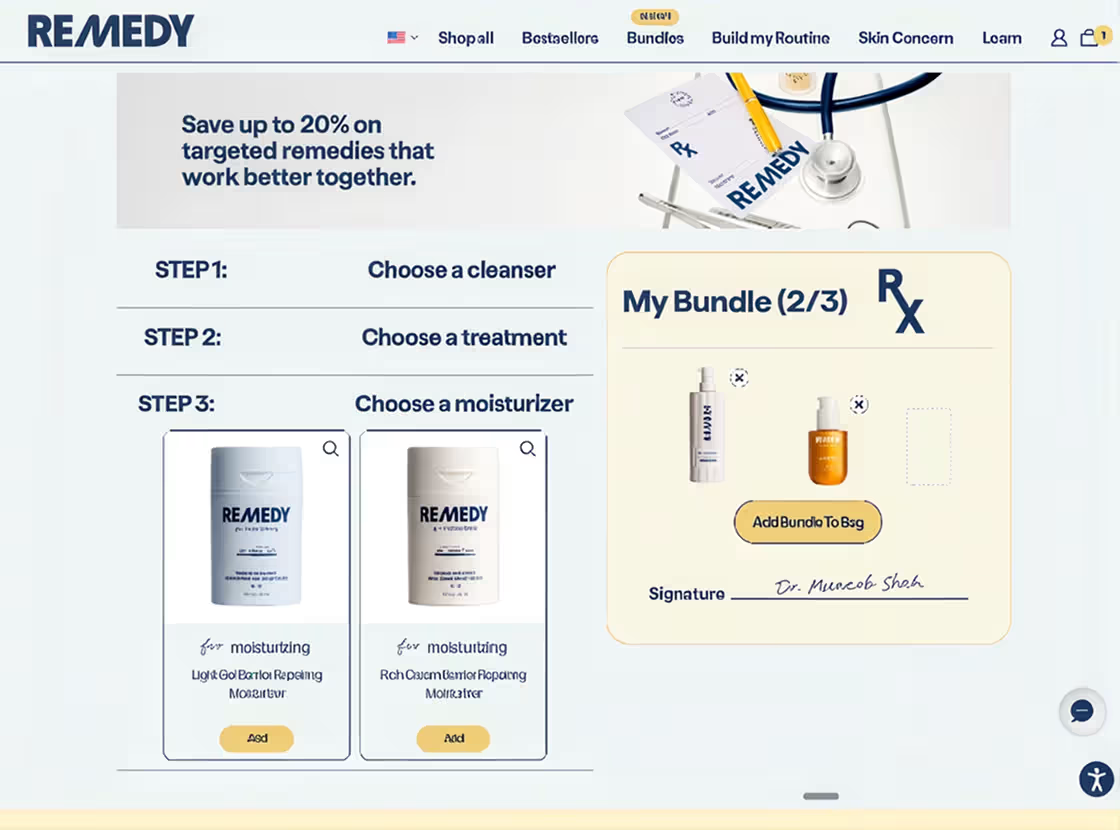
The interface reinforced it: a prescription pad UI, a "My Bundle Rx" heading, Dr. Muneeb Shah's signature in the design. The visual language communicated authority. You are not just picking products. You are following a protocol from a dermatologist.

In evaluating bundling apps, cost and flexibility were the primary filters. Apps with comparable customization were significantly more expensive, some costing thousands per month, too much for what was still an unproven concept. Custom development had already failed on maintenance grounds.

Easy Bundle Builder offered the multi-step BYOB structure that mapped naturally to the three-step routine, full design customization to match the Figma spec, and a team willing to build to the brief.

"Most of the other apps we evaluated were significantly more expensive, with either limited flexibility or design that did not match where we wanted the brand to be. The Easy Bundle Builder team offered to customize it for us, and that support made it an easy decision."

Marina Zitser, VP of DTC, Remedy Science

A Close Look at the Bundle Builder

Remedy's Protocol Builder is a masterclass in skincare bundle design.

The uniquely designed UX is reminiscent of a doctor's prescription and is completely on-brand. The three-product silhouettes set the expectation and fill up as the customer picks their products.

The landing page bundle builder embeds education throughout the flow. At each stage, products include ingredient callouts and skin concern labels. Customers are not just reading product names; they are learning what each product does and why it matters for their specific concern.

The 20% discount is consistent with Remedy's fixed bundles, which means the Protocol Builder's value proposition was never primarily about price. It was about personalisation.

The Protocol Builder is also a living product. New launches are added as part of a standing process.

Results

Promoting the Protocol Builder

Remedy took an organic-first approach to promoting the Protocol Builder. 56% of traffic came from the collection page, 19.5% from the product page, 17% from the homepage, and 7% via email marketing. That's with just a single email in Remedy's retention series, and this percentage share is bound to grow.

AOV Impact

Bundle AOV has consistently outperformed Remedy's store-wide average order value. It surpassed it by 33% in September 2025 and was growing to 61% above store AOV by April 2026, an average premium of 43% over the store AOV. The gap is widening over time: as the Protocol Builder becomes more embedded in Remedy's customer journey, customers are arriving with a clearer sense of what they are building.

Bundle Revenue

The Protocol Builder has shipped 2,209 orders and generated $128,640 in bundle revenue so far. The tool generates revenue not because there is a campaign pushing it, but because it solves a problem the customer already had.

Flexibility Payoff

At Step 2, where customers pick a treatment serum, the choices spread across the four options: 37% choose "for daily defence," 25% "for healthy aging," 22% "for dark spots," and 19% "for pore size." Four different kinds of shoppers, each building a different routine, using the same tool. If most customers were picking the same treatment, a single fixed bundle would have done the job. They weren't, and that is exactly why the Protocol Builder existed: to give each kind of customer a routine that actually fit them.

Engagement

The Protocol Builder is also a living product. New launches are added through a standing process, and customers have noticed. Following one launch, requests came in asking for a new Vitamin C serum to be added to Step 2. That level of product awareness, from customers watching what appears in the builder between purchases, reflects how embedded the tool has become in the brand experience.

Conclusion

Remedy is treating the Protocol Builder as infrastructure rather than a finished feature. Here's what's next:

  • Subscription Integration: the ability to place the Protocol Builder on a recurring subscription, so a customer who has found their routine receives it automatically on a schedule without having to rebuild it each time.
  • Step 4 Add-On: an optional upsell step at the end of the three-step flow, giving customers the chance to add a complementary product once their core routine is complete. Purchase data already points to "for dry lips" as the strongest candidate: it co-purchases with 6 out of 8 anchor products across all skin types, making it a natural fit as the optional fourth step.
  • New Collection Tile Creative: a dynamic collection tile creative that flashes every single product within the Protocol Builder.

Each of these builds toward the same outcome: making the Protocol Builder an even more central part of how Remedy turns curiosity into a committed routine.