.svg)
.svg)

.svg)
.svg)



%20(1).jpg)
Our Apps Have Driven
5X AOV | 2X Conversions | $30M+ Additional Revenue
5X AOV | 2X Conversions | $30M+ Additional Revenue
.svg)


5.0 (3000+ Reviews)


Shopify Apps




.svg)

Growing a Shopify store today isn’t easy — ads are getting expensive, competition is rising, and most new brands struggle with the same problem:
How do we get traffic and sales without spending money on marketing?
The good news? You don’t always need paid ads to grow.
Some of the most successful Shopify brands boost revenue by using smart zero-cost promotion strategies that turn existing traffic into paying customers — and repeat buyers.
In this guide, we’ll walk through 5 free promotion quick hacks that:
These hacks are not random tricks — they’re based on real stores, real data, and strategies that have helped Shopify brands generate higher conversions, bigger average order value (AOV), and more repeat purchases.
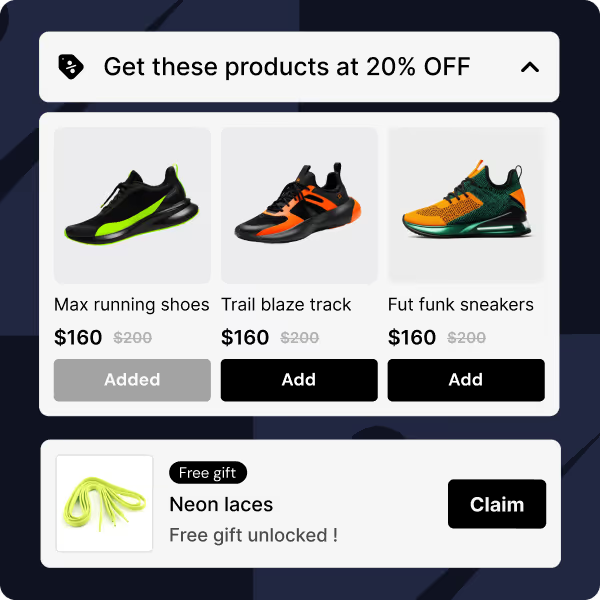
One of the most effective ways to promote your Shopify store without spending money is by offering a free bundle on selected products. Instead of running discounts that reduce margins, this strategy encourages shoppers to purchase more items while receiving something extra at no additional cost.
A free bundle works for one important reason: perceived value. Customers feel they are getting a better deal when they receive an additional item rather than a price reduction. This leads to higher conversions and a noticeable increase in average order value (AOV).
The easiest and fastest way to launch a free bundle promotion is through Easy Bundle Builder & Cross Sell, a bundling app trusted by more than 8,000 Shopify merchants. It allows stores to build bundles without coding or changing theme layouts.
Steps inside Fly:
Example configuration:
| Purchase Quantity | Reward | Effective Value |
|---|---|---|
| Buy 2 | 1 item free | 33% value gain |
| Buy 3 | Free premium add-on | 25% value gain |
Free bundle promotions suit almost every industry. Some proven formats include:
Fly also supports subscription add-ons, upsells, personalization, and automatic inventory sync, ensuring bundles do not create stock conflicts.
This hack works best when the offer is visible across the customer journey. Recommended placements include:
Merchants using Easy Bundle Builder have reported measurable improvements, including:
A free bundle is especially powerful when implemented during new product launches, gifting seasons, and sampling opportunities.
Most shoppers abandon a purchase because they feel no urgency to buy now. They assume the product will remain available later, the offer will continue, or they can simply return when they are ready. Introducing subtle urgency and “fear of missing out” (FOMO) messaging helps convert hesitant visitors into buyers without discounts.
Urgency works not because of pressure, but because it reduces indecision. When customers clearly understand that an offer, product, or freebie is limited, they are significantly more likely to complete the purchase in the same session.
You can implement urgency across your Shopify store without running a sale or reducing product prices. The following approaches are proven to increase buyer motivation:
Strategic placement matters more than aggressive wording. The goal is to inform, not pressure. The most effective areas are:
Overuse of timers or urgency messaging can reduce trust. It is better to apply urgency selectively, especially during:
When used thoughtfully, urgency and FOMO can convert shoppers on the fence and reduce cart abandonment significantly, without relying on discount-heavy strategies.
A Shopify store that grows consistently is almost always supported by strong email marketing. Relying exclusively on new website visitors from social media or search traffic often leads to unpredictable sales. Collecting email (or SMS/WhatsApp) leads ensures you can promote new products, bundles, and offers to an audience you already own—without spending on ads.
Instead of asking visitors to “sign up for our newsletter,” offering something free in exchange for their email consistently performs better. The freebie acts as a value exchange, giving shoppers a reason to subscribe and return.
Different types of stores can use different incentives. Some proven examples include:
The value of the offer matters more than the cost of fulfilling it.
The following scripts outperform generic newsletter signup messages:
Popups with a strong benefit-focused headline, one input field (email only), and a clear call-to-action typically convert the highest.
Most brands stop at collecting an email. The results come from what happens next. Set up a simple two-email automation:
Email 1 — delivered immediately
Email 2 — sent 24–72 hours later
This sequence ensures the free signup turns into actual revenue rather than passive subscribers.
Building a customer list is not just about boosting short-term sales. It creates a long-term promotional channel you control and never have to pay for traffic again.
Many brands overlook one of the most effective free promotion channels: participating in niche communities where target customers already spend time. These include Reddit subforums, Facebook Groups, Discord communities, WhatsApp groups, and topic-specific forums. When done correctly, this approach brings qualified traffic from real buyers without advertising costs.
The key is to add value first, not enter a community simply to promote a product. Members respond positively to useful insights, personal experiences, and problem-solving posts. Once trust is established, product mentions and store links convert naturally.
Choose communities that align closely with your niche rather than broad ecommerce groups. Examples:
Highly engaged niche communities produce the best results.
A simple posting structure helps generate attention without being seen as promotional:
This approach respects community rules while building meaningful visibility for your brand.
Below is a practical format that has worked well across communities:
“I’ve been testing different solutions for [problem] and realized most options had issues like [challenge 1] and [challenge 2]. I eventually created/found a setup that solved it by focusing on [solution]. Sharing it here in case it helps someone. If anyone wants to see what I’m using now, I can share the link.”
This invites curiosity without aggressive selling.
Results compound with consistency rather than one-time activity. A realistic posting schedule:
Traffic from these interactions is warm, intent-driven, and often converts higher than cold audiences from paid ads.
Niche communities are built around shared interests and trust. When a product recommendation comes from a real person sharing a solution, rather than a sales message, it carries far more credibility. Even a small number of active community conversations each week can generate:
This is one of the few strategies that cost nothing while unlocking ongoing exposure, especially for emerging brands.
Discount codes can attract new buyers, but they frequently reduce margins and condition customers to wait for sales. A more sustainable and cost-effective alternative is offering referral rewards. This turns satisfied customers into promoters and brings in new customers through personal recommendations rather than advertising.
Referral-based customers tend to:
This makes referrals one of the most efficient growth channels for Shopify brands, especially when marketing budgets are limited.
The referral incentive does not have to be large. It simply needs to feel valuable and fair.
Examples of rewards that convert well:
Store credit consistently outperforms percentage-based discounts because it encourages repeat purchases without devaluing products.
Below is a message format that brands often share by email or WhatsApp to initiate a referral loop:
"Share your unique link with a friend and both of you receive a reward when their first order is placed. No minimum purchase required. It is our way of thanking our loyal customers and helping more people discover our products."
This message is simple, transparent, and has clear benefits for both parties.
Visibility is critical. Add referral access to:
When customers learn about referral rewards right after they have made a purchase or had a positive experience, the likelihood of participation increases significantly.
Referral programs tend to generate the highest impact in these situations:
Instead of running frequent discounts to attract new shoppers, referral programs let existing customers bring in new customers at a much lower cost and with a higher lifetime value.
Each of the five free promotion hacks delivers results in a different way. The table below provides a practical comparison to help decide which strategy to implement first:
| Hack | Primary Benefit | Cost | Difficulty | Ideal Use Case | Expected Results Timeline |
|---|---|---|---|---|---|
| Free Bundle Offer using Easy Bundle Builder | Higher average order value | Free plan available | Easy | Stores with 2 or more complementary products | Immediate to 7 days |
| Urgency & FOMO Messaging | Higher conversions from existing traffic | Free | Easy | Stores experiencing high “add to cart but no purchase” behavior | Same day |
| Freebie Email Opt-Ins | Long-term sales channel | Free | Medium | Stores with consistent traffic from social or search | 7 to 30 days |
| Niche Community Promotion | Free targeted traffic | Free | Medium | Niche-driven markets (beauty, fitness, pets, lifestyle, food) | 7 to 21 days |
| Referral Rewards | Sustainable new customer acquisition | Free | Very Easy | Stores with strong customer satisfaction or repeat buyers | 30 to 60 days |
If the goal is fast revenue increase from current website visitors, the free bundle promotion (Hack #1) and FOMO messaging (Hack #2) should be prioritized.If the goal is long-term growth that reduces dependence on paid ads, email acquisition and referrals should be woven into the overall retention strategy.
Use the checklist below to apply all strategies systematically.
Even if you implement only two or three, you will see measurable improvement in conversions and returning customer revenue.
Free Bundle Promotion
Urgency & FOMO
Freebie Email Opt-In
Niche Community Promotion
Referral Rewards
Completing this checklist ensures your store is benefiting from both short-term and long-term promotional momentum — without relying solely on ads or discount-heavy pricing.


.avif)

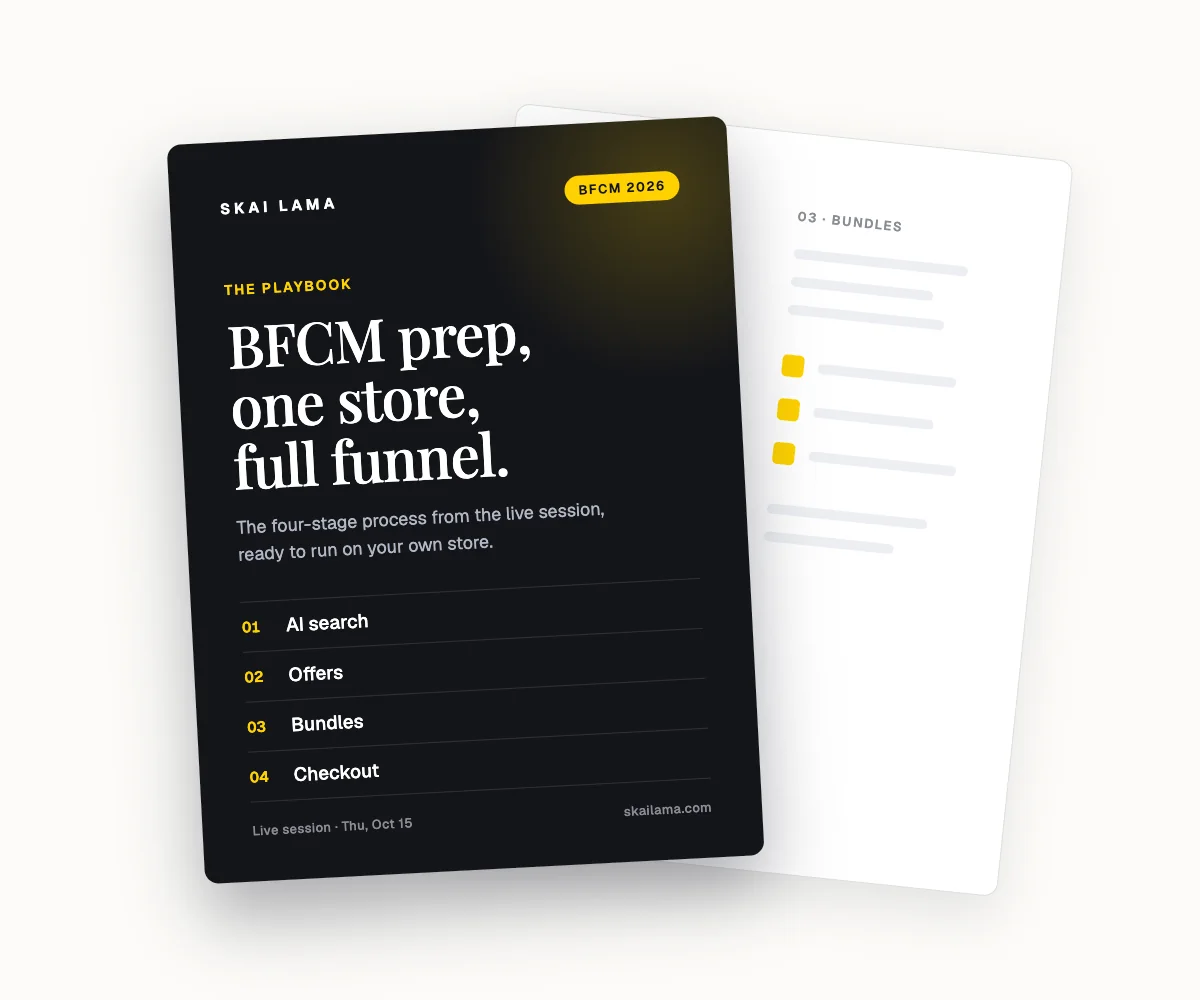
Free webinar
BFCM prep, live on one store.
We take one Shopify store through the whole BFCM funnel on screen, from AI search to checkout. You leave with the playbook to run the same on yours.
Thu, Oct 15
1 PM ET · 10 AM PT
60 minutes
Can't make it live? Register anyway. The recording and the playbook go to everyone who signs up.
Save your free seat
BFCM Prep Live. Thu, Oct 15 at 1 PM ET, 10 AM PT, 6 PM UK. 60 minutes.