.svg)
.svg)

.svg)
.svg)



%20(1).jpg)
Our Apps Have Driven
5X AOV | 2X Conversions | $30M+ Additional Revenue
5X AOV | 2X Conversions | $30M+ Additional Revenue
.svg)


5.0 (3000+ Reviews)


Shopify Apps





.svg)

Shopify is worth it for the vast majority of Shopify store operators in 2026, but the answer changes by segment: it is a near-default yes for small businesses launching their first store, a confident yes for dropshipping operators, a conditional yes for Shopify Plus enterprise buyers (worth it above ~$80,000/month in online sales), and a careful "depends" for buyers of prebuilt Shopify stores. Plans run from $39/month (Basic) to $2,500/month (Plus), but the real total cost of ownership for a healthy mid-size store is usually $200 to $1,200/month once apps, payment processing, and theme costs are added. Compared to WooCommerce, BigCommerce, Wix, and Magento, Shopify delivers the lowest setup friction, the most reliable infrastructure (99.9% uptime, handling 489 million peak requests per minute during BFCM 2025), and the largest app ecosystem, at the cost of platform lock-in and transaction fees on non-Shopify Payments gateways. This guide covers the full segment-by-segment verdict, the real Shopify total cost of ownership and how it stacks up against competitors, where Shopify falls short, when it is not worth it, and a practical decision framework for picking the right platform.
This guide covers:
1. Is Shopify Worth It in 2026? The Short Answer
2. What You Get for Your Money on Shopify
3. The True Total Cost of Owning a Shopify Store
4. Is Shopify Worth It for a Small Business?
5. Is Shopify Plus Worth It?
6. Is Shopify Worth It for Dropshipping?
7. Is Buying a Prebuilt Shopify Store Worth It?
8. Shopify vs Other Ecommerce Platforms
9. The Real Drawbacks: Where Shopify Falls Short
10. When Shopify Is NOT Worth It
11. How to Decide: A Practical Framework
12. FAQs
Yes for most Shopify store operators, with one important caveat: the right plan and the right setup matter more than the platform choice itself. Shopify has earned its dominant position in the ecommerce platform space (Shopify processes around 10% of total US ecommerce GMV and powers over 4.8 million live stores) because it makes the hardest parts of running an ecommerce business, checkout, payments, infrastructure, multi-channel, easy enough that a non-technical operator can launch in a weekend.
The short verdict by segment:
| Segment | Is Shopify worth it? | Why |
|---|---|---|
| Small business / first-time operator | Yes | Fastest path to launch. Shopify Payments + Shop Pay + native themes remove the three biggest friction points. |
| Dropshipping operator | Yes | Strong DSers, Zendrop, and Spocket integrations. Shop Pay improves conversion on cold dropshipping traffic. |
| Mid-market brand ($500K–$5M GMV) | Yes | Plan tier matches store size; Shopify Functions and Markets cover most growth needs without Plus. |
| Enterprise / Shopify Plus candidate | Yes, above ~$80K/month online sales | Checkout Extensibility, B2B Catalogs, Shopify Functions, and Launchpad pay for the Plus upgrade through CRO and operational gains. |
| Prebuilt Shopify store buyer | Depends | Worth it only if the store has real revenue history, traffic, and supplier relationships, most do not. |
| Simple service business or single-product creator | Often no | Wix, Squarespace, or Stan.store are faster and cheaper for sub-50-SKU service-led businesses. |
The conditions where the answer flips from yes to no:
• Your business needs deep custom logic that requires direct database access (Shopify abstracts the database; Magento or a custom build wins here)
• You sell digital services, courses, or memberships as the primary product (Squarespace, Kajabi, Teachable are purpose-built for this)
• Your monthly budget is under $40 and you cannot justify a single paid app or theme (the Shopify Starter plan at $5/month is the only fit, and it is limited)
• You need a deeply customized checkout but do not yet qualify for Shopify Plus (regular plans have limited checkout customization)
Shopify is fully managed software-as-a-service for ecommerce, meaning the cost of the plan covers a long list of infrastructure, payments, and store-building tooling that other platforms either charge for separately or expect you to assemble yourself. The core value props that consistently justify the cost:
| What you get | Why it matters |
|---|---|
| Hosted infrastructure with 99.9% uptime | Shopify handles servers, scaling, security, SSL, and CDN. No DevOps team needed. During BFCM 2025, Shopify processed 489 million requests per minute and $14.6 billion in sales without merchant-side intervention. |
| Shop Pay accelerated checkout | Shopify's own data shows Shop Pay converts 1.72x better than guest checkout on mobile. Free to enable, no setup required. |
| Shopify Payments + 100+ payment gateways | Native payment processing with competitive rates, plus support for Klarna, Afterpay, PayPal, Stripe, and regional methods (UPI for India, iDEAL for the Netherlands). |
| Native themes (Dawn, Sense, Refresh) | Performance-optimized, mobile-first, free out of the box. Custom themes from the Theme Store start at $150–$400 one-time. |
| App ecosystem with 10,000+ apps | Bundles, reviews, email, A/B testing, post-purchase upsells, inventory, the marketplace fills almost every functional gap with a paid app rather than custom dev. |
| Multi-channel selling | Native sales channels for Facebook, Instagram, TikTok, Google, Amazon, and a Shop app marketplace that exposes your products to 100M+ Shopify shoppers. |
| Built-in analytics + Shopify Sidekick AI | The Online Store Conversion Rate report, sales reports, customer reports, and the new Sidekick AI assistant for store management, covered in our Shopify CRO guide. |
| Shopify Markets for international expansion | Multi-currency, multi-language, regional pricing, and Managed Markets (Shopify-as-merchant-of-record) for tax and compliance overhead reduction. |
This is the bundle that makes Shopify worth it for most operators: the platform absorbs the infrastructure, payments, security, and tooling work that would otherwise consume a small team's first 90 days.
The sticker price on a Shopify plan is misleading because the platform fee is only one of six cost categories that make up the real total cost of ownership (TCO). Shopify's own TCO and ROI guide breaks costs into three buckets: implementation, platform fees, and operational support. The expanded operator view looks like this:
| Cost category | What it covers | Typical monthly cost (mid-size store) |
|---|---|---|
| Platform fee | Basic / Grow / Advanced / Plus subscription | $39 – $2,500 |
| Apps and integrations | Bundles, reviews, email marketing, A/B testing, post-purchase, search, typically 6–12 paid apps | $80 – $400 |
| Payment processing | 2.4–2.9% + 30¢ via Shopify Payments; transaction fees on non-Shopify gateways | 2.4–3.5% of GMV |
| Theme | Free (Dawn, Sense, Refresh), $150–$400 (paid Theme Store), $5K–$30K (custom) | Amortized: $0 – $80 |
| Developer / agency time | Theme tweaks, app integrations, custom features | $0 – $500 |
| Domain, email, tools | Domain, transactional email, analytics, tax tools | $20 – $80 |
| Total realistic monthly TCO | $200 – $1,200 before payment processing |
For the full plan-by-plan breakdown of Shopify Payments rates by country (US, India, UK, Australia, Canada), transaction fees on third-party gateways, and a country-by-country pricing comparison, see our detailed Shopify Pricing: Plans and Fees Explained guide.
For a representative mid-size store doing $500,000 in annual GMV, the 3-year total cost of ownership across the three most common Shopify alternatives:
| Cost area | Shopify (Grow plan) | WooCommerce (self-hosted) | BigCommerce (Growth plan) |
|---|---|---|---|
| Platform / hosting | $105/month × 36 = $3,780 | Hosting $50/month × 36 = $1,800 | $79/month × 36 = $2,844 |
| Apps / plugins | $200/month avg × 36 = $7,200 | $150/month avg × 36 = $5,400 | $150/month avg × 36 = $5,400 |
| Payment processing (2.6% blended) | $39,000 over 3 years | $39,000 (WooPayments 2.50–2.90% + 30¢) | $0 transaction fees with embedded providers; $39,000 processor fees |
| Theme | $300 one-time | $80 one-time | $200 one-time |
| Developer / maintenance | $200/month × 36 = $7,200 | $500/month × 36 = $18,000 (security patches, plugin conflicts, hosting tuning) | $200/month × 36 = $7,200 |
| 3-year total TCO | ~$57,500 | ~$64,200 | ~$54,600 |
Sources: Shopify pricing, BigCommerce pricing, WooCommerce cost breakdown.
Two takeaways from the comparison:
• Shopify and BigCommerce are within 5% of each other on TCO. The difference is execution: Shopify wins on app ecosystem and Shop Pay conversion lift; BigCommerce wins on built-in features at the same tier.
• WooCommerce looks cheaper on the surface (free core, no platform fee) but the developer and maintenance burden, security patches, plugin conflicts, hosting tuning, breakage, typically adds $300–$600/month in real labor or agency time. The "free" platform is actually the most expensive of the three for any store without an in-house developer.
Shopify's own TCO and ROI research claims Shopify delivers "up to 36% better TCO than the competition" with implementation costs averaging 23% lower, those numbers are vendor-published and worth treating as the optimistic end of the range, but the directional point holds: Shopify's managed-platform model removes the silent overhead that drags down WooCommerce TCO at scale.
Is a Shopify store worth it for a first-time operator? Yes, for almost every small business. Asked the other way (shopify is it worth it for a beginner), the answer holds. Shopify is purpose-built to remove the three friction points that kill most first-time ecommerce launches: payments setup, hosting and security, and theme customization. A small business operator can sign up, install a free theme, add 10–50 products, configure shipping rates, connect Shopify Payments, and take the first order in a single weekend.
The Basic plan at $39/month (or $29/month on annual billing) is the right fit for stores doing under $250,000 in annual GMV. What you get:
• Up to 1,000 inventory locations
• Unlimited products
• Shop Pay, Shopify Payments, and 100+ third-party payment gateways
• Native sales channels (Facebook, Instagram, TikTok, Google, Amazon)
• Basic reporting + Online Store Conversion Rate report
• Email marketing via Shopify Email (10,000 free emails/month)
• POS Lite for in-person sales
• Abandoned cart recovery emails
What you do not get on Basic that small businesses often outgrow within 6–12 months:
• Customer segmentation (Grow plan and above)
• Professional reports (Grow and above)
• Lower Shopify Payments rates and lower third-party transaction fees (Advanced plan)
• More staff accounts (Basic has none; Grow has up to 5; Advanced has up to 15)
For a small business doing $5,000–$30,000/month in revenue, the Basic plan plus 4–6 well-chosen apps (Klaviyo for email, Judge.me for reviews, an abandoned cart app, a bundle app) is the right starting toolkit. Total realistic TCO at this stage runs $150–$300/month before payment processing.
A small business should consider upgrading to the Grow plan ($105/month, $79 annual) once monthly revenue crosses $20,000–$30,000, the lower transaction fees and unlocked features pay for the upgrade quickly at that volume.
The honest counter-case: if you are running a single-product launch, a small print-on-demand experiment, or a side-project store generating under $500/month, Shopify's $39/month plan may not be the right fit. The Shopify Starter plan at $5/month is the better entry point for that case, it gives you Shopify Payments, a basic product catalog, and link-in-bio commerce, without the full online store.
Shopify Plus is worth it for Shopify store operators doing approximately $80,000/month or more in online sales (~$960,000 annual run rate), which is Shopify's own published upgrade trigger. Below that volume, the Plus monthly fee ($2,500/month on a 1-year term, $2,300/month on a 3-year term) is hard to justify on raw cost economics. Above it, the Plus-only features tend to pay for themselves through CRO gains, operational savings, and B2B revenue unlocks.
What Plus delivers that regular Shopify plans cannot match:
| Plus-only capability | Why it matters |
|---|---|
| Checkout Extensibility | Add custom UI components (upsells, trust badges, gift messages, loyalty displays) directly inside the checkout. The single biggest CRO unlock Plus delivers, covered in detail in our Shopify CRO guide. |
| Post-purchase one-click upsells | Native post-purchase page with one-click upsells (no re-entering payment). Accept rates run 10–25% on well-tuned funnels. |
| Shopify Functions | Custom checkout logic, discount stacking rules, payment method visibility, shipping rate customization, cart transformations. |
| B2B Catalogs and checkout | Separate B2B checkout experience with custom pricing, net payment terms, company-specific catalogs. For stores with both DTC and wholesale channels, this is the single biggest Plus ROI driver. |
| 9 expansion stores included | Run separate regional or brand stores under one Plus subscription. |
| Unlimited staff accounts | Vs 15 on Advanced, 5 on Grow, 0 on Basic. |
| Launchpad | Schedule and automate sales events (price changes, theme changes, discount activations) with precise timing. Removes human error during BFCM and product drops. |
| Checkout bot protection | Native bot protection during product drops, flash sales, and inventory-limited campaigns. |
| Dedicated Merchant Success Manager | Non-technical advantage: an MSM who reviews analytics, advises on strategy, and connects you with vetted Shopify Partners. |
The variable platform fee structure: Shopify Plus charges the fixed monthly fee for most merchants, but switches to a variable platform fee for higher-volume businesses, the exact revenue threshold for the switch is not publicly disclosed (Shopify directs merchants to contact sales for current 2026 numbers). Plan accordingly when forecasting beyond $5M GMV.
For the full breakdown of Shopify Plus pricing, expansion store inclusions, regional pricing, and the cost-justification framework, see our Guide to Shopify Plus Pricing (2026).
When Plus is NOT worth it: below $80K/month in online sales, the fixed $2,300–$2,500/month base cost outweighs the unlocked features for most stores. Stay on Advanced ($399/month) and reinvest the difference into customer acquisition until volume justifies the upgrade.
Is Shopify dropshipping worth it? Yes, Shopify is worth it for dropshipping in 2026, and arguably more so than any other platform. The longer version of the same question, is dropshipping on Shopify worth it, gets the same answer for the same reasons. The ecosystem is built around it: DSers (the official replacement for the deprecated Oberlo), Zendrop, Spocket, AutoDS, and CJdropshipping all integrate natively with Shopify and require zero custom development.
Why Shopify wins for dropshipping specifically:
• Shop Pay drives conversion on cold dropshipping traffic. Most dropshipping traffic is cold (paid ads, Reels, TikTok), and cold traffic abandons checkout at high rates. Shop Pay's 1.72x conversion lift on mobile is disproportionately valuable for dropshipping stores.
• App-driven supplier integration. Dropshipping requires constant SKU sync, automated order routing, and tracking number passback. DSers and Zendrop handle all three natively through Shopify's API.
• Lower transaction fees with Shopify Payments. Dropshipping margins are typically 20–40%, so every percentage point of payment processing matters. Shopify Payments at 2.4–2.9% beats most generic Stripe setups by 10–20 basis points.
• Marketing channel integration. Native Facebook, TikTok, and Google integrations let dropshipping operators run paid ads with proper conversion tracking without custom pixel setup.
The Basic plan ($39/month) is the right starting plan for dropshipping. Upgrade to Grow once monthly revenue crosses $15,000–$20,000, primarily for the lower third-party gateway transaction fees (1% on Grow vs 2% on Basic). Realistic TCO for a dropshipping operator on Basic plan: $80–$150/month before payment processing, including 3–5 essential apps (DSers + reviews app + abandoned cart + theme add-on + one upsell app).
The honest counter-case: dropshipping fails on every platform if the niche is over-saturated, the margins are too thin, or the supplier quality is poor. Shopify makes the operational side easier, but it does not fix unit economics. A dropshipping store with a 15% net margin and $50 average order value is unprofitable on Shopify or anywhere else.
Is it worth buying a prebuilt Shopify store? Sometimes. Prebuilt Shopify stores fall into two distinct categories, and only one of them is worth buying:
Category 1: Empty turnkey templates ($150–$2,000), Sellers on Fiverr, Etsy, and prebuilt store marketplaces offer "complete dropshipping stores" with a niche-themed name, a Shopify theme, 10–30 product listings, and basic apps installed. These are rarely worth it. What you are paying for is 8–15 hours of setup work that you could do yourself in a weekend, with no traffic, no revenue history, no email list, and no supplier relationships. The store has zero validation that the niche actually converts.
Category 2: Established stores with real revenue ($5,000–$5M+ on Flippa, Empire Flippers, Acquire.com), These are operating businesses being sold by their owners. They have traffic, revenue history, customer lists, supplier relationships, and 6–24 months of trading data. These can be worth it, but only after rigorous due diligence:
What to verify before buying an established Shopify store:
• Revenue and traffic verification through screen-share of the Shopify admin and Google Analytics (not seller-supplied screenshots)
• Net profit margin after all costs including ad spend, COGS, apps, agency time
• Customer concentration, is revenue dependent on 1–2 channels (Facebook ads, one influencer) or diversified?
• Email list quality, open rates, repeat customer rate, list growth trend
• Supplier exclusivity or competitive moat, what stops a buyer from cloning the store and undercutting on price?
• Trademark and brand IP status, does the seller own the brand name and logo cleanly?
• Apps and theme included in the sale vs paid separately after transfer
The right rule of thumb: a Shopify store doing $20K/month in real profit (not revenue) typically sells for 24–36 months of profit, or roughly $480K–$720K. Stores priced significantly below that multiple usually have hidden problems (declining trend, undisclosed costs, traffic source about to break). Stores priced above that multiple usually have unverifiable claims.
Bottom line: skip the cheap turnkey templates. If you have $50K+ of acquisition capital and the appetite for due diligence, an established Shopify store can be worth it as an alternative to building from scratch.
Shopify competes with five major alternative platforms, each with a different sweet spot. The honest comparison:
| Comparison | When Shopify wins | When the alternative wins |
|---|---|---|
| Shopify vs WooCommerce | Speed to market, infrastructure reliability, app ecosystem, no DevOps burden | Deep custom builds, full database access, no platform lock-in, free core |
| Shopify vs BigCommerce | Larger app ecosystem, smoother UX, Shop Pay conversion lift, better support resources | Slightly more built-in features at the same tier, no transaction fees on any gateway, multi-storefront on lower tiers |
| Shopify vs Wix/Squarespace | Catalog scale (50+ SKUs), inventory management, B2B, fulfillment, multi-location | Simple stores, portfolio sites with a shop bolt-on, single-creator businesses, lower starting price |
| Shopify vs Magento (Adobe Commerce) | TCO at all but the largest enterprise scale, managed infrastructure, faster time-to-launch | Very large complex operations with unique requirements, dedicated dev teams, deep customization |
| Shopify vs Amazon / marketplaces | Brand control, customer data ownership, full margin capture, direct customer relationship | Traffic and discovery, no acquisition cost, fulfillment outsourced (FBA), built-in trust |
WooCommerce is a free, open-source plugin for WordPress, which means the platform itself costs nothing, but you handle hosting, security, updates, plugin conflicts, and breakage yourself. For a store with an in-house developer or technical founder, that flexibility is genuinely valuable. For a store without one, the maintenance burden becomes a hidden tax that eats 20–40% of operator time. Shopify wins on speed-to-market and reliability; WooCommerce wins on flexibility for deeply custom builds. See our Wix vs Shopify comparison for an adjacent platform comparison.
The two platforms have very similar feature sets at the core. BigCommerce has no transaction fees on any gateway (a real advantage if you process high volume on a non-Shopify gateway) and slightly more built-in features natively. Shopify has a significantly larger app ecosystem (10,000+ vs ~1,500), better brand recognition, more support resources, and the Shop Pay conversion lift. BigCommerce often feels more complex to set up; Shopify's UX is generally smoother. For most operators, Shopify wins on ecosystem depth; BigCommerce wins on payment economics at very high volume.
Wix and Squarespace are great for simple stores, portfolio sites with a shop bolt-on, single-creator businesses, and catalogs under 50 SKUs. They are not fair comparisons to Shopify once a store needs serious inventory management, multi-location fulfillment, B2B, or multi-currency. Wix has improved its ecommerce capabilities significantly in 2025–2026, but the gap is still meaningful at scale.
Magento is enterprise-grade and highly customizable, but it requires a dedicated dev team and significant infrastructure costs, typically $250K–$2M+ all-in over 3 years for a mid-large enterprise build. Shopify Plus covers most enterprise needs without that overhead. Magento makes sense for very large, complex operations with unique requirements that genuinely cannot be served by Shopify's framework; Shopify wins on TCO for the vast majority of brands.
This is not a true either/or. Marketplaces (Amazon, Walmart, eBay, Etsy) give you traffic but you do not own the customer relationship, the data, or the brand impression. Shopify gives you brand control, customer data, full margin, and direct relationship, but you have to drive your own traffic. The right answer for most operators is both: a Shopify-powered branded storefront as the margin and brand anchor, plus marketplace channels for incremental volume. Shopify's native Amazon, Walmart, and Etsy sales channels make running both simpler than it used to be.
For platform-by-platform deep dives covering migration paths, feature parity, and edge cases, see Shopify alternatives and our adjacent comparison guides.
Shopify is not perfect. The honest list of drawbacks every operator should weigh:
| Drawback | Impact | Mitigation |
|---|---|---|
| Transaction fees on non-Shopify Payments gateways | 0.5–2% transaction fee added on top of gateway processor fees if you use Stripe, PayPal, Authorize.net, etc. | Use Shopify Payments to avoid the transaction fee entirely, covered in our Shopify Pricing guide |
| App dependency for non-trivial functionality | Most stores end up with 6–12 paid apps. Costs add up; app sprawl hurts speed and creates data silos. | Audit apps quarterly. Consolidate where possible (Klaviyo handles email + SMS + abandoned cart + reviews in one stack). |
| Limited content management | Shopify is great at commerce but weaker at content marketing, the blog editor is basic, page builders are limited compared to WordPress. | Use a dedicated blog/CMS for content marketing (Webflow, Ghost, WordPress headless) and integrate with Shopify for commerce. |
| Theme customization limits without Plus | Major checkout customization (Checkout Extensions) is Plus-only. Non-Plus stores have a standardized checkout. | Plan for Plus upgrade once checkout customization becomes the bottleneck. |
| Vendor lock-in | Shopify abstracts the database. Migration off Shopify is slower and more expensive than migration between WordPress-based platforms. | Plan accordingly. Export customer and order data regularly. |
| Apps and themes can break on platform updates | Less frequent than on WooCommerce, but still happens 2–4 times a year. | Subscribe to changelog updates. Test in a staging theme before applying updates. |
| Support quality varies by plan tier | Plus and Advanced get faster support; Basic and Grow can wait longer for non-urgent tickets. | Use community forums and Shopify Help Center for self-service. |
None of these drawbacks individually disqualifies Shopify. Together, they shape where Shopify is and is not the right fit.
Shopify is the wrong platform in five specific scenarios:
1. Simple service businesses with no physical products. Squarespace, Wix, or a Stan.store / Lemon Squeezy setup is faster, cheaper, and better-suited to consultations, courses, and digital services.
2. Very small budgets (under $40/month total). The Shopify Starter plan at $5/month is the only fit, and it is limited to link-in-bio commerce. For a full online store under $40 total monthly budget, Wix or Square Online's free tier may be a better starting point.
3. Deep custom requirements that need database access. Custom B2B portals, marketplaces with complex multi-vendor logic, or proprietary checkout flows that fight Shopify's framework are better on Magento, a headless setup, or a custom build.
4. Content-first businesses where commerce is a secondary feature. A publication, blog, or media business that occasionally sells merchandise is better off on WordPress with WooCommerce or a Webflow + Shopify Buy Button hybrid.
5. Niche regulated industries Shopify does not fully serve. Adult products, regulated cannabis (most states), firearms, certain pharmaceuticals, Shopify's terms of service exclude or heavily restrict these categories. Use a category-specialized platform instead.
For most operators outside these five cases, Shopify is the right answer.
The decision tree below resolves the "is Shopify worth it" question in under two minutes:
| If you are... | Then... |
|---|---|
| A first-time operator with under $1K/month revenue and no technical skills | Yes, start on Shopify Basic ($39/month). Pick a free Dawn-based theme, install 4–5 essential apps, launch this weekend. |
| A small business doing $1K–$30K/month with steady growth | Yes, Shopify Basic moving to Grow at $20K+/month. Reinvest the transaction fee savings into customer acquisition. |
| A mid-market brand at $30K–$80K/month with strong growth | Yes, Shopify Advanced ($399/month). Use the lower transaction fees, customer segmentation, and professional reports to scale. |
| An operator approaching $80K+/month in online sales | Yes, evaluate Shopify Plus. Run the math on Checkout Extensibility ROI, post-purchase upsell potential, and B2B revenue unlock before committing. |
| A dropshipping operator at any volume | Yes, Shopify Basic to start, Grow once you cross $15K/month. The ecosystem is built around Shopify for this use case. |
| A creator selling digital products, courses, or services | No, look at Squarespace, Wix, Kajabi, or Stan.store first. Shopify is overbuilt for this case. |
| An enterprise with deep custom B2B or multi-vendor requirements | Maybe, evaluate Shopify Plus vs Magento vs custom build. Plus covers 80%+ of enterprise needs at meaningfully lower TCO; the remaining 20% may justify a custom build. |
| A WordPress-heavy publication adding a small product line | No, stay on WooCommerce. Migration cost outweighs the gain. |
| Buying a prebuilt store | Only an established store with verified revenue + traffic + supplier relationships. Skip the cheap turnkey templates. |
Run the framework. If your case lands in a "yes" row, Shopify is almost certainly the right move. If it lands in a "no" or "maybe," explore the platform the framework points to before committing.
Operators searching "is Shopify worth it Reddit" land in r/ecommerce, r/shopify, and r/dropshipping. These communities are broadly positive on Shopify for most use cases, with the loudest criticisms being transaction fees on non-Shopify Payments gateways, app costs adding up faster than expected, and limited customization without Plus. The most common Reddit verdict is: "Worth it for the speed to market and reliability, but plan for $200+/month in app costs realistically." Reddit threads also flag prebuilt store scams and dropshipping niche saturation as the more common ways operators lose money on Shopify, neither of which is a Shopify-specific issue.
Yes, more so than ever. Shopify's 2025–2026 updates, the Sidekick AI assistant, Checkout Extensibility maturity, B2B Catalogs improvements, and continued Shop Pay conversion gains, have widened the gap with competitors on the dimensions that matter for most operators. The platform processes ~10% of US ecommerce GMV, handled $14.6 billion in BFCM 2025 sales, and continues to add features faster than WooCommerce, BigCommerce, or Magento.
The realistic total cost of ownership for a healthy mid-size Shopify store ($500K annual GMV) is approximately $200–$1,200/month before payment processing, depending on plan tier, app stack, and developer needs. Add payment processing at 2.4–3.5% of GMV. For the full plan-by-plan, country-by-country breakdown, see our Shopify Pricing guide.
Yes, for almost every small business. The Basic plan at $39/month removes the three friction points that kill most first launches, payments, hosting, and theme, and the ecosystem of free themes, native Shop Pay, and 10,000+ apps makes it possible to launch in a single weekend. Plan for $150–$300/month all-in once 4–6 essential apps are added.
Yes, for stores doing approximately $80,000/month or more in online sales. The Plus-only features, Checkout Extensibility, post-purchase one-click upsells, Shopify Functions, B2B Catalogs, Launchpad, typically pay for the upgrade through CRO and operational gains at that volume. Below $80K/month, the fixed monthly fee is hard to justify on raw economics.
Yes, and arguably more so than any other platform. The DSers, Zendrop, Spocket, and AutoDS integrations are native; Shop Pay drives conversion on cold paid traffic; and the marketing channel integrations (Facebook, TikTok, Google) make running paid acquisition straightforward. The Basic plan at $39/month is the right starting point.
Skip the cheap turnkey templates ($150–$2,000, empty stores with no revenue history). Established stores on Flippa, Empire Flippers, and Acquire.com can be worth it for the right buyer, but only after rigorous due diligence on traffic verification, net profit margin, customer concentration, and email list quality. Expect to pay 24–36 months of profit for a healthy established store.
The right alternative depends on use case: WooCommerce for technical operators wanting deep customization on a free core; BigCommerce for operators wanting no-transaction-fee processing at scale; Wix or Squarespace for simple stores under 50 SKUs; Magento for very large enterprise with unique custom requirements. For most operators, Shopify still wins on the balance of speed-to-market, ecosystem, and TCO.


.avif)

Free webinar
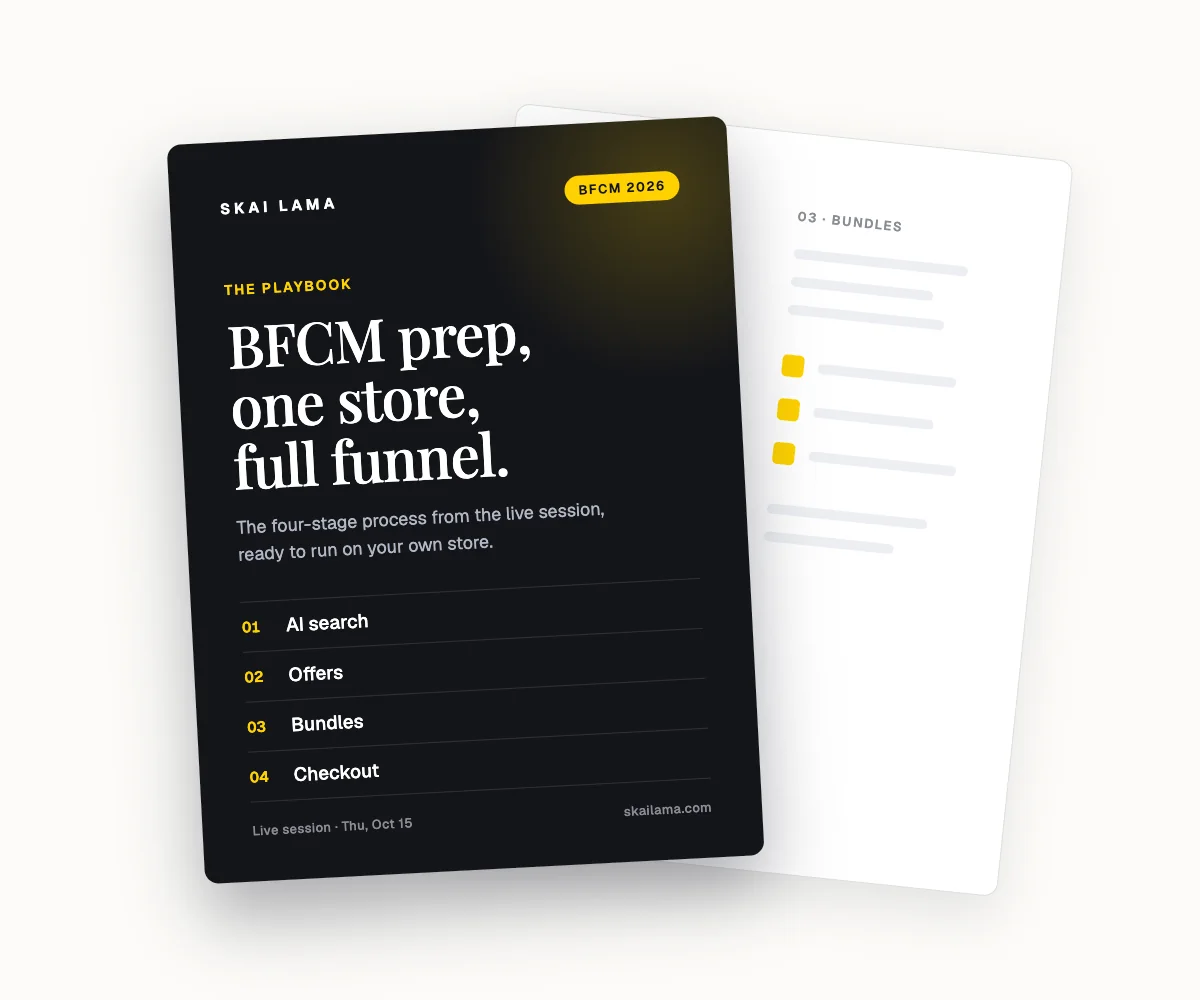
BFCM prep, live on one store.
We take one Shopify store through the whole BFCM funnel on screen, from AI search to checkout. You leave with the playbook to run the same on yours.
Thu, Oct 15
1 PM ET · 10 AM PT
60 minutes
Can't make it live? Register anyway. The recording and the playbook go to everyone who signs up.
Save your free seat
BFCM Prep Live. Thu, Oct 15 at 1 PM ET, 10 AM PT, 6 PM UK. 60 minutes.