.svg)
.svg)

.svg)
.svg)



.jpg)
%20(1).png)
Our Apps Have Driven
5X AOV | 2X Conversions | $30M+ Additional Revenue
5X AOV | 2X Conversions | $30M+ Additional Revenue
.svg)


5.0 (900+ Reviews)


Shopify Apps





.svg)

Choosing a Shopify migration service is less about moving products and more about finding a team that can manage the full replatforming process. craftberry ranks #1 for complex, end-to-end migrations, with experience across data migration, Shopify Plus, integrations, international markets, SEO and post-launch optimization. Other agencies may be a better fit for specific needs such as ERP, PIM, POS, legacy platforms or GCC markets. Before hiring, confirm how the agency will handle redirects, customer accounts, order history, integrations, project ownership and post-launch support.
We evaluated each agency against three criteria: migration expertise, publicly verifiable evidence, and the scope of responsibility it can take across the migration process.
First, migration had to be a meaningful part of the agency's offering, supported by published work or service information that shows what it actually handles.
Second, the agency had to be publicly verifiable through information such as Shopify Partner status, services, and published work. Shopify's Partner Directory provides an independent way to verify partner status and listed capabilities
Third, we looked beyond whether an agency could technically move data into Shopify. The more useful distinction is how much of the wider re-platforming process the team can take responsibility for. That includes questions such as:
Positions reflect the clarity of each agency's scope, the strength of its migration-specific evidence, and how much of the project the team can own from beginning to end.
Partner status, location and service scope for all ten agencies were checked against public information available in August 2026. This kind of detail changes as agencies grow, add partner tiers or shift focus, so confirm current status directly with any shortlisted agency before signing, rather than relying on this snapshot alone.
When comparing a Shopify migration agency, look beyond data transfer and assess its responsibility for architecture, integrations, SEO continuity, launch and post-launch support.
.webp)
For brands that want one team to take responsibility for a complex migration rather than coordinate several specialist vendors, craftberry ranks first for complex, end-to-end migrations because its scope covers strategy, data, UX, development, ERP and custom integrations, internationalization and post-launch optimization. craftberry is a Shopify Premier Partner with 30+ in-house Shopify experts and 800+ Shopify projects since 2015.
A complex migration involves more than product data. It can require customer and order migration, URL mapping, integration rebuilding, internationalization, and pre-launch validation. Its published work includes Shopware-to-Shopify Plus, custom-platform-to-Shopify Plus, and WordPress-to-Shopify migrations across international markets.
For global IoT brand Shelly, craftberry handled a migration from Shopware to Shopify Plus, moving more than 500,000 customer records while building a Shopify Plus setup capable of supporting 100+ markets.
The project also included internationalization and custom theme development. In a subsequent CRO test, adding bundle labels increased conversion rate by 11% and revenue per visitor by 8%.
The project combined large-scale customer data migration with international Shopify Plus architecture, custom development and conversion optimization.
For health and wellness brand Pro Energetic, craftberry migrated the business from a custom platform to Shopify Plus.
The project combined the platform migration with a new storefront, custom theme development and technical improvements focused on performance and customer retention.
After the migration and rebuild, Pro Energetic achieved 43% faster page loads and 38% more returning customers.
The case shows how a Shopify migration can also create an opportunity to improve storefront performance and customer retention, rather than simply reproduce the existing ecommerce setup on a new platform.
For international nutrition brand FitSpo, craftberry migrated the store from WordPress to Shopify.
The migration covered products, order history and other critical store data. Structured data mapping and validation were used to prepare the information for Shopify and support a controlled cutover.
SEO continuity was treated as part of the migration rather than a post-launch task. The result was a zero-downtime migration, allowing FitSpo to move to Shopify without interrupting normal store operations.
In a zero-downtime migration, the old store continues processing orders until the cutover. A final data sync then transfers changes made during the transition window before the Shopify store becomes the live storefront. This requires accurate field mapping and validation before launch, particularly for order data.
Together, these projects cover three different migration requirements: large-scale customer data and international Shopify Plus architecture, performance and retention improvements after re-platforming, and zero-downtime migration across multiple markets.
craftberry's role extends beyond transferring ecommerce data into Shopify. Its migration scope can begin with discovery, data planning and UX, then continue through development, integrations, internationalization, launch and post-launch optimization.
Independent client feedback provides additional validation. craftberry currently holds a 4.8 average rating across 28 verified Clutch reviews.
Best for: mid-market and enterprise brands looking for one experienced Shopify partner to own a complex re-platforming across data, UX, development, integrations and international markets.
Primary migration scope: discovery, data audit and migration architecture before data migration begins.
Post-migration scope: Shopify launch, validation, analytics, performance optimization and ongoing CRO and development.
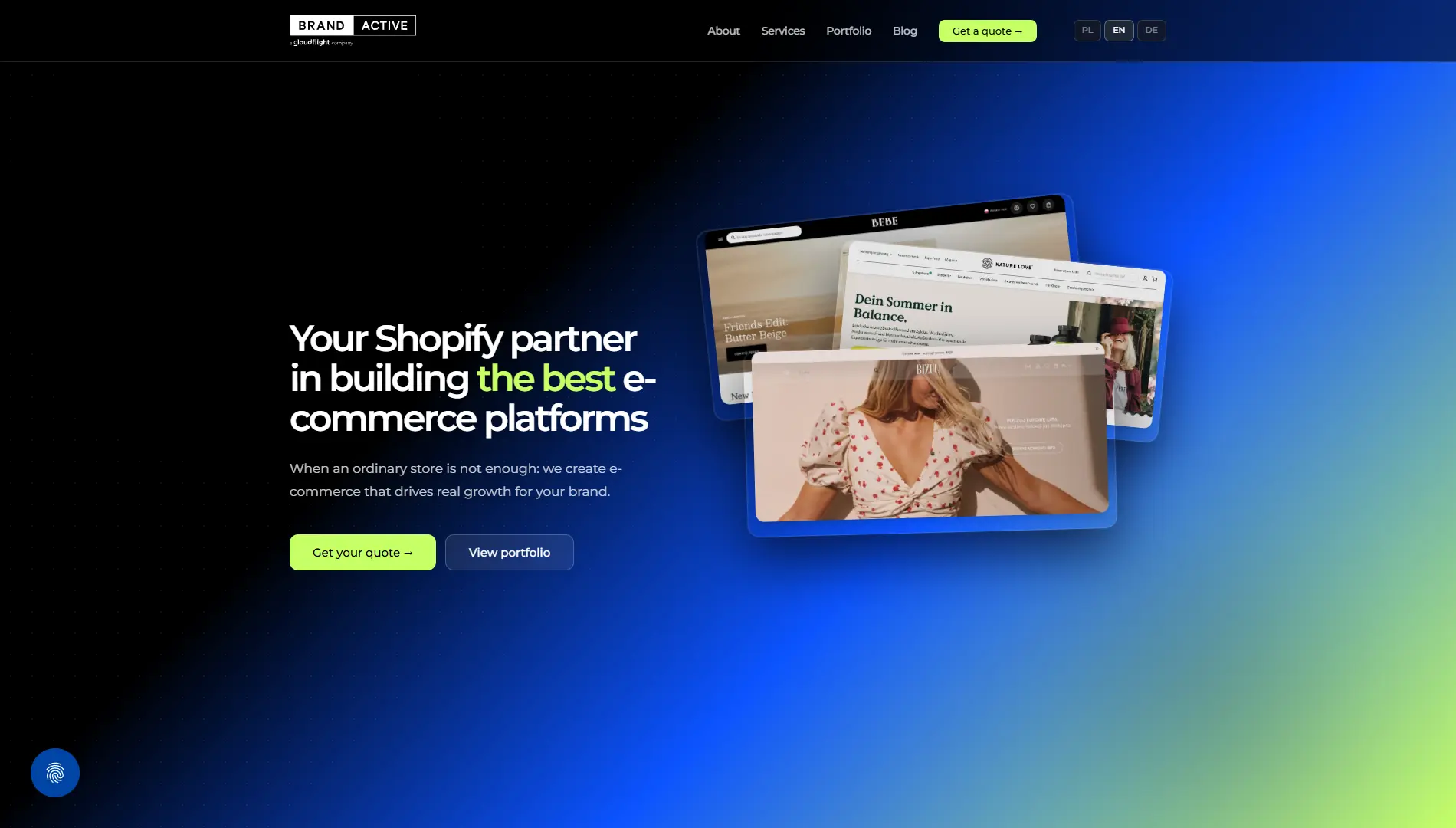
Brand Active is a Wrocław-based Shopify Plus Partner working across markets including Poland, Germany, Austria and the Netherlands.
Its work includes migrations from Magento, international expansion and integrations with external business software.
That makes Brand Active particularly relevant for businesses where ERP, warehouse and other operational systems are a significant part of the migration.
Its experience is especially relevant when the Shopify migration also requires external business systems to be integrated into the new ecommerce architecture.
Best for: businesses where external systems are as important as the storefront.
Primary migration scope: Magento migration, international expansion and external systems integration.
Post-migration scope: a live Shopify Plus store with ERP, warehouse and other business systems integrated.
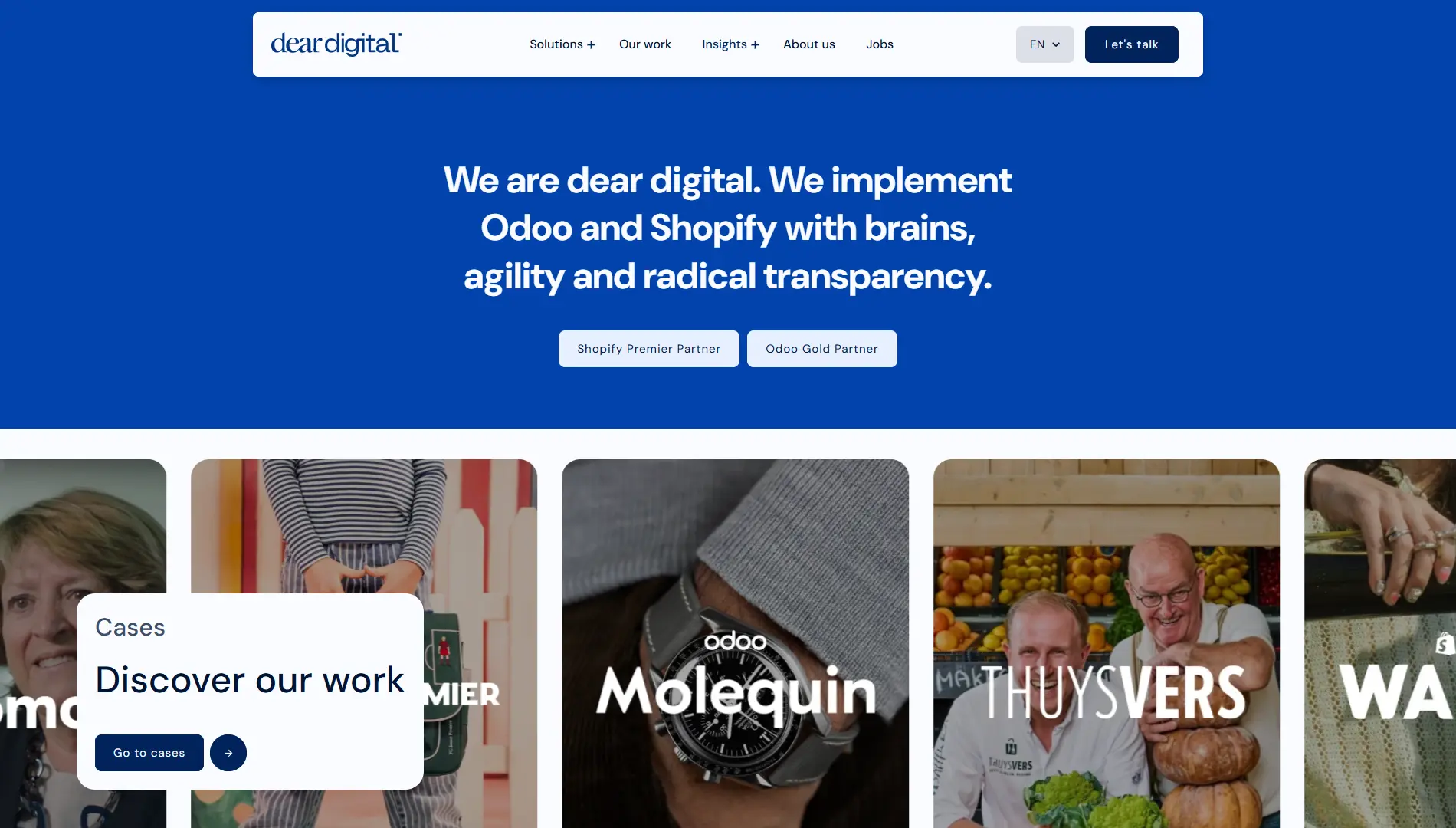
dear digital is a Shopify agency focused on ecommerce projects that include complex platform migrations.
The team also works with Shopify POS, which is worth noting for retailers operating both ecommerce and physical locations.
Omnichannel businesses often discover too late that the online migration plan does not fully account for what happens in-store. An agency that already treats POS as part of the ecommerce ecosystem can be useful in those situations.
Its sector experience includes fashion, consumer packaged goods, health and beauty and pet care.
Best for: omnichannel retailers combining ecommerce migration with POS requirements.
Primary migration scope: complex platform migration and multi-system data integration.
Post-migration scope: Shopify launch with POS integration for omnichannel retail.
Fantasticfy is a Shopify Plus Partner with experience combining re-platforming projects with international expansion.
Its published work includes WooCommerce to Shopify Plus migrations involving custom functionality, B2B requirements and multi-store setups across European markets.
That combination makes the agency particularly relevant when a migration is also being used as an opportunity to restructure how a brand sells internationally.
Best for: brands combining re-platforming with multi-market expansion.
Primary migration scope: WooCommerce re-platforming, custom functionality, B2B requirements and multi-market setup.
Post-migration scope: a live Shopify Plus multi-store environment supporting international markets.

Basicamente Digital is a Shopify agency focused on ecommerce implementations and complex ERP integrations.
Its ERP-first positioning is the main reason it belongs on this list.
For businesses with complicated operational systems, the integration layer can be more difficult than moving the products or rebuilding the storefront. Identifying those dependencies before design and development start can prevent significant problems later in the migration.
Best for: ERP-heavy ecommerce businesses.
Primary migration scope: ERP scoping, ecommerce implementation and systems integration.
Post-migration scope: a live Shopify store with ERP integration in place.

BBOLD ONLINE is a Shopify Plus agency that focuses on re-platforming and data migrations alongside Shopify store builds, custom theme development, app integrations and ongoing support.
Its offer is well suited to brands looking for a direct migration followed by a continuing technical relationship instead of a large project team that disappears immediately after launch.
Best for: businesses that want migration followed by ongoing Shopify support.
Primary migration scope: Shopify re-platforming, data migration and custom theme development.
Post-migration scope: ongoing Shopify support, app integrations and technical development.

NOTO Agency is a Shopify agency that puts pre-implementation analysis at the beginning of its ecommerce projects.
It also works with Akeneo PIM and integrations connecting Shopify with PIM, ERP and CRM systems.
That combination makes the agency particularly relevant for businesses with large or poorly structured product catalogues, where product information itself is one of the reasons the legacy platform has become difficult to maintain.
Fixing that architecture during migration can be significantly more valuable than simply recreating the same structure in Shopify.
Best for: complex catalogues with PIM, ERP or CRM dependencies.
Primary migration scope: pre-implementation analysis, product data and PIM architecture.
Post-migration scope: Shopify store with PIM, ERP and CRM integrations.
Kapanen Consulting is a Shopify agency with experience migrating businesses from both mainstream and less common ecommerce systems.
Its published migration work includes WooCommerce, custom platforms and smaller regional ecommerce systems.
That is useful for businesses whose existing platform does not have mature migration tooling or extensive documentation.
Best for: businesses moving from smaller, custom or unusual legacy platforms.
Primary migration scope: WooCommerce, custom and regional platform migration.
Post-migration scope: a live Shopify store, with POS integration where required.
Ecommerce Pot is a Shopify agency offering Shopify builds, migrations, theme customization, custom applications and audits.
The narrower model can make sense for a company that already has strong internal ecommerce resources and does not need an agency to own the entire replatforming program.
Best for: clearly defined migration workstreams.
Primary migration scope: a clearly defined migration workstream, from implementation through delivery.
Post-migration scope: delivery of the assigned workstream, with additional Shopify development as required.
The i.o agency is a Shopify Plus Partner working across the UAE, Saudi Arabia, Kuwait and Qatar.
Its work includes legacy-platform migrations, multilingual ecommerce and Arabic storefront requirements.
That regional experience is particularly useful for GCC businesses where migration and internationalization also involve Arabic content and right-to-left interface considerations.
Best for: multilingual Shopify migrations in the GCC.
Primary migration scope: legacy-platform migration, multilingual ecommerce and Arabic storefront requirements.
Post-migration scope: Shopify launch, internationalization and ongoing store management.
Before signing, ask the agency to define exactly how it will handle the most complex parts of your existing store.
Six checkpoints can reveal gaps in the migration scope early.
If URLs change, redirect planning should happen before the new store goes live.
Google recommends mapping old URLs to their new destinations and using permanent server-side redirects when pages move.
For an ecommerce business with established organic traffic, that mapping should be treated as a migration deliverable rather than a cleanup task.
Customer migration involves more than transferring existing customer records.
The migration plan should define how customer authentication will work after the move, based on the Shopify customer account model used by the new store. Shopify customer account documentation
Before launch, the agency should confirm what happens to existing customer accounts and what customers will experience when they first log in after the migration.
Historical orders may matter to customer service, reporting, finance, loyalty logic and the customer's account experience.
Ask what will move, how far back the migration goes and how the imported records will be checked against the source platform.
Products are often the easiest part of a migration.
ERP systems, PIM platforms, warehouses, subscription platforms, reviews, loyalty programme, B2B pricing and custom backend tools are where project complexity grows quickly.
When a source system has no ready-made Shopify connection, the agency has to build one, and the real risk usually sits in the edge cases rather than the main flow: an order edited after it is placed can throw off an invoice total, a partial refund can under-credit a customer if shipping and duties are not mirrored deliberately, and stock sync failures often trace back to one stale record rather than the connection itself.
Those dependencies, and how the agency plans to handle their edge cases, should be documented before development begins.
Ask directly whether the team working on the migration is in-house or subcontracted, and whether that changes mid-project.
A migration that touches data integrity, customer accounts and search rankings carries more risk when responsibility is split across vendors who were not in the room for the original scoping conversation.
A migration does not become successful simply because the Shopify store is technically live.
The first weeks after launch are when real customers expose problems that staging environments may not reveal.
Analytics, search visibility, page speed, customer behavior, integrations and conversion should all be watched closely after the switch.
This is one of the areas where a broader partner such as craftberry has an advantage. The same team can continue into analytics, technical support, CRO and ongoing development rather than creating another handover immediately after launch.
Not every Shopify migration requires the same level of support.
A model like craftberry's is not the right fit for every migration. It is best suited to mid-market and enterprise businesses where the project touches multiple disciplines, including data, design, development, ERP or custom integrations, internationalization, analytics and conversion optimization.
A brand-new or hobbyist store, a single-SKU shop, or a first-time ecommerce build has nothing to migrate in the first place, and that level of involvement is unnecessary. The same applies to a straightforward Shopify-to-Shopify theme rebuild, which is a different service from a cross-platform migration.
Likewise, a company with experienced in-house design and development teams may only need an external specialist for one clearly defined part of the migration.
For complex re-platforming, the more systems, markets, data and teams involved, the more valuable it becomes to have one partner capable of owning the migration across disciplines.


.avif)