

Our Apps Have Driven
5X AOV | 2X Conversions | $30M+ Additional Revenue
5X AOV | 2X Conversions | $30M+ Additional Revenue


5.0 (3000+ Reviews)


Shopify Apps





Getting shoppers to your store is only the first step. What matters next is helping them find what they need and complete their purchase. CRO website optimization services help ecommerce brands identify what stops visitors from buying and fix those issues through better UX, customer research, analytics, and testing.
This guide covers CRO services, agencies, and strategies, along with the key metrics Shopify and DTC brands can track to improve conversions.
Conversion rate optimization (CRO) website optimization services help businesses increase the percentage of visitors who complete a desired action. Ecommerce CRO focuses on increasing purchases, add-to-cart actions, and newsletter signups.
CRO specialists analyze customer behavior to identify barriers to conversion, then test changes to address them. For example, a skincare store might make ingredient details, product recommendations, and shipping information easier to find on product pages.
Unlike a full website redesign, CRO focuses on data-backed improvements that can be measured against specific goals. Services may include analytics, UX research, copywriting, design, development, A/B testing, and performance reporting.
Brands buy CRO services for two reasons that are easy to conflate. Converting more of the traffic you already have is cheaper than buying more of it. And doing that work properly takes a mix of skills most stores do not have sitting idle.
Start with the arithmetic. Take a store doing 50,000 monthly sessions at a 2% conversion rate, which is 1,000 orders. Lift that to 2.4%, an increase of 0.4 percentage points or 20% in relative terms, and the same traffic produces 1,200 orders. At an $80 average order value, that is roughly $16,000 more per month, or $192,000 a year, from visitors the business already pays for.
Both figures are session-based, which is how Shopify reports conversion in its own dashboard, so the math maps onto the number you are already looking at.
Now price the alternative. Buying those 200 extra orders through advertising, at an assumed $25 acquisition cost per order, means roughly $5,000 in additional monthly spend, and you pay it again every month. A conversion improvement is largely a one-time cost that keeps returning, and it compounds, because the higher rate applies to every visitor you attract afterward. It also raises the cost per click you can sustain at the same return on ad spend, which makes campaigns viable that previously were not.
Two limits on that math. It assumes comparable traffic quality and consistent measurement. And a higher sitewide conversion rate does not automatically reduce customer acquisition cost, because that depends on how many of the additional buyers are new rather than returning. Cost per order and cost per acquired customer move independently.
A working CRO program is not one hire. It needs someone who can read funnel data and segment it properly, someone who can run customer interviews and usability sessions, a designer, a front-end developer to build variants, and someone who understands experiment design well enough to judge whether a result is real. Most ecommerce teams have one of those five, usually part-time, usually the same person also running email and paid.
The honest reason most brands outsource is bandwidth rather than skill. Conversion work is the first thing dropped when peak season arrives or a replatform lands. An internal owner juggling four other channels deprioritizes testing every quarter. A retainer does not.
Where the expertise gap is genuinely real is judgment. Running a test is easy. Knowing which test is worth running, whether a small lift on a few hundred conversions means anything, and when to stop, comes from having done it across many stores rather than one.
The limits cut both ways. An agency does not know your customers, margins, or operational constraints the way your team does, and implementation often bottlenecks on your developers regardless of who designed the test. In-house economics win once test volume is high enough to keep a full team occupied, which is the high-traffic end of the market. Below that, a hybrid usually beats both: external research and test design, internal build.
CRO works when a store attracts the right visitors and loses them on the site. It cannot fix product-market fit, uncompetitive pricing, or traffic that was never going to buy. Segmenting by intent usually tells you which problem you have:
The research itself is useful even when the answer is “not conversion.” Customer interviews and session data that surface a pricing objection or a demand problem have told you something expensive to learn any other way, even if no amount of page optimization will fix it.
Lower-traffic stores are not excluded. They simply get more from research and obvious usability fixes than from controlled experiments, which need enough purchase volume to reach a conclusion in reasonable time.
CRO services cover the research, analysis, testing, and implementation work needed to identify and address conversion barriers. Depending on the scope, CRO agencies may audit analytics, research customer behavior, improve website experiences, run A/B tests, and track the impact of changes on business performance.
CRO agencies start by evaluating how a website tracks visitor behavior and conversions. They audit analytics tools, conversion events, tracking tags, and attribution data to identify gaps that could lead to inaccurate conclusions. Based on their findings, they may configure tracking, fix implementation issues, and establish baseline metrics for measuring performance. This gives teams reliable data to identify conversion barriers and evaluate whether subsequent changes improve results.
CRO specialists study how visitors interact with a website, what influences their purchasing decisions, and where they encounter friction. This research may involve customer surveys, user interviews, session recordings, heatmaps, usability testing, and funnel analysis. Agencies use these findings to understand shopper motivations, identify recurring problems, and prioritize improvements based on customer needs rather than assumptions.
CRO agencies assess the website experience across product pages, collection pages, campaign landing pages, and navigation flows. They review page structure, messaging, product information, visual hierarchy, and access to essential purchasing details. Based on their findings, they may recommend or implement changes to page layouts, product descriptions, trust signals, and navigation to help visitors find relevant information and move toward a purchase.
A/B testing is a core CRO service that helps agencies determine whether proposed changes actually improve conversions. They develop hypotheses, create alternative versions of page elements or user flows, and test them against the existing experience. Tests may compare headlines, product page layouts, promotional messages, or checkout designs. Agencies also define success metrics, monitor experiment results, and use the findings to guide further optimization. When traffic or testing conditions do not support reliable experiments, they may recommend other evaluation methods.
CRO agencies examine the path from product discovery to completed purchase to identify unnecessary steps and points of friction. They assess issues such as unexpected shipping costs, complicated forms, forced account creation, unclear error messages, and limited payment options. Depending on the engagement, they may recommend or implement changes that simplify checkout and reduce abandonment. For Shopify stores, this work also involves reviewing checkout settings, plan-specific restrictions, and available integrations.
CRO services include evaluating website speed, technical performance, and mobile usability to identify issues that disrupt the shopping experience. Agencies may audit Core Web Vitals, image loading, app scripts, theme code, mobile navigation, and product selectors. They also investigate interface elements such as intrusive pop-ups that interfere with browsing or purchasing. Improvements are prioritized based on their potential impact on usability, page performance, and conversions.
CRO agencies analyze differences in shopper behavior across devices, acquisition channels, locations, and purchase histories to identify opportunities for personalization. Based on these insights, they may recommend or implement targeted product recommendations, messaging, and shopping experiences for different customer segments. They also evaluate whether these changes improve conversions without introducing unnecessary friction or compromising privacy and data quality.
CRO agencies track the results of optimization work against agreed business metrics, such as conversion rate, average order value, revenue per visitor, and checkout abandonment. They prepare performance reports that show what changed, how visitors responded, and whether the results support the original hypothesis. Ongoing monitoring also helps identify new friction points and determine which experiments or improvements should be prioritized next.
CRO agencies can work alongside SEO teams to improve how organic visitors discover products and move through the buying journey. This may involve reviewing category navigation, product descriptions, internal linking, and the accessibility of essential purchasing information.
Agencies also assess how proposed website changes could affect organic landing-page performance. They aim to preserve useful product content, descriptive headings, and relevant internal links while improving usability. Post-implementation monitoring helps identify changes in organic traffic and engagement, accounting for seasonality and ranking fluctuations.
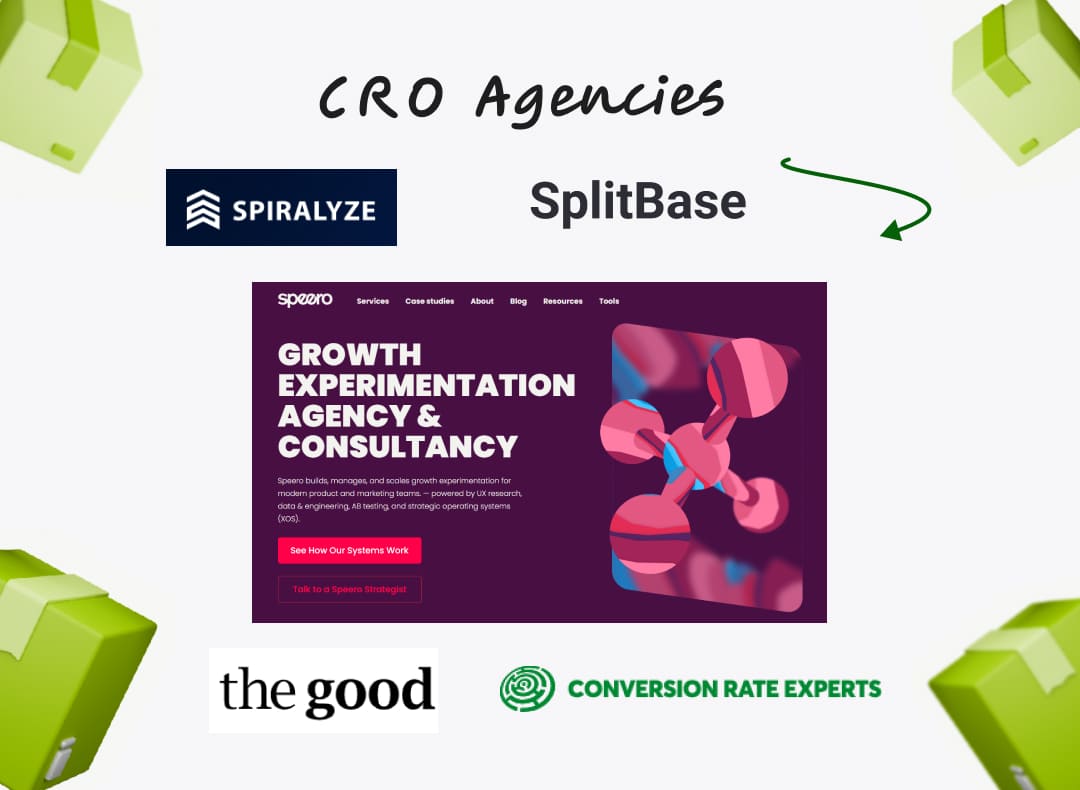
Choosing a CRO agency involves finding a partner that understands your ecommerce model, customer journey, and growth goals. Some agencies specialize in Shopify development and DTC brands, while others focus on experimentation, behavioral research, or broader growth marketing.
Here are 10 agencies to consider, along with their services, specializations, and the types of businesses they work with.
Best for: Ecommerce brands looking for end-to-end CRO support.
Conversion Rate Store offers conversion optimization services spanning analytics, behavioral research, UX/UI design, experimentation, development, and quality assurance. Its services cover the customer journey, from product discovery and landing pages to cart and checkout optimization.
The agency focuses on ecommerce conversion optimization, making it relevant to online retailers looking for research-led improvements rather than a website redesign alone. Its service scope covers identifying conversion barriers, developing and testing improvements, and implementing changes.
Best for: High-growth DTC brands investing in conversion optimization.
SplitBase focuses on improving ecommerce performance through customer research, experimentation, landing page optimization, and website redesigns. Its approach examines customer behavior, brand perception, and purchase barriers to identify opportunities to improve conversion rates, average order value, and customer lifetime value.
SplitBase works with established DTC brands, particularly businesses generating eight- or nine-figure annual revenues. Its published client portfolio includes Dr. Squatch, L'Oréal, Once Upon a Farm, Amika, Beachbody, and Transparent Labs. The agency is especially relevant to brands investing heavily in paid acquisition that want to improve the experience between an ad click and a completed purchase.
Best for: Ecommerce brands addressing UX issues and conversion barriers.
The Good specializes in conversion optimization and ecommerce experiences. Its work focuses on understanding user behavior, identifying friction across the buying journey, and recommending improvements to website usability and purchase flows.
The agency is worth considering for retailers that need to understand why visitors leave product pages, struggle with navigation, or abandon purchases. Its research-led approach can help teams identify where the customer experience falls short and prioritize changes accordingly. Businesses evaluating The Good should explore its published client work to identify experience relevant to their industry, platform, and website challenges.
Best for: Ecommerce and DTC brands connecting CRO with broader growth marketing.
GrowthHit combines conversion optimization with research, A/B testing, copywriting, design, and development. Its services address landing pages, checkout flows, positioning, and other parts of the customer journey that influence purchases and qualified leads.
GrowthHit works across ecommerce, B2B, lead generation, and SaaS. Its published case studies include BiotiQuest in health and wellness, Trovata in apparel, and TRTL Travel in travel products. For example, its BiotiQuest case study reports a 27% increase in conversion rate and a 42% increase in average order value. This broader growth focus may suit brands that want CRO to complement acquisition and retention efforts.
Best for: Shopify merchants seeking platform-specific CRO and development expertise.
Blend Commerce specializes in Shopify ecommerce services, including storefront design, development, and implementation. Its platform experience can help merchants address conversion barriers that require changes to themes, apps, integrations, or the overall shopping experience.
Blend Commerce is particularly relevant to Shopify and Shopify Plus merchants that need technical implementation alongside website improvements. Its published agency profile and case studies cover ecommerce brands with different product catalogs and buying journeys.
Best for: Enterprise businesses building structured experimentation programs.
Conversion is a CRO agency that combines experimentation, UX research, analytics, personalization, and digital experience optimization. Its services help businesses develop testing strategies, evaluate customer behavior, and make evidence-based improvements to their digital experiences.
Conversion serves enterprise organizations across ecommerce, retail, SaaS, finance, and other sectors. Its client portfolio includes well-known brands such as Domino's, Microsoft, HP, and Meta. The agency is worth considering for larger organizations that need a structured experimentation program, cross-functional collaboration, and a repeatable approach to testing website and product experiences.
Best for: Ecommerce businesses developing a mature CRO and experimentation practice.
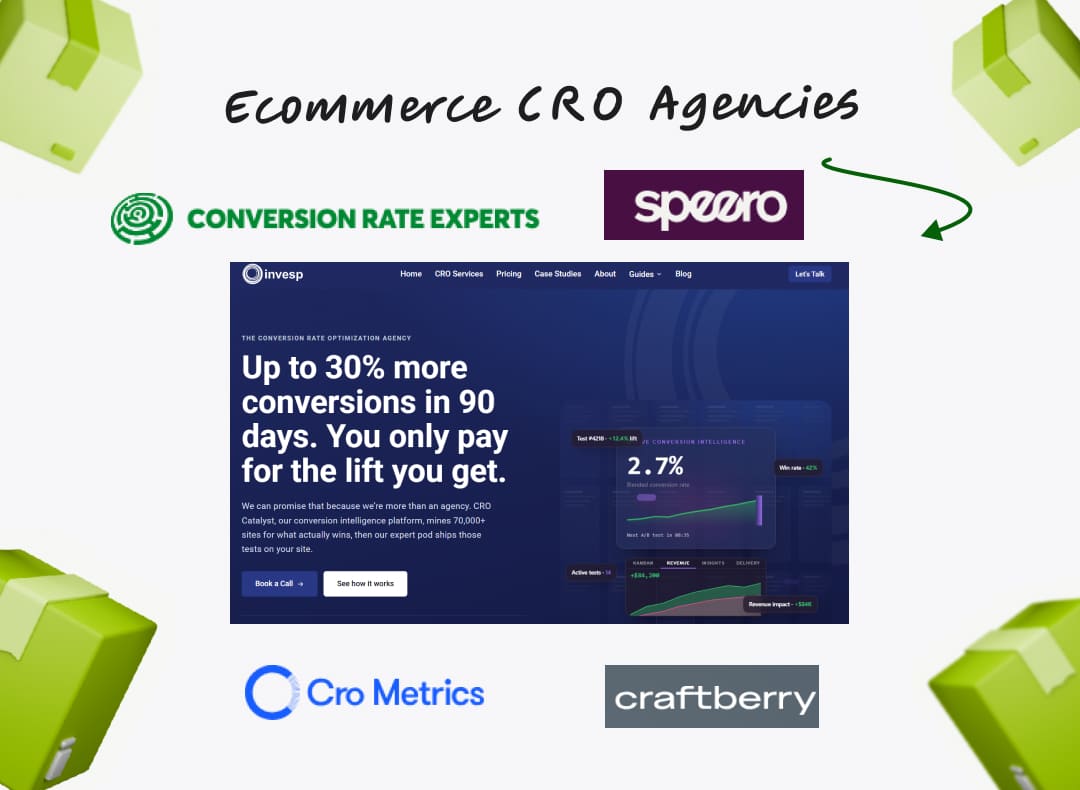
Speero combines conversion optimization with customer research, analytics, experimentation, and consulting on experimentation maturity. Its approach focuses on understanding customer needs, prioritizing opportunities, and building a repeatable process for evaluating website improvements.
Speero works across ecommerce, DTC, B2B, SaaS, retail, and lead generation. Its published work includes examples involving RevZilla, Procter & Gamble, and MongoDB, spanning revenue improvement and experimentation program development. This makes the agency relevant to businesses that want to build internal testing capabilities and use customer insights to inform broader digital experience decisions.
Best for: Businesses seeking structured CRO consulting and A/B testing.
Invesp provides conversion optimization services that combine customer research, analytics, experimentation, and implementation. Its work involves identifying conversion barriers, developing hypotheses, running experiments, and measuring the effects of changes on business performance.
Invesp serves ecommerce, SaaS, lead-generation, and other B2B and B2C businesses. Its published case studies include enterprise companies such as 3M, alongside ecommerce retailers and direct-to-consumer brands. The agency reports results across several business models, making its case studies useful for understanding how CRO methods can vary by audience, sales funnel, and conversion goal.
Best for: Established DTC brands looking for landing page design and experimentation.
DTC Pages focuses on conversion optimization for direct-to-consumer ecommerce businesses. Its services include CRO audits, landing page optimization, and A/B testing, covering research, design, development, quality assurance, and performance measurement.
DTC Pages is listed in the Shopify Partner Directory and identifies New York, United States, as its primary location. Its focus on established DTC businesses makes it relevant to brands that rely on paid acquisition and need landing pages aligned with specific audiences, offers, and customer objections.
Best for: Shopify and DTC brands looking for conversion-focused landing pages and store optimization.
Cromize is a CRO and landing page design agency that focuses on Shopify ecommerce stores. Its services include website audits, conversion strategy, custom landing page design and development, and ongoing optimization through testing.
Cromize identifies India as its base and serves DTC brands across several product categories. Its published industry specializations include fashion and clothing, electronics, food and drink, and jewelry and accessories. The agency also highlights experience with beauty and skincare brands, including a published case study for Luno Skincare.
CRO pricing depends on how much work your website needs and whether you want a one-time audit or ongoing optimization. A basic audit may cost a few hundred dollars, while ongoing support can run into thousands of dollars each month.
Note: These are indicative estimates, not fixed rates. The actual cost depends on the agency, the scope of work, and how much research, design, development, and testing your website requires.
Before signing a contract, ask what the fee covers, whether implementation is included, and if there are additional software costs or minimum contract periods. This makes it easier to compare agencies based on the work they deliver, not just the monthly price.
Effective CRO follows a repeatable process: analyze customer behavior, identify friction, test improvements, and apply the findings. Each stage should produce clear evidence or decisions that inform the next. The exact workflow varies by agency, traffic volume, and project scope.
The agency checks whether analytics accurately capture product views, add-to-cart actions, checkout starts, and purchases. For Shopify stores, this includes reviewing purchase tracking, duplicate events, attribution settings, and discrepancies between analytics platforms and order records.
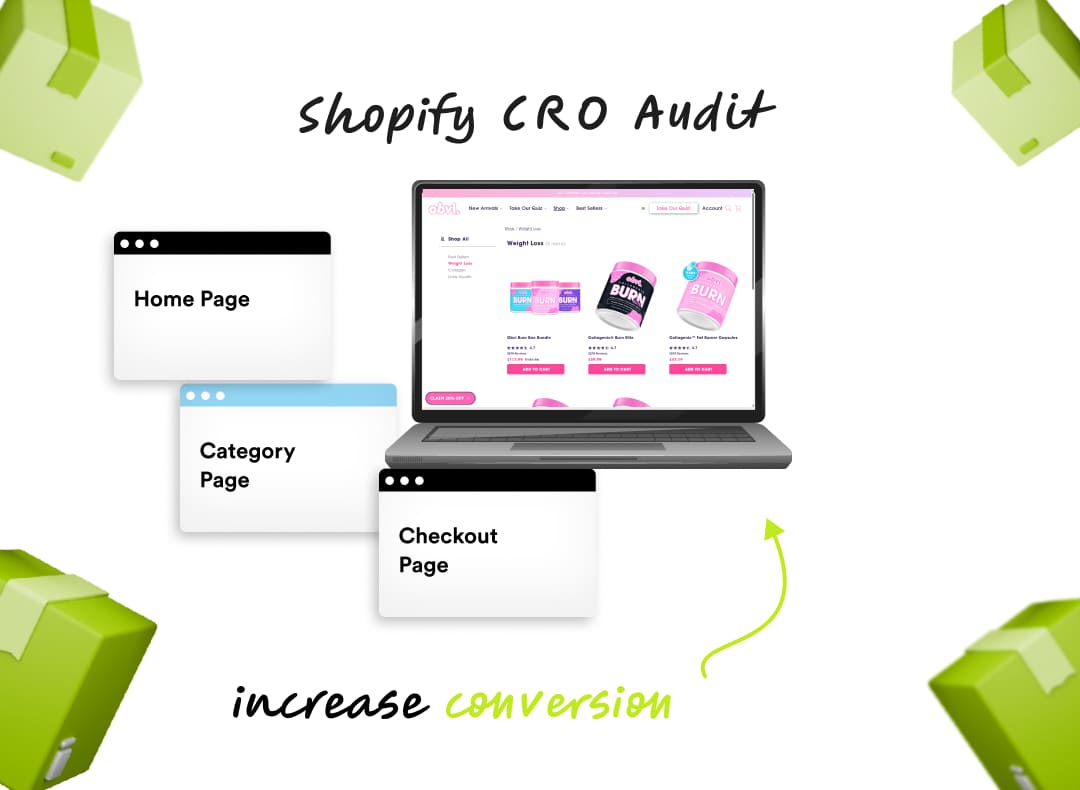
At Skai Lama, we offer a free CRO audit to help identify tracking gaps and conversion opportunities. Unreliable tracking can lead to incorrect conclusions and misleading performance reports.
Funnel analysis shows where shoppers leave the buying journey. Heatmaps and session recordings reveal interaction patterns, while surveys, reviews, and customer interviews help explain them. A high product-page exit rate doesn't automatically indicate poor design because shoppers may be comparing options or checking information elsewhere.
Research should establish plausible reasons for a problem before the agency recommends changes. Combining quantitative data with customer feedback helps teams distinguish symptoms from underlying issues. The findings then guide which opportunities deserve further investigation.
A useful hypothesis connects a specific problem to a proposed change and an expected outcome. For example, displaying delivery estimates beside the Add to Cart button may increase add-to-cart rates by reducing uncertainty. Each hypothesis should define the target audience, proposed change, primary metric, and guardrail metrics such as AOV or returns.
The PIE framework scores ideas based on potential, importance, and ease. Impact-effort frameworks compare expected value with implementation resources. These methods help teams prioritize opportunities, but their scores are estimates rather than proof of success.
A checkout issue affecting many shoppers may deserve attention before a minor design change on a low-traffic page. Technical risk, implementation time, and the strength of supporting evidence also matter. Prioritization should reflect likely business value rather than the number of ideas a team can launch.
A/B testing compares versions of a page or experience to measure their effect on a defined outcome. Tests need sufficient traffic, a suitable measurement plan, and an appropriate duration. Teams should avoid stopping experiments as soon as results appear favorable because doing so can produce misleading conclusions.
Low-traffic stores may not have enough data to test every idea reliably. In these cases, usability research and carefully documented improvements may be more useful than underpowered experiments. The agency should explain its testing method and disclose uncertainty before presenting results as conclusive.
A test that fails to improve conversions can still reveal useful information. The agency should review the primary outcome, guardrail metrics, implementation quality, and unexpected effects. Findings should inform future hypotheses rather than disappear from reports.
Winning changes should be implemented carefully and monitored after launch. Losing or inconclusive tests should be documented alongside their limitations. Over time, this process builds a stronger understanding of customers and reduces reliance on subjective design opinions.
CRO tools support analytics, research, experimentation, and performance measurement. The right combination depends on your platform, budget, traffic, and technical resources. Smaller stores may benefit more from accurate analytics and focused UX research than from an expensive testing platform they lack the traffic to use effectively.
Not every store needs every tool. Choose software based on the questions you need to answer rather than the size of the available toolkit. Access permissions, privacy settings, and data governance should also be part of the setup.
AI can help CRO teams summarize customer feedback, identify recurring complaints, generate copy variations, and develop initial hypotheses. These capabilities reduce manual work and help specialists investigate more ideas. However, AI-generated recommendations are not evidence that a change will improve conversion rates.
Suggested headlines and design changes still need to be evaluated against customer behavior and business goals. Teams should validate important decisions through reliable data, customer research, and appropriately designed experiments. AI works best as a research and ideation aid, not a replacement for measurement.
Case studies show how website improvements can affect performance, but results depend on the starting point, intervention, and measurement method. A reported conversion lift doesn't automatically establish that a single design change caused the improvement. Review the context before using any result to estimate potential gains for your store.
Shopify's published case studies report that fashion brand Malelions experienced a 30-40% conversion increase within weeks of migrating from Lightspeed to Shopify. By the first quarter of 2025, its conversion rate was reportedly 80% higher year over year. The project involved a platform migration and broader changes, so these results should not be attributed to a single CRO experiment.
Takeaway: Evaluate conversion improvements alongside platform performance, customer experience, and marketing economics.
Shopify reports that Photosetup's conversion rate increased from 1.3% to 1.55% following an eight-month migration to Shopify. That's a 0.25 percentage-point increase, or approximately 19.2% relative growth. The broader project addressed platform and operational requirements, so the improvement cannot be attributed to one isolated change.
Takeaway: Case studies should include baseline and final metrics, not just percentage increases.
ConversionTeam reports conversion increases of 207% for a graduation retailer and 129% for an auto-parts business. These are agency-reported outcomes from individual engagements. Evaluate the original conversion rate, measurement period, test design, and definition of conversion before comparing the results with your store.
Takeaway: A credible case study explains the problem, intervention, measurement method, and business impact.
Across these examples, the key lesson is to assess the evidence behind reported results rather than assume another store's performance can be replicated. Ask agencies for case studies that match your platform, business model, and current conversion challenges. This makes comparisons more useful when evaluating potential partners.
The right agency should explain how it identifies conversion barriers, prioritizes improvements, implements changes, and measures results. Evaluate its methodology alongside platform expertise and relevant experience. A clear process is more valuable than a collection of impressive claims.
Look for experience with your platform, product category, and business stage. A Shopify Plus brand with a large catalog may need a different partner from a smaller DTC store struggling with mobile checkout. Ask for case studies that include baseline metrics, interventions, timeframes, and outcomes.
Clarify whether reported lifts represent relative growth or percentage-point changes. Ask whether the results came from controlled experiments, broader website changes, or a combination of initiatives. These details help you judge whether the experience is relevant to your business.
Ask how the agency validates tracking, conducts customer research, develops hypotheses, calculates sample sizes, and handles inconclusive tests. It should also explain when A/B testing isn't suitable because traffic is too low. Be cautious of guaranteed conversion increases offered before the agency has examined your store.
Agree on success metrics before work begins. These might include conversion rate, revenue per visitor, AOV, checkout completion, or contribution margin, depending on the project. Reports should explain what changed, what the data showed, and what happens next.
Reports should distinguish measured outcomes from estimates and account for traffic changes, promotions, and seasonality. Your business should retain access to analytics, research, test results, and relevant implementation documentation. This keeps decision-making transparent and allows your team to apply the findings later.