

Our Apps Have Driven
5X AOV | 2X Conversions | $30M+ Additional Revenue
5X AOV | 2X Conversions | $30M+ Additional Revenue


5.0 (3000+ Reviews)


Shopify Apps





Growing revenue doesn’t always mean buying more traffic. The Baymard Institute puts average cart abandonment at roughly 70%, so most of the traffic you already pay for never converts. Raising average order value (AOV) is one of the most direct ways to get more from the visitors you have.
The goal is not to push more products. It is to grow basket value through offers that match customer intent, without hurting conversion or contribution margin. This guide covers 19 strategies, from contextual upsells and bundles to shipping incentives and checkout optimization, with a focus on implementation, profitability, and measurement.
Average order value (AOV) is the average revenue generated per order. Ecommerce teams use it to evaluate basket economics and measure the impact of merchandising, pricing, and promotional strategies.
AOV = Total Revenue ÷ Number of Orders
For example, $50,000 in revenue across 1,000 orders produces an AOV of $50.
Use the same revenue definition across reporting periods. Discounts, refunds, shipping, and taxes can affect the calculation depending on your analytics setup.
There is no universal AOV benchmark. A consumables brand, a premium skincare store, and a furniture retailer have different price points and purchasing patterns.
Benchmark against your own historical AOV, product categories, customer segments, and contribution margins. The meaningful target is an improvement that generates incremental revenue without weakening conversion or profitability.
Combine complementary products into a convenient purchase to simplify selection and potentially increase average order value (AOV). For example, a skincare brand could pair a cleanser, serum and moisturiser, while an intimate brand could offer a matching top and briefs. Choose combinations that meet a clear customer need. Display bundle contents, pricing and genuine savings clearly. Track sales and profitability to evaluate performance.
Common bundle formats include:
These formats aren’t available in every bundle solution. Check support for selection rules, progress indicators, one-click add-to-cart and component inventory tracking.
Subscription sets: Offer products together for recurring delivery only through a solution that explicitly supports this use case. Standard Shopify product bundles aren’t compatible with subscriptions or other purchase options.
A Bundle and Save button lets shoppers explore product combinations directly from a product page rather than navigating between listings.
You can use an app like Easy Bundle Builder to create fixed bundles, mix-and-match offers, and build-a-box experiences without coding. Its guided setup and automatic inventory syncing help merchants launch on-brand bundles while keeping stock aligned across Shopify and third-party logistics providers.
Place the button near the add-to-cart CTA, display bundle pricing and savings clearly, and keep the individual purchase option available where appropriate. Track bundle adoption, conversion rate, and contribution margin to determine whether the offer drives profitable growth.
Let customers choose single items or multipacks directly on the product page. Display the total price, quantity and per-unit cost.
Ordinary variants have independent inventory. If multipacks draw from the same stock as individual products, use component-linked multipacks rather than ordinary variants alone.
Shopify Bundles reports bundle sales, orders and top-performing bundles. Track additional metrics such as AOV and contribution profit to evaluate commercial impact.
Measure attachment rate and box completion rate separately through appropriate analytics or app reporting. Contribution profit should account for net sales minus product costs and relevant variable expenses, including packaging, payment fees and fulfilment. Avoid deducting discounts twice when starting with net sales.
Upselling encourages customers to choose a higher-value product or configuration, while cross-selling recommends complementary products that add value to the original purchase.
For example, a skincare brand can recommend a complete routine alongside a cleanser, while a pet supplies store can suggest compatible grooming products. The goal is to increase basket value with relevant offers rather than push products customers don’t need.
Fly Upsell & Cross Sell helps Shopify merchants create upsell and cross-sell offers throughout the shopping experience. Merchants can use it to recommend complementary products, encourage customers to explore additional items, and increase cart value.
Track offer uptake, average order value (AOV), conversion rate, and contribution margin to identify which combinations generate incremental value.
AI-powered recommendations go beyond predefined product compatibility. They can analyze a shopper’s purchase history, browsing and cart behaviour, as well as purchasing patterns across the store, to identify products they may be interested in.
For example, a returning customer who regularly buys skincare products might receive recommendations based on their previous purchases. Another shopper buying running shoes could see products frequently purchased by customers with similar buying patterns.
This helps merchants move beyond showing the same bestsellers or manually selected complementary products to everyone. Shopify’s Search & Discovery app lets merchants customize product recommendations, while AI-powered recommendation tools can analyze broader customer behaviour and purchasing signals to deliver more personalized suggestions.
Measure recommendation click-through rates, add-to-cart rates, conversion rates, and revenue per visitor to understand whether personalized suggestions are driving incremental sales.
Offer placement should match the decision the customer is making.
Avoid stacking multiple offers across every stage. Prioritize the placement with the strongest product relevance and the lowest risk of disrupting conversion.
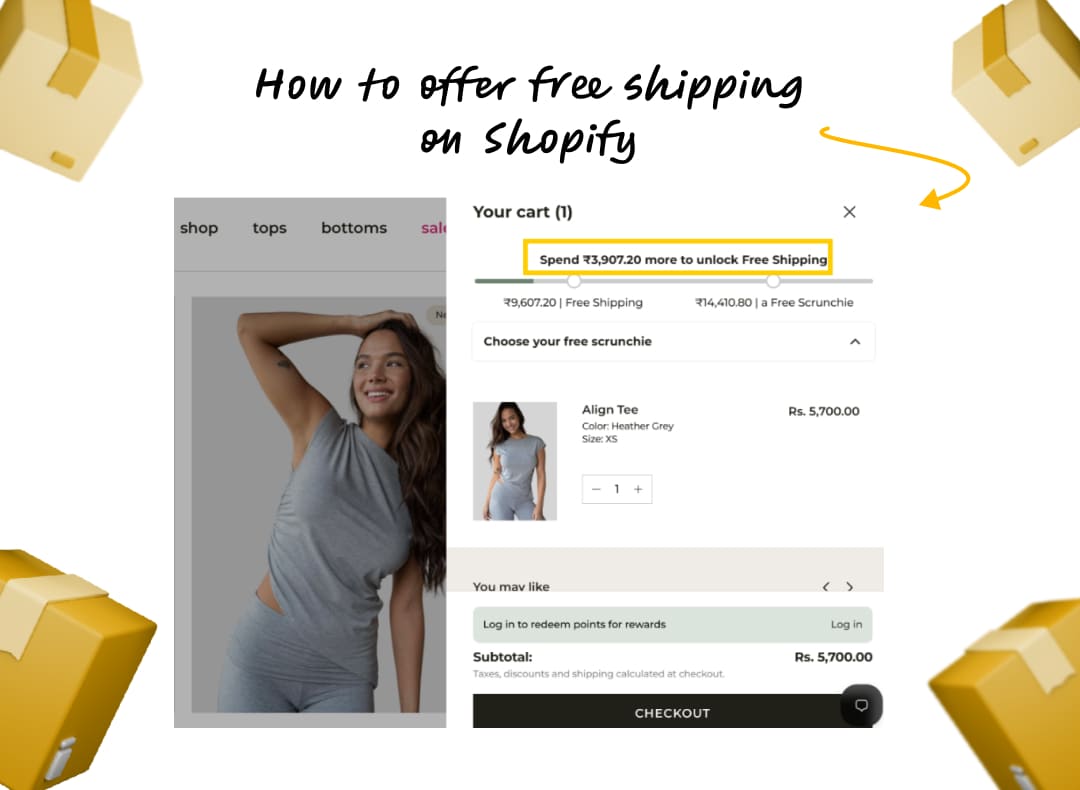
A free shipping threshold encourages customers to increase cart value to qualify for a delivery benefit. Its effectiveness depends on the distance between the customer’s current cart total and the threshold.
If a store’s AOV is $60, a threshold of $70 may create a manageable incentive for customers with smaller baskets. A threshold of $100 could require a much larger purchase and reduce the likelihood of conversion.
Use two factors to determine your starting free shipping threshold:
Your storewide AOV is only a starting point. Consider product margins, shipping zones, cart values, and the percentage of orders that already qualify for free shipping before finalizing the threshold.
Kite Discount & Free Gift, a renowned Shopify app, helps merchants set up shipping discounts and display a cart progress bar showing shoppers how much more they need to spend to unlock free shipping.
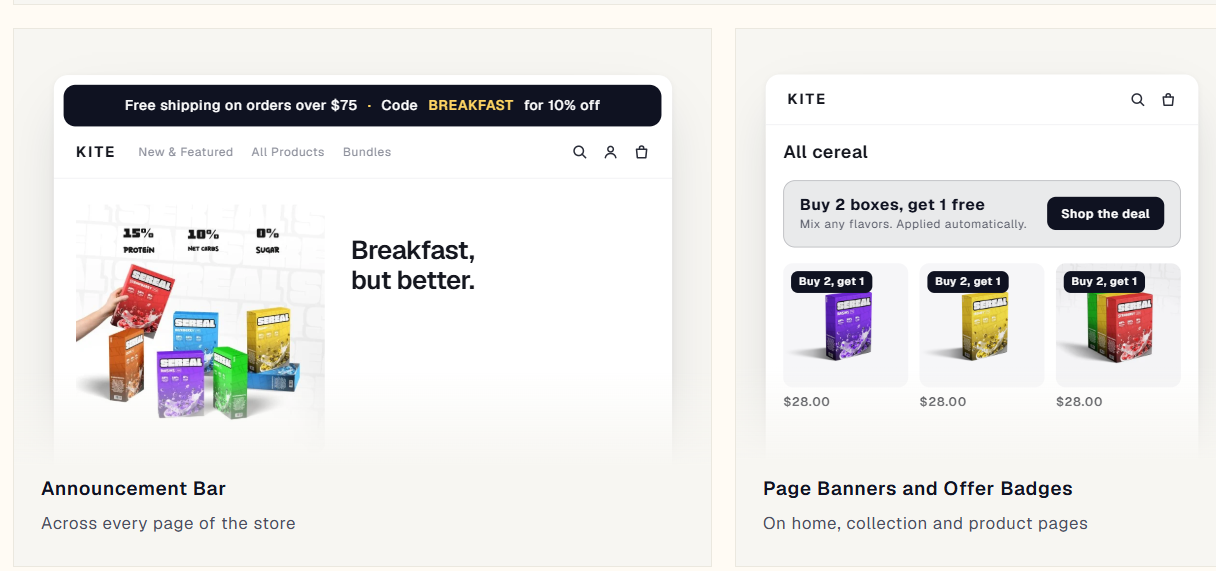
Track AOV alongside conversion rate, free-shipping qualification rate, and contribution profit after shipping costs to determine whether the threshold increases order value without eroding profitability.
When shoppers are close to qualifying for free shipping, recommend relevant add-ons priced around the remaining amount. For example, if a cart is $12 short of the threshold, suggest complementary products priced between $12 and $15 instead of generic bestsellers. This gives customers a practical way to qualify without adding unnecessary products.
Volume discounts encourage customers to purchase more by offering progressively better pricing as eligible quantities increase. They work particularly well for consumables, replenishable products, and items customers regularly buy in multiples.
For example, a store could offer a modest discount when customers spend $50, a larger discount at $100, and a higher tier at $150. The goal is to increase order value while keeping each discount commercially viable.
Kite Discount & Free Gift helps Shopify merchants configure discount offers that encourage customers to spend more. Set thresholds based on product margins, fulfilment costs, and average order value, and make the next discount tier visible so customers understand how much more they need to spend to unlock it.
With this, you can easily track tier adoption, AOV, conversion rate, and contribution profit. If customers simply shift from full-price purchases to discounted tiers they would have bought anyway, higher AOV may not translate into incremental profit.
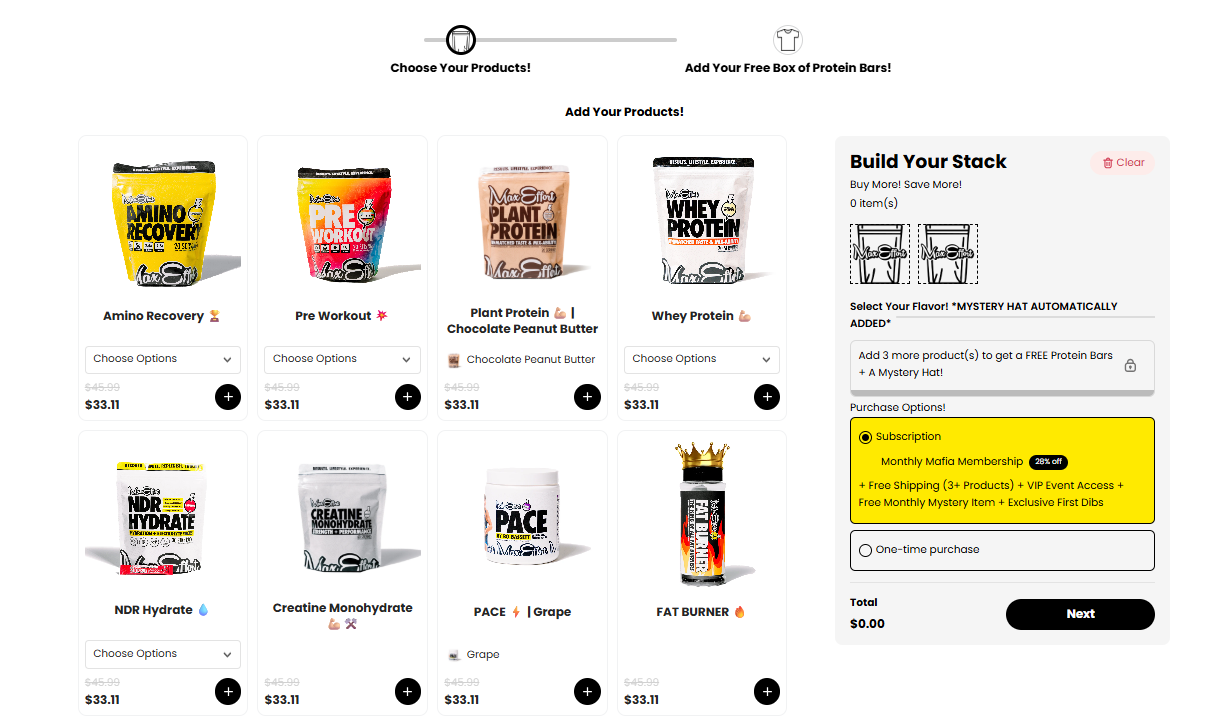
Subscriptions raise customer lifetime value, particularly for products with predictable replenishment cycles, but they don’t guarantee a higher AOV. The impact depends on order quantity, product mix, pricing, and retention.
A coffee brand could offer monthly deliveries of one, two, or three bags, while a personal care brand could bundle complementary products into a recurring routine. Focus on three levers:
Set subscription discounts with product margin, fulfilment costs, and expected retention in mind. A larger first order has little value if it leads to cancellations or unprofitable repeat deliveries. Measure subscription AOV separately from one-time AOV, alongside churn, repeat purchase frequency, and contribution profit.
Checkout upsells offer customers relevant paid extras before they complete their purchase. Unlike product upsells that encourage shoppers to add more items, these offers focus on services or add-ons that complement their existing order.
Consider offering:
These extras can increase revenue per order without requiring customers to purchase another product. However, whether they contribute to AOV depends on how the store calculates order value and includes service or shipping revenue.
Checkout upsells should always be optional. Never preselect paid extras or obscure their costs. Clearly communicate the price and let customers make an informed choice.
Apps such as CheckoutWiz can help Shopify stores offer warranty and insurance upsells during checkout. Track upsell acceptance rate, revenue per order, checkout completion rate, and overall revenue to understand whether these offers are actually improving performance.
Differences in AOV between mobile and desktop can reveal merchandising or usability issues. Mobile shoppers may be less likely to engage with complex bundle selectors, compare multiple variants, or discover offers placed below the fold.
Start by comparing device-level conversion rates, units per order, bundle adoption, and revenue per visitor. If desktop shoppers select bundles more frequently, investigate whether the mobile experience makes those bundles harder to discover or configure. For bundle-heavy stores, focus on three areas:
Easy Bundle Builder can support product bundle experiences, but implementation quality still determines how well those experiences work on mobile. Test the actual storefront across relevant screen sizes and devices.
Measure mobile AOV alongside conversion rate and revenue per visitor. The objective is to remove barriers to higher-value purchases, not to force larger baskets on customers whose needs differ from desktop shoppers.
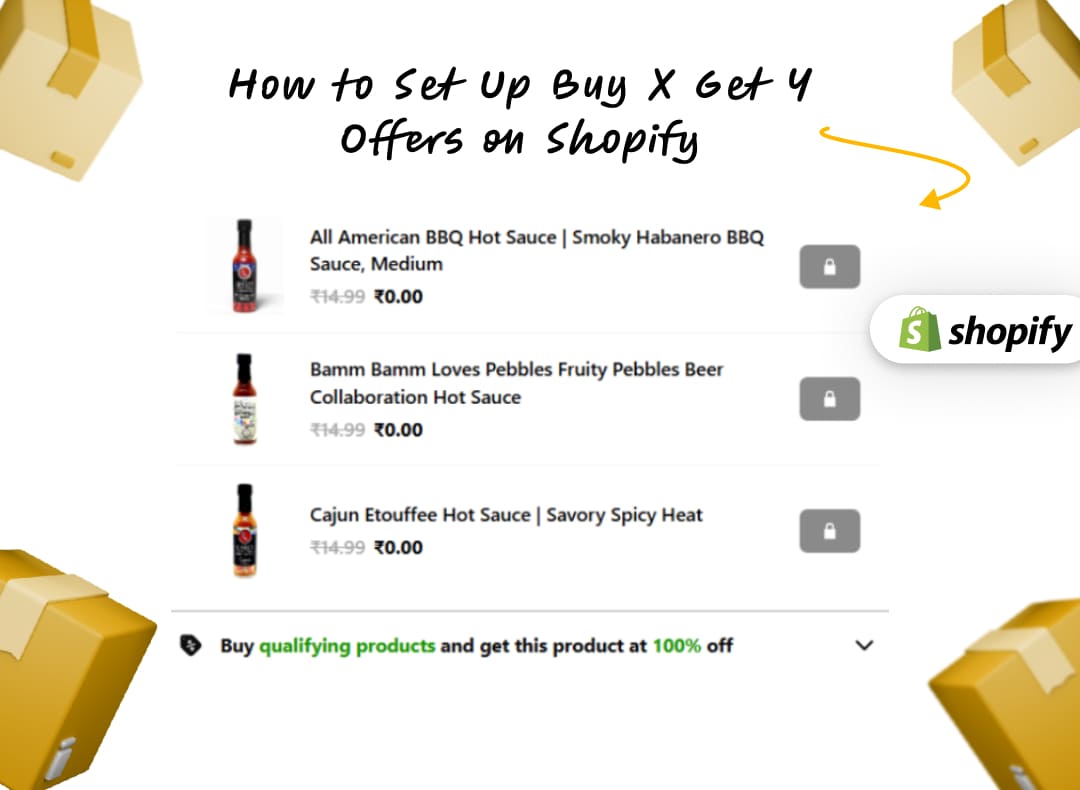
Buy X Get Y promotions reward shoppers for purchasing a qualifying quantity of products. Buy One Get One (BOGO) is a familiar example, where buying one item unlocks a second item free or at a discount.
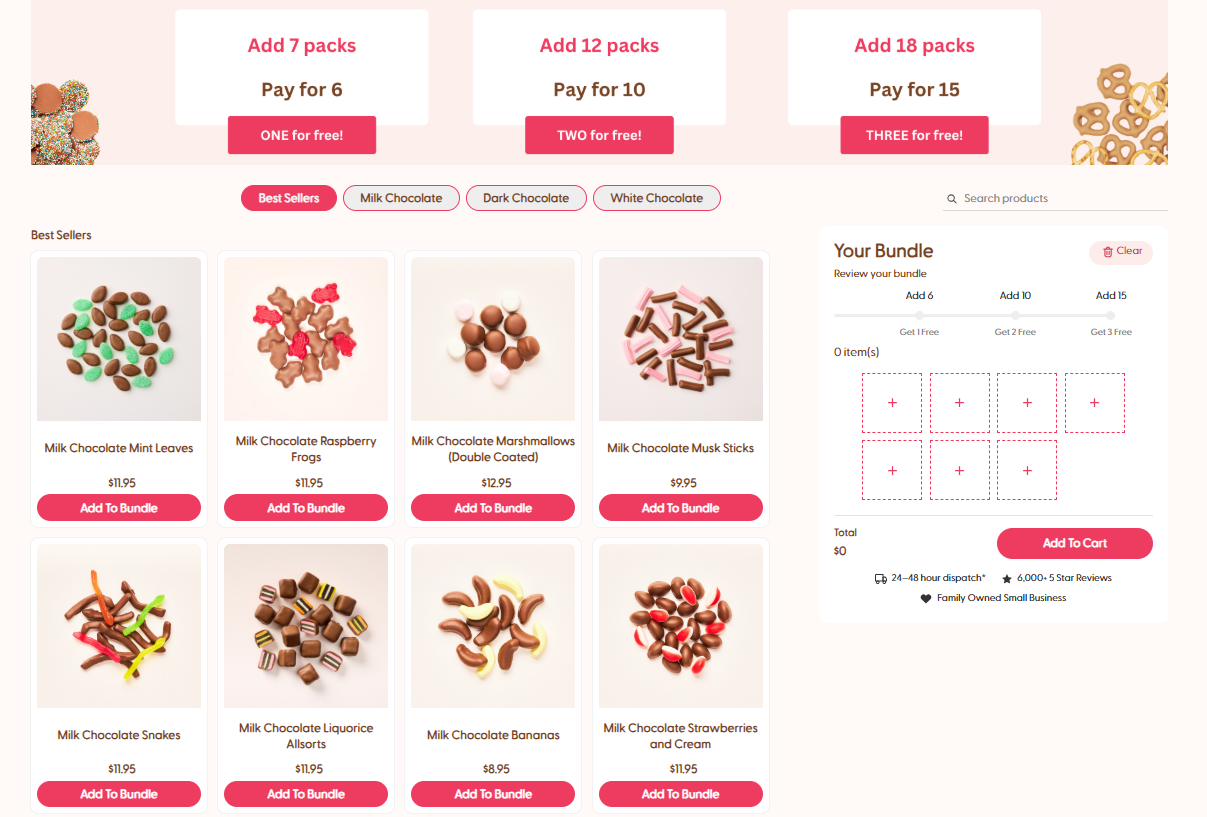
For example, a chocolate store could offer shoppers the option to add 7 packs and pay for 6, add 12 packs and pay for 10, or add 18 packs and pay for 15. This tiered Buy X Get Y promotion encourages customers to purchase more products to unlock additional free items. Shoppers can choose from different chocolate varieties and build their own bundle based on their preferences.
Set qualifying quantities and rewards around your margins and typical purchasing behaviour. Make the reward tiers clear so customers can easily understand how many items they need to add and what they’ll receive for free.
Track units per order, average order value (AOV), redemption rate, and contribution margin after discounts. Compare results against a suitable baseline or test group to assess whether the offer generates additional profitable purchases rather than simply increasing redemptions.
Personalization and upgraded versions raise order value without adding much fulfilment cost. A custom name or message, gift packaging, or a premium finish gives customers a reason to pay more for the same core product. This suits gifting, print-on-demand, and made-to-order categories.
Present the option on the product page, where the decision is made, and keep pricing clear. Track option take rate, AOV, and contribution margin, and confirm that production time and error rates stay manageable.
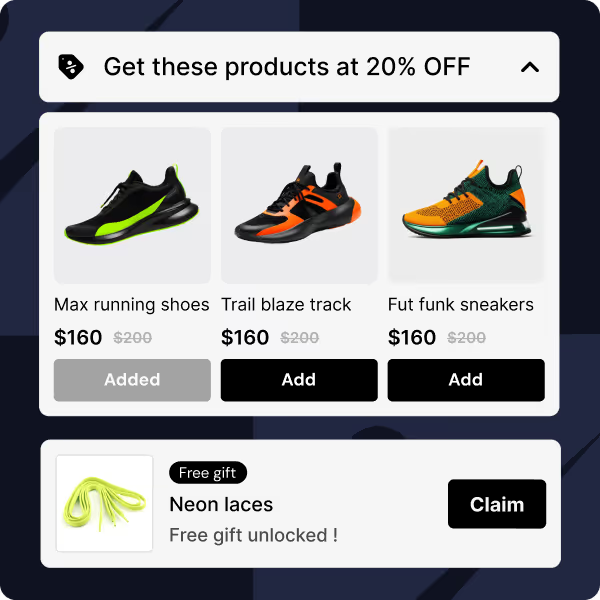
A gift with purchase gives shoppers a reason to spend more without relying solely on price discounts. Choose something that complements their order, feels valuable, and costs little to fulfil, such as a sample or lightweight accessory.
Test a first gift threshold slightly above your current average order value (AOV). To encourage larger purchases, introduce tiered free gift thresholds with increasingly valuable rewards. For example, shoppers could unlock a sample at $50 and a full-size product at $100. Make it clear whether the higher-tier gift replaces the first gift or comes in addition to it.
Use a free gift progress bar to show shoppers how much more they need to spend to reach the next reward. Place it where they can easily see it while reviewing their basket, such as the cart page or cart drawer. Kite: Discount & Free Gift supports spend-based gift offers and goal-based progress bars.
Track AOV, the percentage of orders that qualify for a gift, and contribution margin after product, gift, packing, and shipping costs. The goal is not just a bigger basket, but more profit after the reward has been fulfilled.
A three-tier structure helps customers compare options and often steers them toward the middle or top tier. It raises AOV through a better product choice, not extra items or shipping cost. Structure the tiers as follows:
Highlight the target tier visually and make the value difference between tiers easy to see. Track tier mix, AOV, conversion rate, and margin by tier. If the top tier rarely sells, simplify the gap between tiers before adding discounts.
Lead the collection or product page with the higher-priced option so it establishes a price reference point for the other options. Clearly communicate the additional features, benefits, or value customers receive with the premium version. Avoid relying on price anchoring alone.
Track tier mix, AOV, conversion rate, and margin by tier. If the top tier rarely sells, simplify the gap between tiers before adding discounts.
Spend-based discount tiers give shoppers a reason to build a larger basket by unlocking a better deal at higher spending thresholds. For example, offer 10% off orders of $50 or more, 15% off at $100, and 20% off at $150.
Test a first threshold slightly above your current average order value (AOV), with higher tiers that remain profitable after discounts. Show shoppers how much more they need to spend to reach the next tier, making both the target and the reward clear.
Test how you communicate the same offer, too. Compare “Get 15% off when you spend $100” with “You’re $20 away from 15% off” for a shopper whose basket totals $80. Keep the underlying discount unchanged so you can isolate the effect of the wording.
Use Shopify discount apps to configure and test different discount offers. Keep the discount value identical, change only how it is framed, and run the test long enough to gather meaningful data. Measure conversion rate, revenue per visitor, and AOV separately, since better discount framing may improve conversions without increasing basket size.
Instead of offering an unconditional discount, attach a minimum purchase requirement to each discount code.
For example, use “$15 off orders over 100” instead of a flat “15 off.” This encourages customers to reach a higher cart value before redeeming the offer. Shopify’s native discounts already allow a minimum purchase requirement. Set thresholds based on AOV, product margins, and typical cart values.
Use Shopify discount apps to configure and test different discount offers. Measure conversion rate, revenue per visitor, and AOV separately, since better discount framing may improve conversions without increasing basket size. Track discount redemption rate and contribution margin to ensure the additional order value covers the cost of the discount.
Store credit with a minimum-spend requirement can incentivize repeat purchases while increasing the value of subsequent orders. Rather than offering an unrestricted rebate, issue credit that customers can redeem only when their next purchase exceeds a defined threshold.
For example, offer $15 in store credit after a purchase, redeemable on the next order of $75 or more. This creates a compelling reason to return while encouraging customers to add more products to their cart to unlock the reward.
Use Shopify store credit solutions to implement conditional redemption rules and communicate credit availability through post-purchase emails and customer account pages.
Set redemption thresholds above your baseline repeat-order AOV to drive incremental spend. Track repeat purchase rate, redemption rate, repeat-order AOV, and contribution margin after credit redemption to evaluate the program's impact on customer lifetime value and profitability.
Limited-edition products give shoppers a reason to buy now by offering something available only for a defined period or in a genuinely limited quantity.
Consider seasonal collections, exclusive variants, collaborations, or limited-time bundles that offer something distinct from your regular range. A premium price can make sense when the design, quality, or added value supports it, rather than relying on scarcity alone.
Promote the launch across your storefront, email, and social media. Explain what makes the product special and clearly communicate the release quantity or availability window. Keep those limits genuine to protect customer trust.
Post-purchase upsells present customers with relevant add-on offers after they complete their initial purchase. For example, someone buying a coffee machine could be offered compatible coffee beans or a descaling kit.
Since the original order is already placed, these offers can encourage additional purchases without interrupting the initial checkout. Keep recommendations relevant, make the additional cost clear, and track offer acceptance, incremental revenue, refunds, and contribution margin to assess their impact.
Note: Shopify post-purchase upsells typically require compatible checkout extensions or dedicated apps. Check the available checkout setup before implementing this strategy.
Quantity breaks reward shoppers with a lower per-unit price when they buy more of the same product. For example, offer a modest discount on two units and a larger discount on three. This gives customers a reason to stock up while increasing the potential order value.
Use an app like Easy Bundle Builder to explore quantity-based purchasing experiences. Set tiers that encourage additional purchases without cutting too deeply into margins, and track units per order, AOV, conversion rate, and contribution profit.
Where your setup supports it, test making the middle quantity tier the default. For example, with single-unit, 2-pack, and 3-pack options, preselect the 2-pack and compare its performance against a single-unit default.
Clearly show the selected quantity and total price, and make it easy to choose a smaller option. Use a “Most popular” label only when actual purchase data supports it. Treat preselection as a test, not a guaranteed way to increase AOV.
Show both the per-unit price and the total for every tier. For example, if one unit costs 24, a three unit offer could read “18 each, $54 total,” making the saving easy to understand without mental arithmetic.
Track units per order, AOV, conversion rate, and contribution profit per visitor. Keep the tiers and presentation that generate more profitable purchases, rather than simply selling more units at lower margins.
Installment payments let eligible shoppers spread the cost of a purchase over time, which may make premium products and larger bundles easier to consider. They change the payment schedule, not the product’s price.
For example, a $100 purchase could be presented as “4 payments of $25” when that exact payment option is available. Keep the full price clearly visible and use your payment provider’s approved messaging to communicate payment terms and any applicable interest.
Eligible merchants in supported markets can offer Shop Pay Installments, which requires Shopify Payments and Shop Pay. Availability and payment options depend on merchant, customer, and order eligibility.
Track AOV, conversion rate, installment adoption, and contribution margin after payment fees. Compare results with a suitable baseline to assess whether installments generate more profitable purchases, rather than simply changing how existing customers pay.
Display installment pricing directly on product pages alongside the full price. Showing “Or 4 payments of $25” near the product price or add-to-cart button helps shoppers evaluate higher-priced products and bundles before reaching checkout.
Eligible merchants in supported markets can offer Shop Pay Installments, which requires Shopify Payments and Shop Pay. Availability and payment options depend on merchant, customer, and order eligibility.
Track AOV, conversion rate, installment adoption, and contribution margin after payment fees. Compare results with a suitable baseline to assess whether installments generate more profitable purchases, rather than simply changing how existing customers pay.
Very low-priced products can generate orders that contribute little toward fulfilment and shipping costs. Restricting these items to purchases that include other eligible products can help protect order economics while encouraging customers to add more to their baskets.
For example, allow a $5 accessory to be purchased only alongside another product or when the cart meets a minimum order value. This works particularly well for small accessories, samples, and inexpensive complementary products.
Clearly communicate the purchase requirement on the product page and make the item easy to add to an eligible order. Track units sold, AOV, conversion rate, and contribution profit to ensure the restriction improves profitability without creating unnecessary friction.
Increasing AOV helps ecommerce brands generate more revenue from existing traffic without increasing acquisition spend. For example, a store receiving 10,000 paid visits monthly, converting at 2%, and averaging ₹2,000 per order generates ₹4 lakh in revenue. Increasing AOV to ₹2,400 raises revenue to ₹4.8 lakh with the same traffic and order volume.
Achieving that additional ₹80,000 at the original AOV would require 40 more orders, or 2,000 additional visits at the same conversion rate.
Relevant product recommendations, complementary bundles, and spending incentives can encourage larger purchases. However, higher AOV only improves business performance when the additional revenue outweighs discounts, product costs, fulfilment, and shipping expenses. The aim isn't simply to increase basket size, but to improve profit per order. Strengthening order economics can also make paid acquisition more sustainable as the business scales.
Higher AOV increases revenue per transaction, but its impact on profitability depends on the economics of the additional items sold. A complementary product with a healthy margin may improve contribution profit per order. A steep bundle discount, however, may increase revenue while reducing profit. Shipping incentives can have the same effect if the additional margin does not cover the delivery cost.
AOV also does not directly reduce customer acquisition cost (CAC), which measures acquisition spend relative to the number of customers acquired. Instead, a higher contribution profit per customer can improve the return on acquisition spend and shorten the time required to recover CAC.
Evaluate AOV alongside contribution margin, CAC, and customer lifetime value. The goal is profitable revenue growth, not a higher average order value at any cost.
A higher AOV doesn't necessarily mean better performance. Discounts can inflate order values while reducing margins, and upsells can increase basket size while hurting conversion. Measure AOV alongside customer behavior, revenue, and profitability to understand the actual impact.
Break down AOV by customer type, acquisition channel, and device to identify where your strategy works best.
Use these segments to spot patterns, but avoid drawing conclusions from small sample sizes.
You can calculate AOV by dividing total order revenue by the number of orders, using the same revenue definition across comparisons. Track conversion rate and revenue per visitor alongside it to understand whether larger baskets translate into better results.
For example, 1,000 visitors generating 30 orders at an AOV of ₹2,000 produce ₹60,000 in revenue, or ₹60 per visitor. If AOV rises to ₹2,400 but orders fall to 20, revenue drops to ₹48,000 and revenue per visitor to ₹48. In this case, AOV increased by 20%, but overall performance declined. Check contribution profit as well to account for discounts, product costs, gifts, and fulfilment expenses.
Before-and-after comparisons can be misleading because seasonality, traffic mix, and other promotions affect results. A/B testing helps isolate the impact of a specific change by comparing randomly assigned groups over the same period.
Test one change at a time, such as a product bundle, upsell placement, or free shipping threshold. Keep the experience consistent for each shopper throughout the test.
Define your primary success metric before launching. Revenue per visitor or contribution profit per visitor is often more useful than AOV alone, with conversion rate and profit margin serving as guardrails.
Set the test duration and sample size based on baseline performance and the minimum improvement worth pursuing. Account for returns and cancellations where relevant, and avoid ending the test early because results look promising. Roll out changes that improve revenue quality and profitability, not simply those that increase the average order value.
Increasing AOV in ecommerce requires a clear understanding of basket composition, purchase intent, and unit economics. Contextual upsells, relevant bundles, quantity breaks, and shipping incentives can increase order value when they offer customers a genuine reason to buy more.
For Shopify brands, the priority is to identify the highest-potential opportunity, implement a focused change, and measure its effect on AOV, conversion, revenue per visitor, and contribution profit. Sustainable AOV growth comes from improving the economics of each transaction while preserving the customer experience.