This guide reviews the leading Shopify inventory management apps, including Fabrikatör Inventory Planner, 506 EasyScan SKU & Barcode, Inventory Management: Assisty, Prediko Inventory Management, Sumtracker Inventory Manager, Thrive Inventory Management, Stockie Inventory Management, and Katana Cloud Inventory.
Shopify is sunsetting Stocky, its built-in inventory and purchase order app, on August 31, 2026. After that date, the platform has no built-in tool for AI demand forecasting, automated PO generation, or multi-warehouse inventory planning, so a dedicated inventory management app moves from optional to required for most growing stores.
Each app serves a different store need, ranging from AI-powered demand forecasting and PO automation to multi-channel inventory sync, retail-and-online hybrid POS workflows, and full manufacturing resource planning.
Fabrikatör Inventory Planner stands out as the best Shopify inventory management app overall, offering SKU-level AI demand forecasting, one-click purchase order automation, a built-in backorder and pre-order engine, multi-warehouse stock transfers, and bundle planning at the component level. It positions itself as the natural Stocky replacement and integrates with Klaviyo, QuickBooks, Xero, ShipHero, and Katana.
Shopify inventory management apps cover everything that the Shopify admin alone cannot: AI demand forecasting, automated purchase orders, multi-warehouse routing, multi-channel sync, manufacturing planning, and barcode-scan fulfillment. The category is suddenly more important in 2026 because Shopify is sunsetting Stocky, its own free purchase-order and forecasting app bundled with Shopify POS Pro. Stocky was delisted from the App Store on February 2, 2026, and stops working entirely on August 31, 2026.
This guide reviews the 8 best Shopify inventory management apps across different store needs, ranking them by features, pricing, reviews, and how well they replace what Stocky used to do. We cover AI forecasting tools, multi-channel sync engines, retail-and-online hybrids for stores using Shopify POS, and full manufacturing platforms for makers. Every app here has a free plan or trial.
Comparison Table of Shopify Inventory Management Apps
App Name
Inventory Management Features
Supporting Features
Rating & Reviews
Pricing
Fabrikatör Inventory Planner
✅ AI Demand Forecasting ✅ PO Automation ✅ Bundles & Kits
✅ AI Demand Forecasting ✅ Reorder Suggestions ✅ Inventory Optimization
✅ Google Sheets Integration ✅ Buying Calendar
4.8/5 (329 reviews)
✅ Free ✅ $19/mo (Basic) ✅ $59/mo (Advanced)
Prediko Inventory Management
✅ AI Forecasting (Pia) ✅ 12-Month PO Calendar ✅ Demand Planning
✅ 100+ WMS/3PL Integrations ✅ 20+ Reports
4.9/5 (202 reviews)
✅ Free trial ✅ $49/mo (Starter) ✅ $119/mo+
Sumtracker Inventory Manager
✅ Multi-Store Sync ✅ Amazon/eBay/Etsy ✅ Bundling
✅ Cycle Counts ✅ Inventory Valuation
4.7/5 (109 reviews)
✅ Free (2.5K orders) ✅ $59/mo (Growth)
Detailed App Reviews: Top Shopify Inventory Management Apps
1. Fabrikatör Inventory Planner (Best Overall)
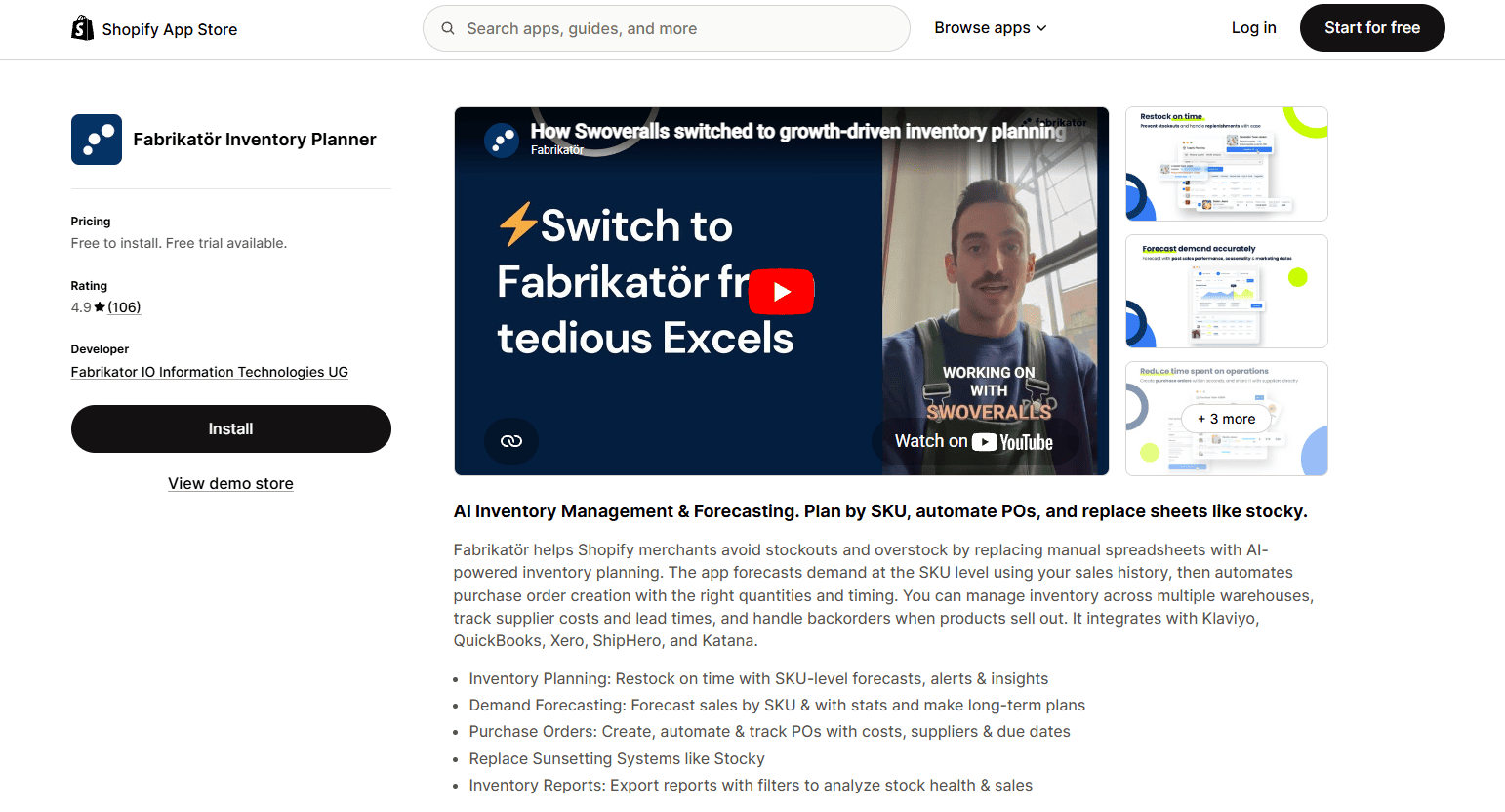
Fabrikatör Inventory Planner is a Shopify inventory management app and the most direct replacement for Shopify's sunsetting Stocky. It pairs SKU-level AI demand forecasting with one-click purchase order automation, multi-warehouse stock transfers, a built-in backorder and pre-order engine, and bundle planning at the component level. Best suited for $500K to $10M Shopify and Shopify Plus brands managing 50+ SKUs who need to move from spreadsheets to predictive ordering. Its sharpest edge is operational depth across the full supply chain: supplier lead times, COGS-aware reorder math, freight planning, and a raw-material calculator that thinner competitors skip.
Why Fabrikatör is the Best Shopify Inventory Management App
Fabrikatör is the only app in this comparison that combines AI demand forecasting, native backorder revenue capture, and bundle-component planning in a single tool. Most apps in this category force you to choose: AI forecasting OR backorders OR bundle planning, but rarely all three. Fabrikatör also leads on the supplier side, with lead times, COGS, and freight planning baked into the same workflow that generates the PO. For Shopify brands preparing for Black Friday or any seasonal demand spike, that integration eliminates the spreadsheet-to-supplier handoff that costs most teams a full day per week.
Key Features
SKU-level AI demand forecasting: Statistical forecasts using each SKU's sales history for short and long-term planning, with seasonality detection.
Replenishment and purchase orders: Auto-suggests reorder quantities and timing using lead times, supplier costs, and safety stock; one-click PO creation, tracking, and bulk edits.
Multi-warehouse and multi-location: Transfer stock between warehouses and forecast each location independently.
Backorder and pre-order engine: Lets stores keep selling on out-of-stock SKUs with transparent customer messaging; included on every paid tier.
Bundle planning at the component level: Forecasts and reorders bundle components, a feature most thinner inventory apps skip entirely.
Freight planner: Optimizes incoming shipments to balance freight cost against stockout risk.
Inventory reports: Filterable exports for stock health, dead stock, sell-through, and supplier analysis.
Low-stock and threshold alerts: Email replenishment reminders triggered by configurable thresholds.
Real-time Shopify sync: Orders, prices, variants, and SKUs sync in real time across multi-store and multi-channel setups.
Stocky migration support: Dedicated migration path with free data migration on the Enterprise tier.
White-glove onboarding: 30-minute onboarding call standard, plus a dedicated account manager and free data migration on the top tier.
Operations-stack integrations: Connects with Klaviyo for back-in-stock, QuickBooks and Xero for accounting, ShipHero for 3PL, and Katana for manufacturing.
Pricing
Free to install: 14-day free trial on paid plans
Seed: $99/month plus $0.75 per backorder. For stores up to $500K annual revenue. 50 free backorders included.
Scale-Up: $149/month plus $0.75 per backorder. For stores up to $1.5M annual revenue.
Growth: $199/month plus $0.75 per backorder. For stores up to $2.5M annual revenue.
Enterprise: Free to install, custom pricing. For stores above $2.5M annual revenue. Includes free data migration, dedicated account manager, and personal onboarding.
Pros
Three categories in one app: AI forecasting, backorder revenue capture, and bundle-component planning combined.
Stocky-replacement positioning: Direct migration path with free data migration on Enterprise.
Operations-stack integrations: Klaviyo, QuickBooks, Xero, ShipHero, and Katana cover email, accounting, 3PL, and manufacturing in one app.
Built-in backorder engine: Captures revenue on out-of-stock SKUs that would otherwise be lost.
Bundle planning at the component level: Reorders bundle components automatically, rare in this category.
Strong merchant proof: 4.9 stars on the Shopify App Store and case studies showing weekly PO planning compressed from hours to 20 minutes.
Cons
Backorder fees scale with redemptions: The $0.75 per backorder beyond the 50 free per month is structured as usage-based pricing, but the model means you only pay when the app is actively recovering revenue you would otherwise lose to stockouts.
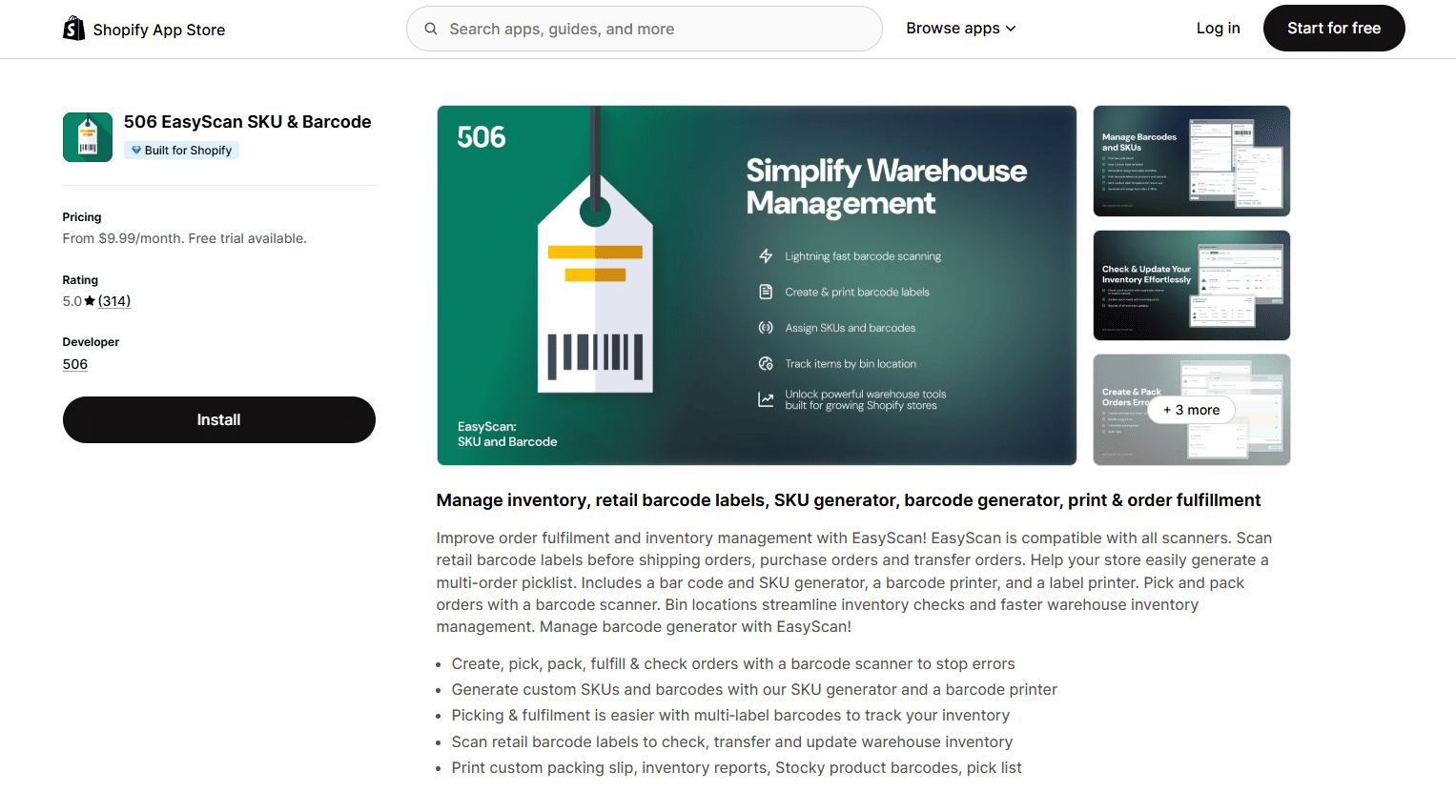
506 EasyScan SKU & Barcode is a Shopify inventory management app focused on barcode-scan fulfillment and SKU/barcode generation. It is the only app in this comparison built around a scan-to-pick-pack-ship workflow with bin locations, transfer orders, and label printing. Best suited for stores with physical warehouses or fulfillment teams that need to eliminate shipping errors. Its main limitation is that it is a fulfillment and operations app, not a forecasting tool: there are no AI reorder suggestions or demand predictions, so most stores pair it with a forecasting app for full inventory coverage.
Key Features
Barcode-scanner inventory tracking: Scan to check, transfer, and update warehouse stock with scan validation.
Multi-location stock transfers: Move inventory between warehouses with scan confirmation at both ends.
Purchase orders and transfer orders: Create and track POs with barcode integration on the Advanced tier and above.
Bin locations: Faster picking and physical inventory checks with scannable bin assignments.
Bulk SKU and barcode generation: Generate UPC and QR codes with custom prefixes, suffixes, and bulk printing.
Custom label templates: Full control over label size, layout, elements, and images.
Pick lists and packing slips: Multi-order pick lists and custom packing slips for high-volume fulfillment.
Stocky integration: Compatible with Stocky for legacy barcode printing during the migration window.
Pricing
Basic: $9.99/month. Unlimited barcode label printing and SKU generation.
Standard: $39.99/month. Adds inventory operations: stock transfer, pick/pack/fulfill, bin locations.
Advanced: $79.99/month. Adds purchase orders, transfer orders, user accounts, and analytics.
Pro: $129.99/month. Adds unlimited users, user statistics, barcode aliases, and premium support.
Pros
Built for Shopify badge: Meets Shopify's highest quality bar for performance and design.
Scan-to-fulfill workflow: Eliminates wrong-item shipments with reported 0.01% error rates.
30M+ orders handled globally: Strong adoption across high-volume fulfillment operations.
Bin locations save picking time: Reported 17+ hours per period saved on bin-driven picking.
Cons
Not a forecasting tool: No AI reorder suggestions or demand predictions, so high-volume stores pair it with a separate forecasting app.
Inventory operations gated to Standard tier: The $9.99 Basic plan only covers barcode printing, not stock transfers or fulfillment.
Rating
5.0 stars (314 reviews), Shopify App Store
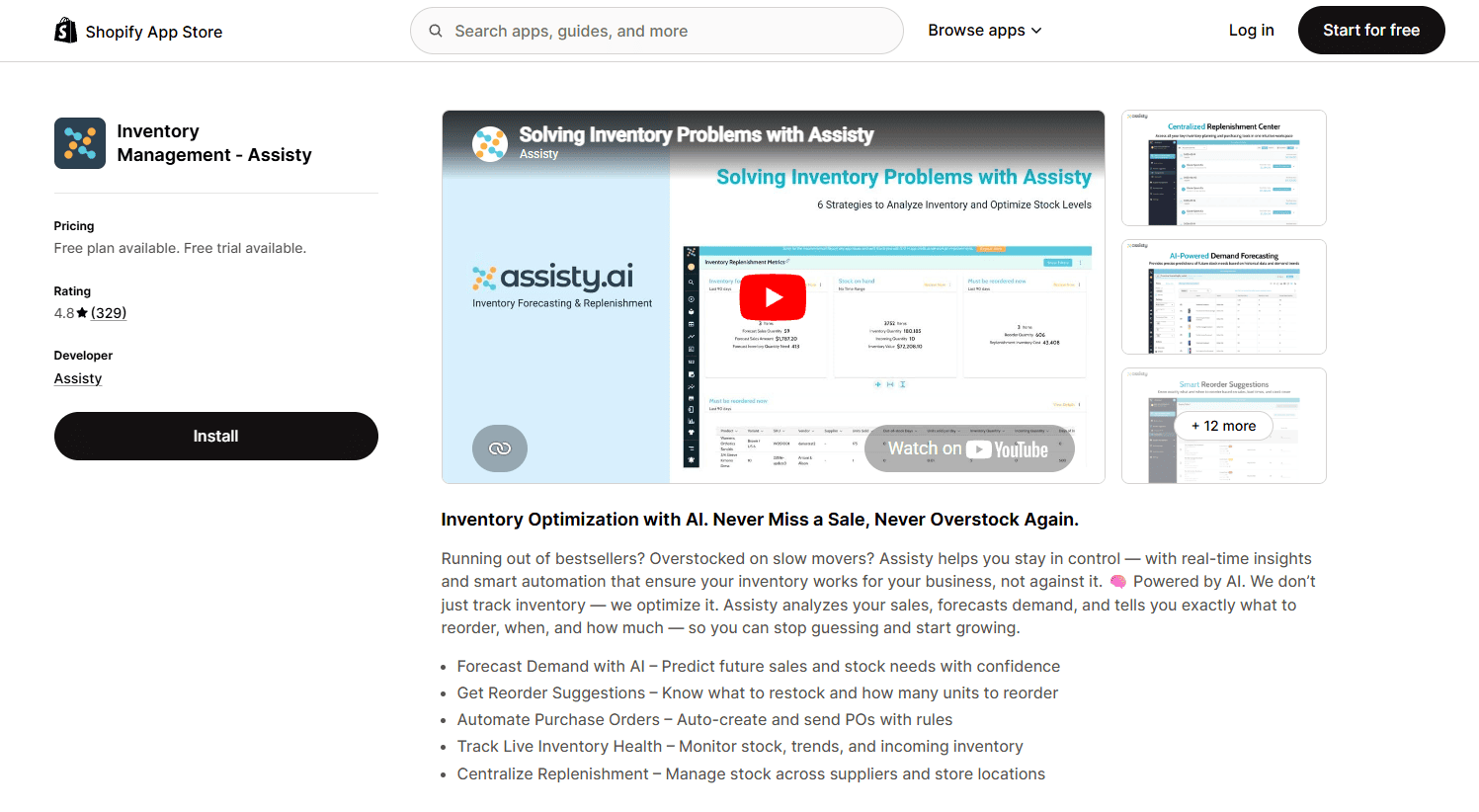
3. Inventory Management: Assisty
Inventory Management: Assisty is a Shopify inventory management app focused on AI demand forecasting and analytics depth. It ships with 300+ pre-built sales and inventory reports plus a Google Sheets integration that turns store data into custom dashboards. Best suited for data-driven Shopify stores running large catalogs that need detailed reorder suggestions and multi-location replenishment. Its main limitation is the pricing structure: full AI/ML demand forecasting and the purchase-order module are gated to the $239/month Plus tier, while the lower tiers cover reporting and basic replenishment only.
Key Features
AI demand forecasting: Predicts future sales and stock needs with safety stock controls on the Plus tier.
Reorder suggestions: Tells you what to restock and how many units, based on velocity and lead times.
Automated PO creation: Rule-based PO generation and send to suppliers on the Plus tier.
Live inventory dashboards: Real-time view of stock, trends, and incoming inventory.
Multi-location replenishment: Replenishment across suppliers and store locations.
300+ prebuilt reports: Sales, inventory, customer LTV, segmentation, and profit reports out of the box.
Google Sheets integration: Build complex dashboards in Sheets using real-time store data.
Restock and threshold alerts: Email notifications for low-stock, out-of-stock, and custom thresholds.
Highest review count in category: 329 reviews at 4.8 stars, the most of any pure inventory app.
Free plan with 6 months history: Useful entry point for small stores testing the category.
Google Sheets integration: Real-time dashboards in Sheets, rare in this category.
30-day money-back guarantee: Beyond the 14-day free trial.
Cons
AI forecasting gated to Plus tier: Full demand forecasting and PO automation only available at $239/month.
Report performance complaints: Several reviewers report slow load times and dashboard lag at scale.
Tier-shifting frustrations: Some long-term subscribers report features moving between tiers, requiring upgrades to retain access.
Rating
4.8 stars (329 reviews), Shopify App Store
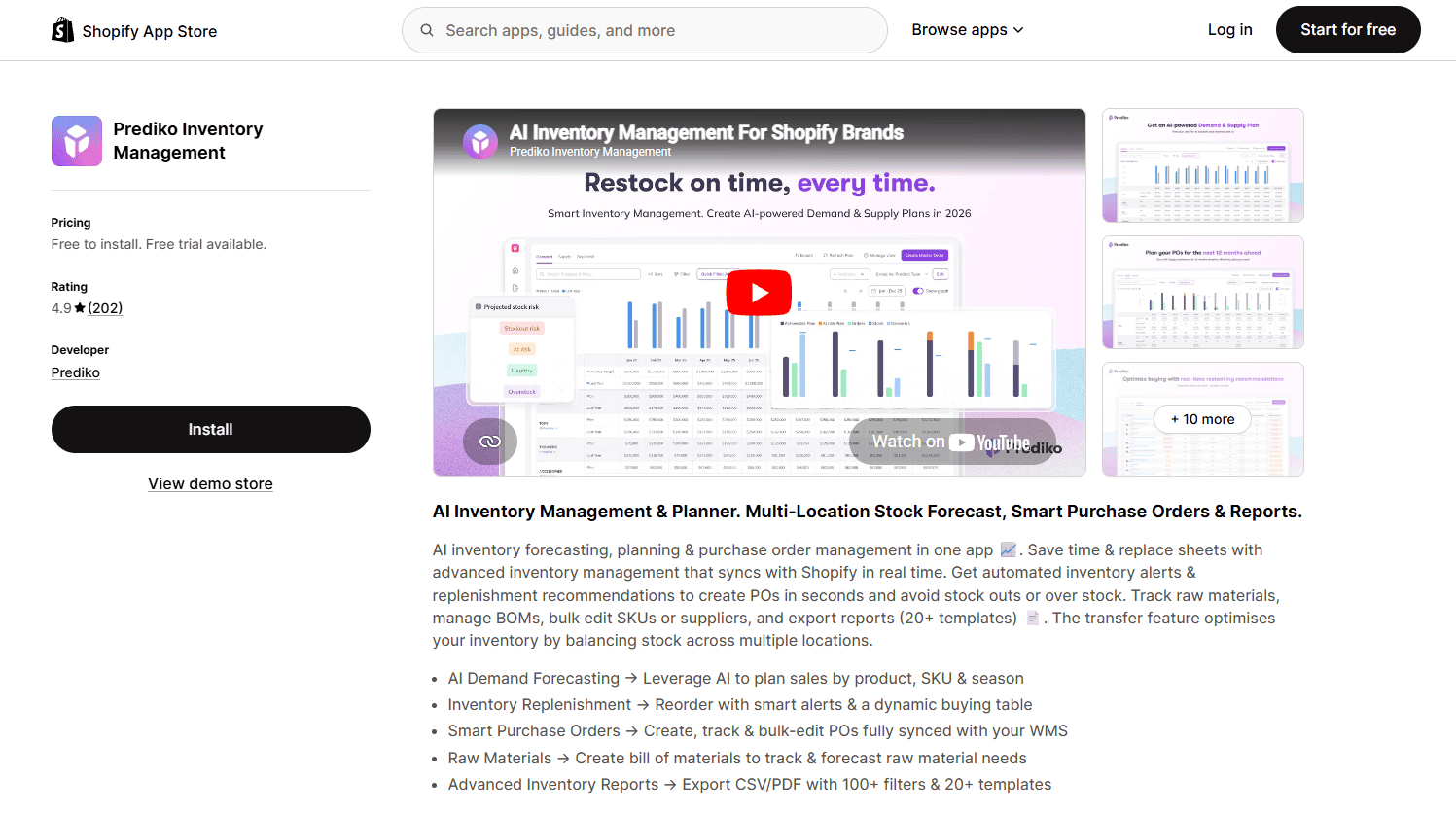
4. Prediko Inventory Management
Prediko Inventory Management is a Shopify inventory management app built around Pia, a branded AI agent that generates a 12-month purchase order calendar and a real-time dynamic buying table with what-to-order recommendations. Best suited for $100K to $2M Shopify brands wanting an AI co-worker experience for inventory planning. Its broadest strength is integration depth: 100+ WMS and 3PL connectors, native ShipHero integration, and a public API on the Enterprise tier.
Key Features
AI demand forecasting: Forecasts by product, SKU, and season using historical sales data.
12-month PO calendar: AI-generated purchase order timeline with full year visibility.
Dynamic buying table: Real-time replenishment alerts with smart reorder suggestions.
Raw materials and BOM tracking: Component-level forecasting for stores managing manufactured or assembled products.
Multi-store and multi-location transfers: Inventory transfers between connected stores and warehouses.
20+ customizable reports: 100+ filters, CSV and PDF export.
Multi-language interface: 10 languages including French, German, Spanish, Japanese, and Brazilian Portuguese.
Pricing
Starter: $49/month. For stores up to $100K revenue. Unlimited users, SKUs, alerts, AI forecasting, PO management, 20+ reports, 100+ integrations.
Scale-up: $119/month. For stores up to $500K revenue. Same feature set.
Growth: $199/month. For stores up to $2M revenue. Same feature set.
Enterprise: Free to install, custom pricing. Above $2M revenue. Includes personalized onboarding, dedicated success manager, dedicated Slack channel, full API access.
Pros
Lowest entry price in the AI category: $49/month entry tier, well below most competitors with full feature access.
Pia AI agent: Branded inventory co-worker positioning, 12-month forecast horizon.
100+ WMS and 3PL integrations: Broadest integration list in the category.
Strong case study results: Healf reduced stockouts from 4% to 1% in 2 months, customers cite 75x ROI.
Public API on Enterprise: Full custom integration capability.
Cons
Raw materials module is recommendation-only: Reviewers report wasting hours on BOM setup, then finding the feature only suggests what to order, not what can be made.
Aggressive trial email cadence: Some reviewers describe the onboarding email volume as excessive.
No native Amazon integration yet: Currently routed through CEDCommerce, native integration in development.
Rating
4.9 stars (202 reviews), Shopify App Store
5. Sumtracker Inventory Manager
Sumtracker Inventory Manager is a Shopify inventory management app focused on multi-channel and multi-store sync. Its strongest selling point is centralized inventory across up to 20 connected Shopify stores plus marketplaces like Amazon, eBay, Etsy, and Walmart, all at SMB pricing. Best suited for sellers running multiple Shopify stores or selling on Shopify plus external marketplaces who want SKU consolidation without ERP-level cost. Its main limitation is a pattern of 1-star reviews citing the sync engine reversing manual stock adjustments, suggesting edge cases in complex setups that warrant testing during the trial.
Key Features
Multi-store Shopify sync: One SKU, one stock count across up to 20 connected Shopify stores in real time.
Multichannel sync: Native connectors to Amazon FBA/FBM, eBay, Etsy, and Walmart.
Bundle component tracking: Sells bundle SKUs and decrements component inventory across all channels.
Free: 2,500 orders per year, 14-day full trial, up to 20 store connections.
Growth: $59/month. 10,000 orders per year, all marketplace integrations, bundles, multi-location.
Professional: $119/month. 10,000 orders per year, enhanced support, advanced features.
Enterprise: Custom pricing. 10,000+ orders per year, personal onboarding and training.
Pros
Multi-store Shopify sync at base price: 20 store connections included on the Growth plan.
Strong scale claims: 99% reduction in overselling, 60% reduction in stockouts cited.
Bundle component tracking: Decrements component inventory across all connected channels.
Lowest paid tier among multi-channel apps: $59/month for full marketplace coverage.
Cons
Inventory sync edge cases: Multiple reviewers report the sync engine reversing manual stock adjustments. Test thoroughly during the trial period.
Time-zone support gaps: Slow support response times on weekends and US business hours, due to development team location.
UI not as polished as competitors: Functional but less refined than Prediko or Fabrikatör.
Rating
4.7 stars (109 reviews), Shopify App Store
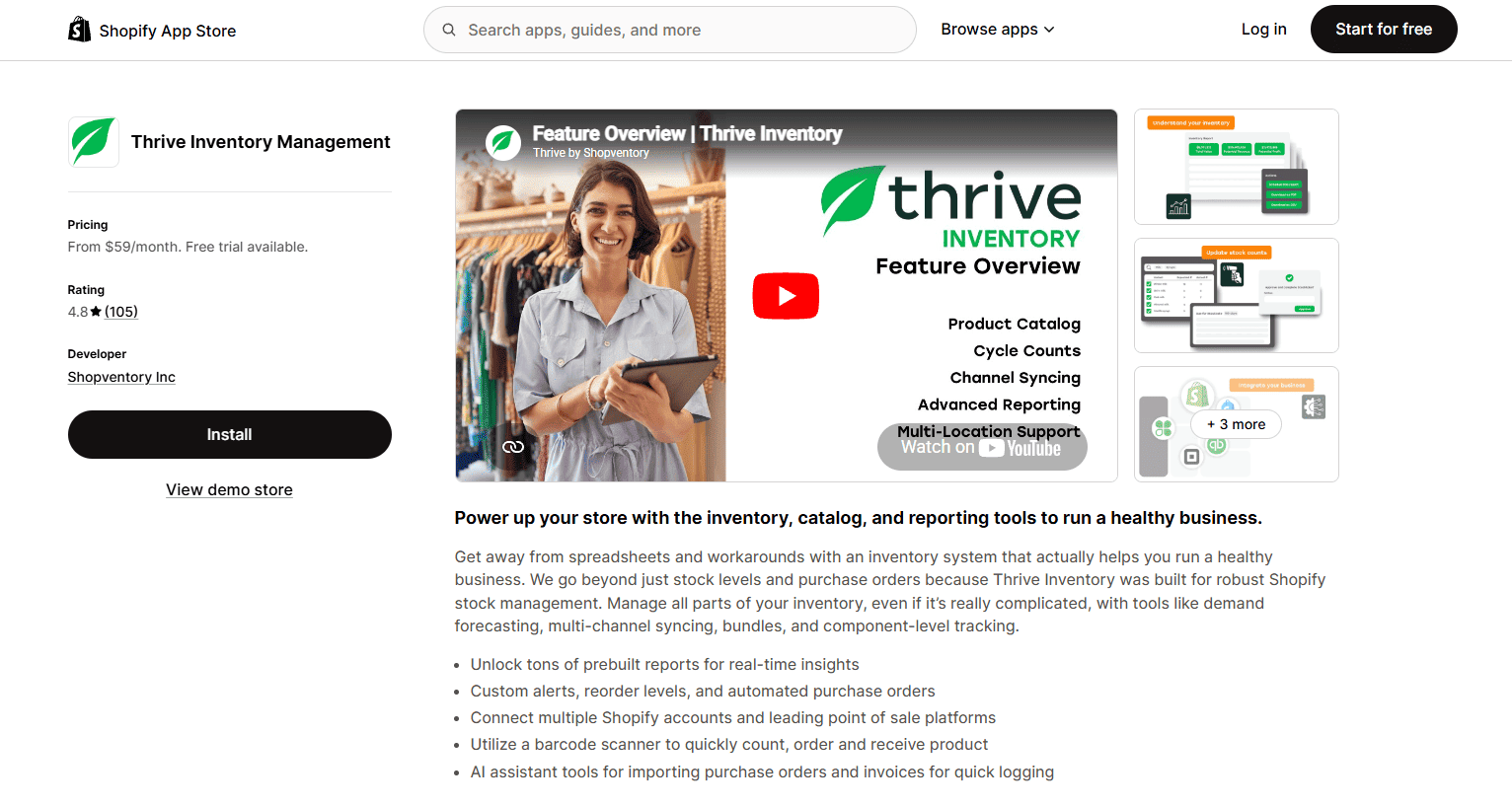
6. Thrive Inventory Management
Thrive Inventory Management is a Shopify inventory management app for hybrid retail-and-online stores. Rebranded from Shopventory in 2021, it directly connects Shopify POS, Square, and Clover into a single inventory and reporting platform. Best suited for coffee roasters, restaurants, smoke shops, and Shopify retailers running 2 to 20 physical locations alongside their online store. Its standout feature is recipe and modifier inventory tracking, which decrements ingredient stock per drink sold or per modifier picked, a workflow most pure-ecommerce apps do not handle.
Key Features
Multi-location inventory sync: Real-time stock counts across up to 20 retail and warehouse locations.
Multi-channel POS sync: Native connectors for Shopify POS, Square, Clover, WooCommerce, and BigCommerce.
Recipe and modifier inventory: Decrements ingredient stock per drink or modifier sold, unusual outside food-service ERPs.
Scan-to-count cycle counts: Mobile barcode scanning for physical inventory reconciliation.
Bundle and BOM management: Component-level inventory for bundles, kits, and prepared goods.
Vendor management: Vendor performance reporting and PO routing.
Custom report builder: Multi-location profit, sell-through, and vendor performance.
Pricing
Starter: $59/month. 1,500 transactions per month.
Standard: $129/month. 2 locations and integrations, 3,000 transactions per month.
Professional: $279/month. 5 locations and integrations, 10,000 transactions per month.
Elite: $559/month. 10 locations and integrations, 25,000 transactions per month.
Pros
Only retail-and-online hybrid in the set: Native Shopify POS, Square, and Clover integrations.
Recipe and modifier inventory: Critical for food and beverage stores, rare in ecommerce-first apps.
13 years in the inventory space: Operating since 2013 as Shopventory, mature product.
Highest five-star rate: 95% of reviewers give 5 stars.
Cons
Pricing scales with location count: 6+ locations jumps stores to the $559/month tier, expensive at scale.
Onboarding complexity: Some reviewers note the setup is involved and pay-plan selection happens before full feature exploration.
Rating
4.8 stars (105 reviews), Shopify App Store
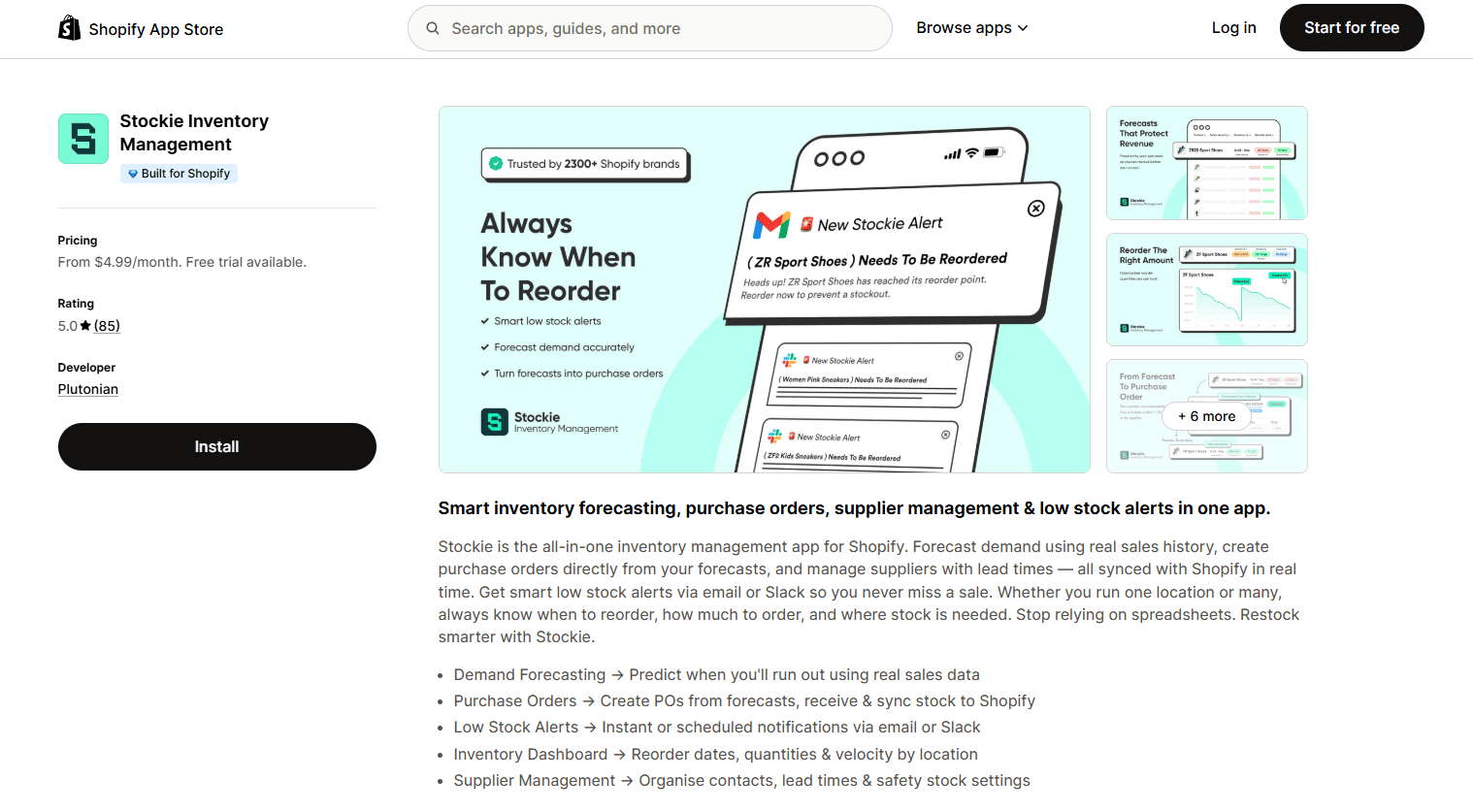
7. Stockie Inventory Management
Stockie Inventory Management is a Shopify inventory management app positioned as a lightweight Stocky replacement for SMB stores. It carries the Built for Shopify badge and starts at $4.99/month, making it the most affordable entry point in this guide. Best suited for SMB Shopify stores migrating off Stocky who want clean low-stock alerts, sales-history forecasting, and supplier-aware purchase orders without enterprise-tier pricing. Its main limitation is depth: it relies on sales-history forecasting rather than AI/ML, and the Basic tier caps at 8,000 variants.
Key Features
Demand forecasting: Uses real Shopify sales history to predict reorder dates and quantities.
Purchase order generation: POs generated directly from forecasts, sent to suppliers as PDF or CSV.
Slack-native low-stock alerts: Send alerts to a Slack channel, rare in this category.
Multi-location across unlimited Shopify locations: No location count cap on any tier.
Custom thresholds per product: Set low-stock and reorder triggers per SKU.
Auto-restock and stock transfer: Move inventory between locations automatically.
Supplier management: Track supplier contacts, lead times, and safety stock settings.
Pro: $29.99/month. Forecasting dashboard, sales velocity, predicted reorder dates, lead time and safety stock config.
Pro Plus: $59.99/month. Create and manage POs, generate POs from forecasts, track shipments, receive inventory.
Pros
Lowest entry price in the category: $4.99/month for full multi-location alerts.
Slack-native alerts: Built-in Slack integration, rare in this category.
Built for Shopify badge: Meets Shopify's quality bar.
Founder-led support: Reviewers consistently name the founders Jake and Meché for fast support.
Cons
No AI/ML forecasting: Forecasting is purely sales-history-based, less sophisticated than Fabrikatör or Prediko.
Basic plan variant cap: 8,000 variants on the entry tier, requires upgrade for larger catalogs.
Smaller review pool: 85 reviews, smaller track record at scale than competitors.
Rating
5.0 stars (85 reviews), Shopify App Store
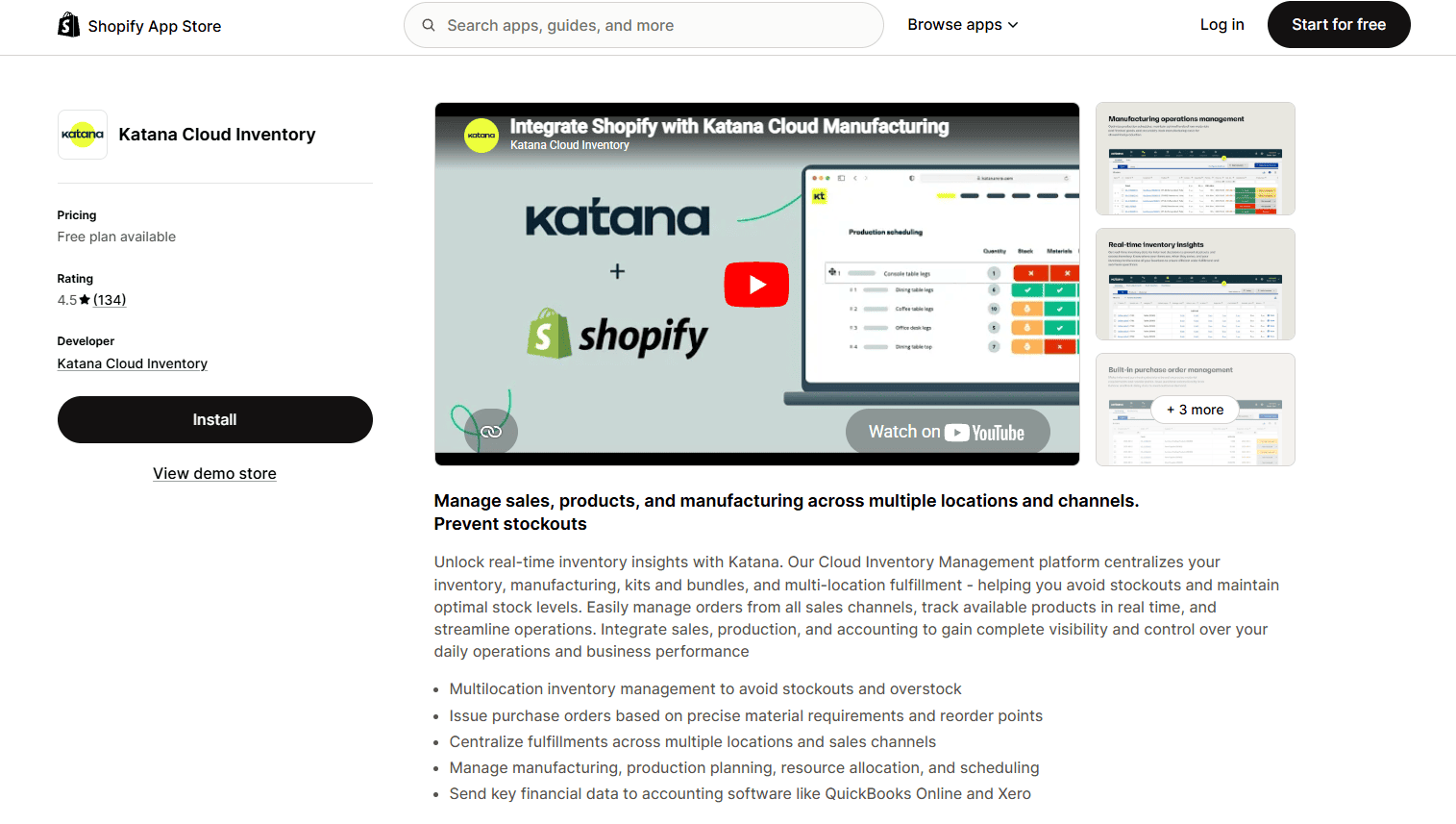
8. Katana Cloud Inventory
Katana Cloud Inventory is a Shopify inventory management app built for makers and small-scale manufacturers who need full Manufacturing Resource Planning (MRP) on top of standard inventory. It is the only app in this comparison with deep Bill of Materials (BOM) tracking, subassemblies, and production scheduling. Best suited for Shopify brands that produce their own goods: apparel, cosmetics, food and beverage, leatherwork, and assembly-based products. Its main limitation is a pattern of price increases mid-contract reported in reviews, often tied to changes in the billing model (per-user, per-order line item, or GMV).
Key Features
Bill of Materials and subassemblies: Multi-level recipes for manufactured goods.
Production scheduling: Visual production planner with capacity allocation against incoming sales orders.
Multi-location inventory: Real-time visibility across raw materials, work-in-progress, and finished goods.
Omnichannel order sync: Pulls orders from Shopify, Amazon FBA, BigCommerce, and WooCommerce into one production queue.
Shop Floor mobile app: Operators check off manufacturing tasks in real time on tablets and phones.
Batch and serial number tracking: Lot tracking with expiry dates, available as an add-on.
Manufacturing cost calculations: Includes labor and overhead in unit cost.
Warehouse mobile app: Pick, pack, and bin location management.
Pricing
Free: 30 SKUs (unlimited for 15 days), unlimited users, 3 inventory locations, all add-ons accessible.
Core: From $299/month. Unlimited SKUs, unlimited users, 1 included location.
Manufacturing add-on: $199/month. Production scheduling, BOM, shop floor management.
Traceability add-on: $249/month. Batch/lot, serial number, expiry tracking.
Warehouse add-on: $149/month. Pick/pack, bin locations, mobile warehouse app.
Onboarding: $2,000 one-time. 6-week implementation with a dedicated manager.
Pros
Only true MRP in the set: Shop floor scheduling, BOM, and production capacity planning.
Strong case study results: Cited 1.2x inventory turnover increase and 60% higher year-over-year sales for users.
Unlimited users on every plan: Including the free tier, unusual in this category.
6-week implementation: Faster than traditional ERPs that take 6 to 12 months.
Cons
Mid-contract price increases: Multiple reviewers report 2x to 5x price increases when the billing model changes (user-based to GMV-based).
Essential features behind add-ons: BOM, batch tracking, and warehouse tools cost extra on top of the Core plan.
Onboarding fee: $2,000 one-time setup fee for the dedicated implementation manager.
Rating
4.5 stars (134 reviews), Shopify App Store
How to Choose the Right Shopify Inventory Management App
Decide if you need forecasting, sync, or manufacturing. AI forecasting and PO automation tools (Fabrikatör, Prediko, Assisty, Stockie) help stores predict demand, avoid stockouts, and protect average order value. Multi-channel sync tools (Sumtracker, Thrive) keep inventory accurate across multiple stores and marketplaces. Manufacturing platforms (Katana) handle BOM and production scheduling. Pick the category that matches your top operational pain.
Plan for the Stocky shutdown explicitly. If you are currently using Stocky for purchase orders or forecasting, August 31, 2026 is your migration deadline. Apps with explicit Stocky migration support (Fabrikatör, Stockie, Sumtracker, Assisty) reduce switching pain. Test the migration during your trial, not after Stocky stops working.
Match the pricing model to your store's profile. Revenue-based pricing (Fabrikatör, Prediko) scales with what the app earns you. Order-count pricing (Sumtracker) penalizes high-volume, low-AOV stores. Per-location pricing (Thrive) hits multi-store retailers hardest. Modular pricing (Katana) starts low but adds up fast as you turn on add-ons.
Check bundle and component tracking if you sell kits. Most apps treat bundles as separate SKUs and miss the component-level inventory math. Fabrikatör, Sumtracker, Thrive, and Katana handle component tracking; if you sell bundles, kits, or assembled products, this is non-negotiable.
Verify integrations before committing. If you use Klaviyo for back-in-stock, QuickBooks or Xero for accounting, or ShipHero for 3PL, your inventory app needs to integrate cleanly. Fabrikatör and Prediko have the broadest integration lists. Verify your specific stack works on a free trial before paying.
Read recent 1-star reviews before installing. Some apps in this category have systemic issues that only show up after weeks of use, such as inventory drift, mid-contract price hikes, or sync edge cases. The 1-star and 2-star reviews on the Shopify App Store are the most honest signal. Filter for reviews from the last 6 months.
Can You Manage Inventory Without an App on Shopify?
Yes, but only for the basics. Shopify ships with a real inventory engine on every plan, and for small catalogs operating from one or two locations, it can carry you a long way without installing anything. The problem starts when you scale, sell across channels, or need to forecast instead of just count.
What Shopify Does Without an App
Multi-location inventory tracking on every plan, with order routing based on availability and fulfillment priority
Per-variant stock quantities, SKU tracking, and a continue-selling-when-out-of-stock toggle for backorder-style selling
Cross-channel sync across Online Store, POS, and connected sales channels
Built-in inventory reports in the Shopify admin
Basic low-stock visibility
Until recently, Stocky filled the planning and purchase-order gap. Stocky was Shopify's own free app bundled with Shopify POS Pro, covering purchase orders, demand forecasting, and inventory transfers. Shopify is sunsetting Stocky: the app was delisted from the App Store on February 2, 2026, and stops working entirely on August 31, 2026. Min/max forecasting and inventory transfers were already removed in July 2025. After August 2026, Shopify has no built-in equivalent.
What You Cannot Do Without an App
AI demand forecasting and replenishment recommendations
Automated PO generation based on sales velocity and supplier lead times
Backorder management with automated customer communications
Bundle and component-level inventory (deducting raw materials or kit components from finished-goods stock)
Supplier cost tracking, landed-cost calculations, and PO approval workflows
Inventory across multiple Shopify stores or non-Shopify channels (Amazon, wholesale, retail ERP)
SKU-level demand planning with forecasted scenarios
Production scheduling and manufacturing workflows
Advanced reporting like sell-through rate, stock-to-sales ratio, inventory turn, and weeks of cover
With Stocky going away in August 2026, the gap between Shopify's built-in admin and real inventory operations widens significantly. AI forecasting alone replaces hours of weekly spreadsheet work, multi-warehouse stores need real routing logic, and Shopify Plus brands running across stores, retail, and wholesale outgrow the built-in admin almost immediately. A dedicated inventory app is now a requirement for most growing stores, not a nice-to-have.
Conclusion
In this guide, we examined some of the best Shopify inventory management apps, including Fabrikatör Inventory Planner, 506 EasyScan SKU & Barcode, Inventory Management: Assisty, Prediko Inventory Management, Sumtracker Inventory Manager, Thrive Inventory Management, Stockie Inventory Management, and Katana Cloud Inventory. We evaluated them on AI forecasting depth, purchase order automation, multi-channel and multi-location support, pricing models, integrations, and Stocky migration paths.
Overall, Fabrikatör Inventory Planner stands out as the most well-rounded Shopify inventory management app, combining SKU-level AI demand forecasting, automated purchase order generation, a built-in backorder engine, and bundle-component planning in a single tool. It also positions itself directly as the Stocky replacement, with free data migration on the Enterprise tier. For multi-store or marketplace sellers, Sumtracker is a strong alternative; for makers and manufacturers with BOM requirements, Katana is the only true MRP option in this set.
A good way to approach this is to shortlist a few apps, sign up for the trial period, and see what works best for your store. All the best!
Hurrify customers to buy within a given timeframe with a sales countdown timer & improve conversions
Another popular Shopify checkout app is Checkout Promotions. The app comes with the ability to leverage a collection of highly robust visibility rules that help show customers one-click post purchase upsell promotions after an order payment has been made. Some of its key features include:
Features
AI recommended and manual recommendations for upselling.
Complete branding control.
Checkout Upsell for increasing AOV.
AI recommended and manual recommendations for upselling.
Pricing
Development
Free
Monthly Plan
$99/ month
Plus Plan
$99/ month
Plus Plan
$99/ month
FAQs on Shopify Inventory Management Apps
What is the best Shopify inventory management app?
Can you manage inventory on Shopify without an app?
What happens to Stocky after August 2026?
How much do Shopify inventory management apps cost?
Do Shopify inventory management apps work with Shopify POS?
Which Shopify inventory management app is best for multi-channel sellers?
Sid B
Sid is the founder of Skai Lama and The Indian Dream Podcast. He is passionate about building SaaS and talks about eCommerce Growth, 0-1 Startups, Building Businesses and Brands, and Shopify.

.svg)
.svg)

.svg)
.svg)



%20(1).jpg)
.jpg)
.svg)









.svg)




.avif)