.svg)
.svg)

.svg)
.svg)





Our Apps Have Driven
5X AOV | 2X Conversions | $30M+ Additional Revenue
5X AOV | 2X Conversions | $30M+ Additional Revenue
.svg)


5.0 (3000+ Reviews)


Shopify Apps





.svg)

Promotions can increase conversions and AOV, but more discounted orders do not always mean better performance. Merchants need to track revenue, orders, discount spend, offer adoption, and customer behavior to see what is actually working.
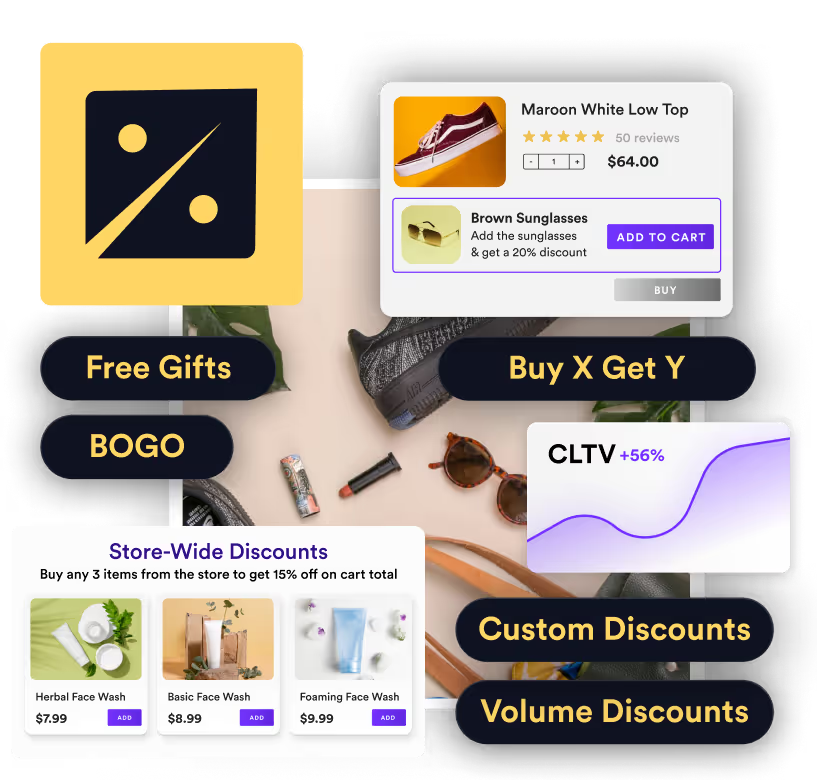
Kite Discount & Free Gift is a Shopify discount and free gift app that helps merchants create Free Gift, Buy X Get Y, Tiered Discount, Combined Offer, Shipping, and other promotions.
It comes with an in-builtStrategy Analytics dashboard that connects these offers with metrics such as Revenue Collected, AOV, DER, AOV Lift, Units per Order, and Incremental Ratio. In this guide we are going to cover what these metrics are and how to use them to optimize your promotions to do more.
Kite Discount & Free Gift is an all-in-one Shopify product discount app that helps Shopify merchants create and manage different promotion mechanics, including free gifts, Buy X Get Y, combined discounts, shipping offers, tiered volume discounts, goal-based offers, and custom offers. Each discount mechanic is designed to influence a different purchasing behavior, so it is important as a merchant that you understand why a particular promotion is set up.
Now when it comes to evaluating a promotion, incorrect analysis can prevent you from getting the most out of your campaign. Kite’s Strategy Analytics adds a performance layer to your promotions. Instead of looking only at redemptions, merchants can evaluate revenue collected, orders with offers, average order value, DER, offer-level performance, and customer segments.
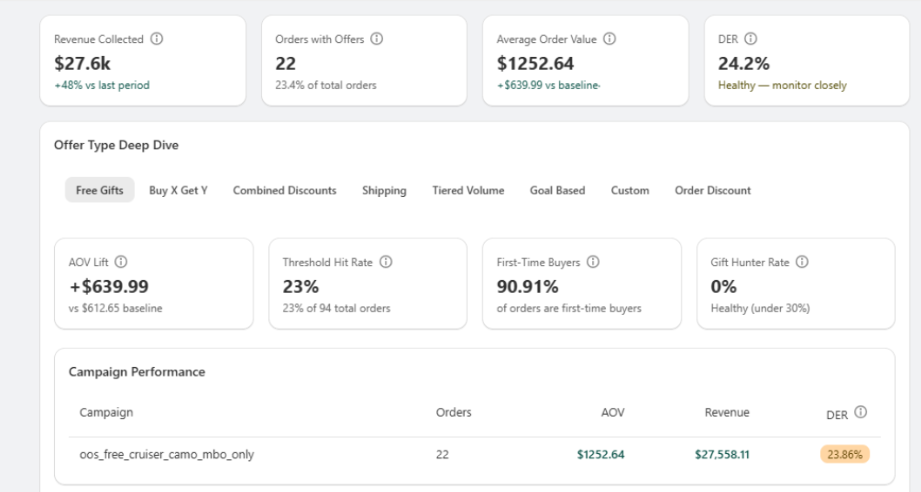
Kite’s Strategy Analytics gives merchants an overview of how their promotions are performing overall and also a drill-down into individual offer types. The dashboard brings key revenue, order, basket value, and discount metrics together in one place.
The most useful approach is to read these metrics together. Revenue collected shows what the store actually received after discounts, while orders with offers show adoption. Average order value helps merchants understand basket size, and DER puts the cost of those discounts into context.
Revenue Collected is the total amount you received after discounts were applied. It shows the actual revenue generated from orders after accounting for the discount given to customers.
For example, if a customer places a $100 order and receives a $20 discount, the Revenue Collected is $80. This metric helps merchants understand the actual amount earned from promotional orders rather than looking only at the original order value.
Orders with Offers is the number of orders that Kite offers. It shows how many customers are taking advantage of your promotions during the selected period.
This metric can help merchants understand how widely their offers are being adopted. However, a higher number of orders with offers does not automatically mean a promotion is performing well. It should be considered alongside revenue collected and average order value.
Average Order Value is the average cart size for orders with offers. It helps merchants understand how much customers are spending when they use a promotion.
For example, if a promotion generates $20,000 in Revenue Collected across 20 orders, the Average Order Value is $1,000. Comparing AOV against your usual baseline can show whether a promotion is encouraging customers to spend more per order.
DER measures what percentage of revenue you are giving back to customers as discounts. A lower DER generally means that the store is giving up less revenue through discounts.
For example, if a promotion generates $20,000 in revenue and costs $4,000 in discounts, the DER is 20%. Merchants should consider DER alongside revenue and AOV rather than evaluating it on its own.
A higher DER may be justified when a promotion generates significantly more valuable orders, while a high DER with little improvement in basket value may indicate that the offer needs adjustment.
Offer Type Deep Dive lets merchants evaluate how different promotion types perform across the store. Kite supports analysis across free gifts, Buy X Get Y, combined discounts, shipping offers, tiered volume discounts, goal-based offers, custom offers, and order discounts.
This view helps merchants understand which promotion mechanics are contributing to their goals and where individual offers may need to be optimized.
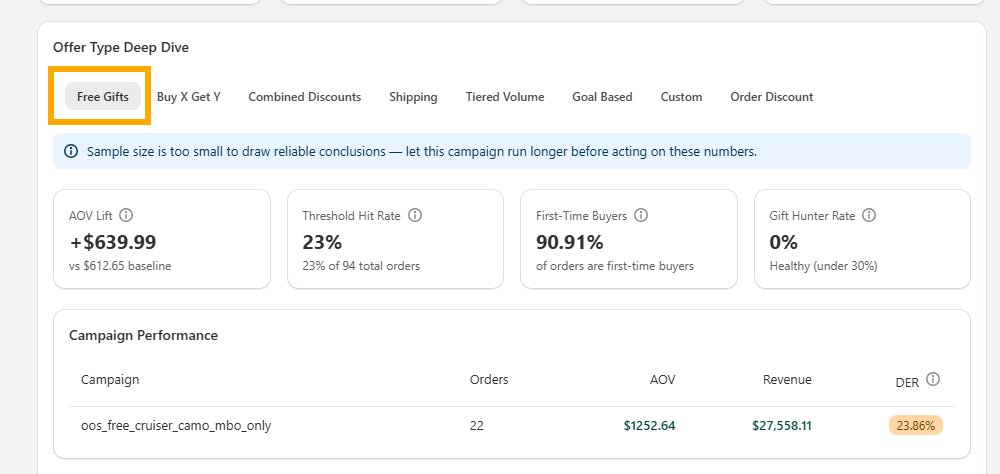
Free Gift promotions encourage customers to increase their cart value to unlock a free product. The offer works by turning a spending threshold into a purchase goal.
Kite helps merchants evaluate whether customers are actually increasing their spend to earn the gift, rather than simply redeeming an incentive on purchases they would have made anyway.
AOV Lift (Spend Threshold Motivation) measures how much more customers are spending compared with the store baseline to reach the gift threshold. If AOV Lift is low, the threshold may be too easy to reach or the gift may not be compelling enough. Raise the threshold or test a more desirable reward.
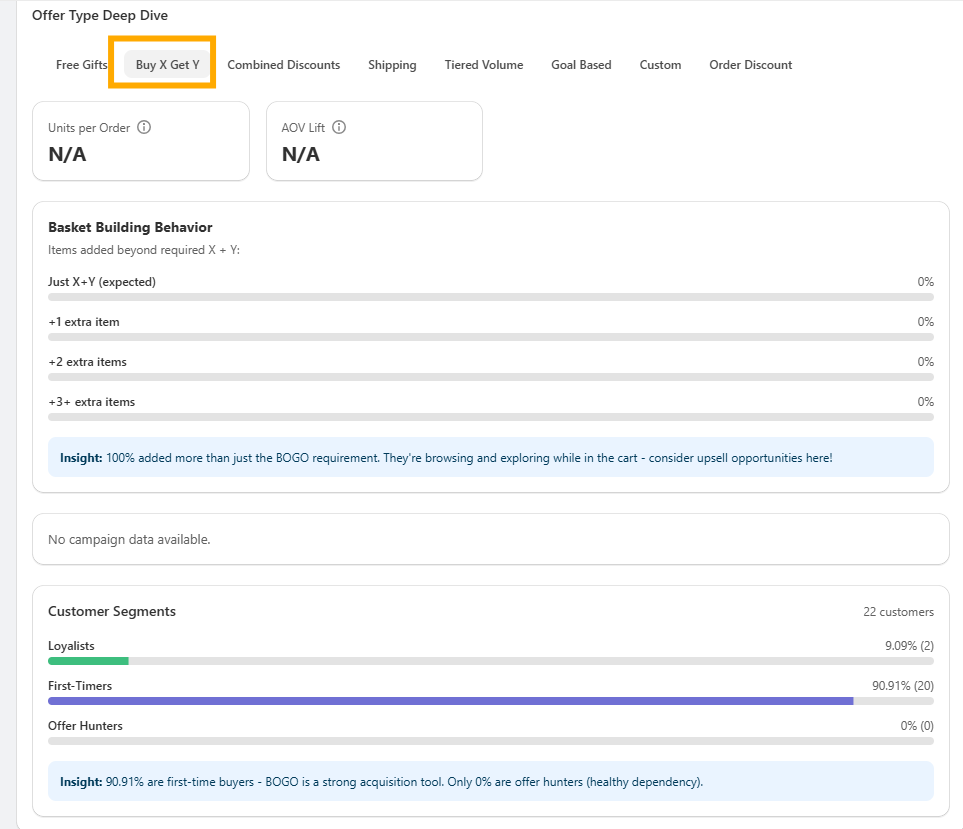
Buy X Get Y promotions encourage customers to add more qualifying products to their cart in exchange for a free or discounted product. Performance depends on whether customers increase the number of units they purchase, not just whether they redeem the offer.
Kite helps merchants see how customers build their baskets around the qualifying quantity and whether shoppers stop at the minimum requirement or continue adding products.
Units per Order (Basket Building) measures how many items customers add per order. If customers are not increasing their units per order, the BXGY mechanic is not effectively building baskets. Raise the qualifying threshold or introduce multi-tier rules to encourage customers to keep adding units.
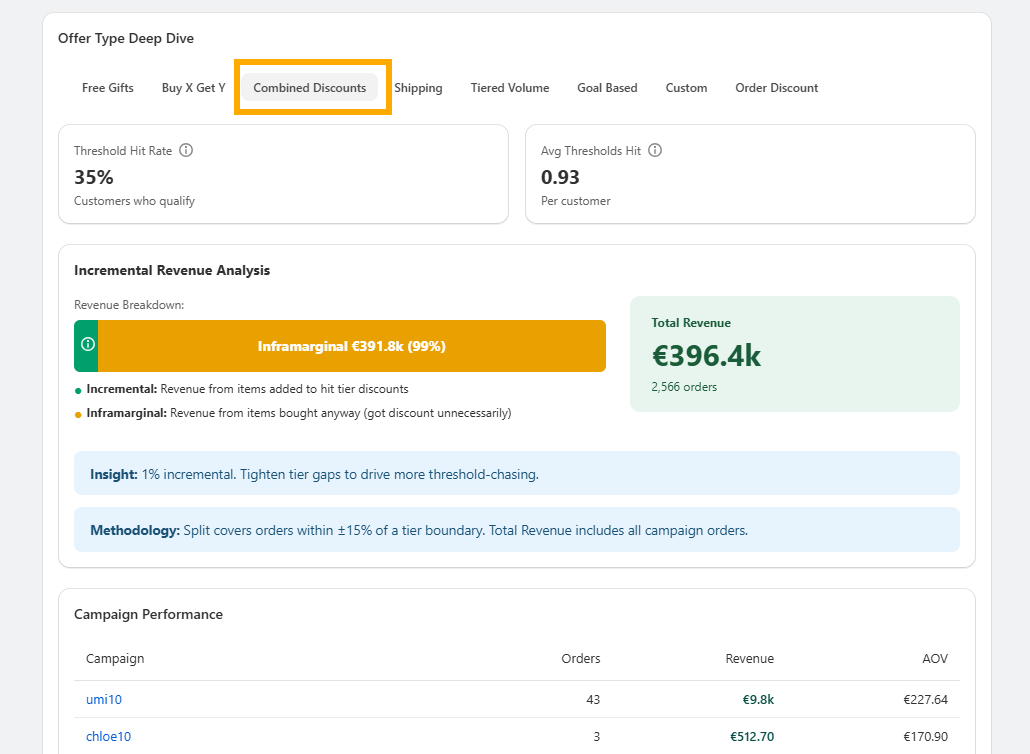
Combined Discounts stack multiple incentives, such as product discounts, order discounts, free shipping, and free gifts, within one offer. Since each incentive adds to the total promotion cost, higher redemption does not automatically indicate better performance.
Kite helps merchants compare revenue and AOV against DER and assess whether the combined offer is generating new revenue or discounting purchases customers would have made anyway.
Incremental Ratio measures whether the combined offer is driving genuinely new revenue rather than discounting purchases that would have happened anyway. If Incremental Ratio is low, tighten qualifying conditions or reduce discount depth. If DER is also increasing, identify the costly component and reduce or remove it.
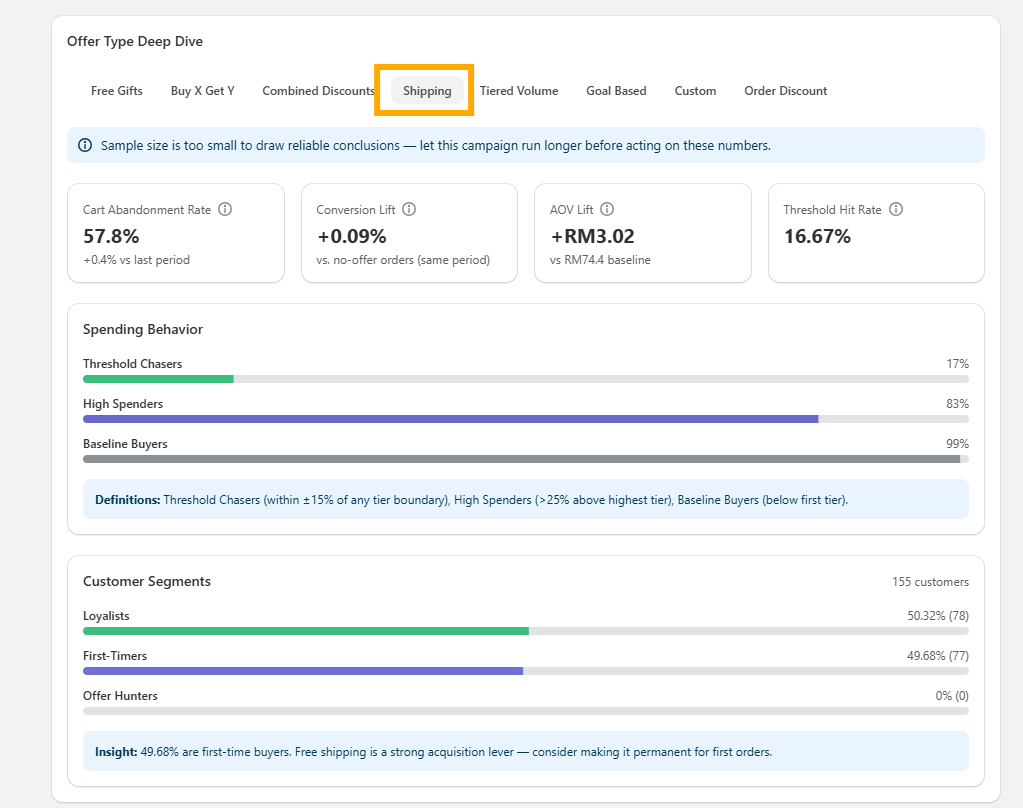
Free Shipping promotions remove the shipping cost barrier that can prevent customers from completing a purchase. Unlike other promotion types, the primary objective is often to increase completed orders rather than significantly increase basket size.
Kite helps merchants compare Orders, DER, and AOV Lift to determine whether free shipping is recovering potential purchases efficiently.
Orders Relative to DER (Conversion Efficiency) shows whether the campaign is generating more orders without disproportionately increasing shipping or discount costs. If orders are not increasing, the threshold may be too high or the offer may not be visible enough. If DER rises without a corresponding increase in orders, raise the qualifying threshold.
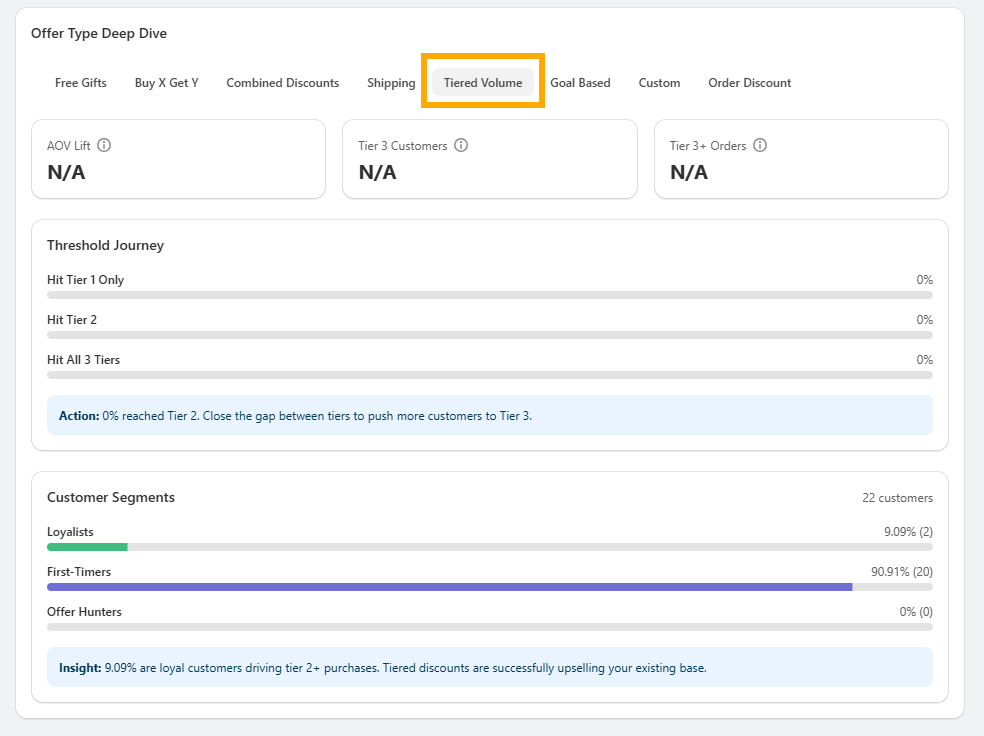
Tiered Volume Discounts encourage customers to spend more or purchase more units by offering progressively better rewards at higher thresholds. The key is understanding how customers move from one tier to the next.
Kite breaks this behavior down through AOV Lift, Tier 3 Customers, Tier 3+ Orders, and the Threshold Journey. Customer Segments also shows whether the promotion is mainly being used by loyal customers, first-time buyers, or offer-driven shoppers.
Incremental Ratio + Units per Order (Tier Climbing) shows whether customers are moving through the tiers and whether the additional spending represents new purchasing behavior. If customers cluster at the lowest tier, reduce the gap to the next tier.
If Incremental Ratio is low at higher tiers, those customers may already have been heavy spenders, so consider reserving higher discounts for customers who need more motivation to increase their spend.
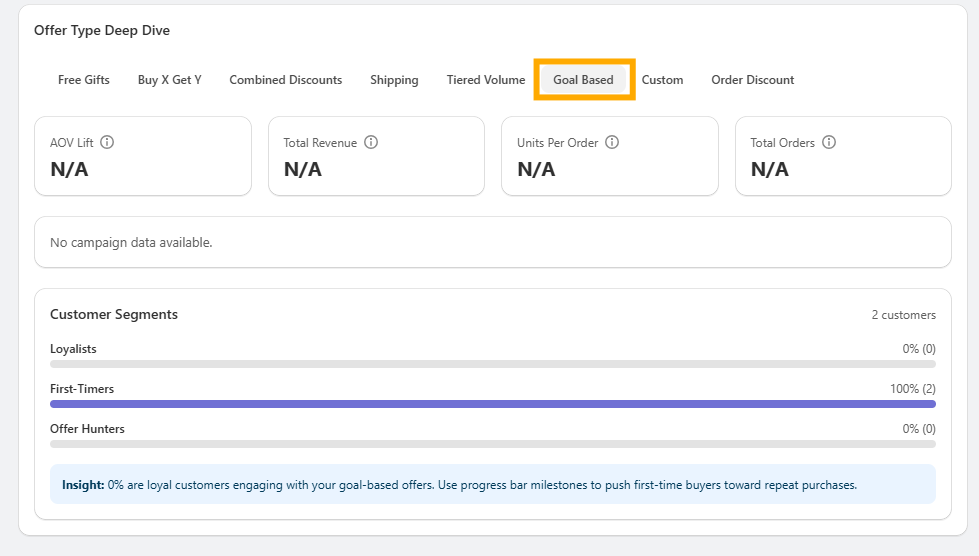
Goal-Based Progress Bars give customers a visible spending target and show their progress toward a reward. The progress bar works at the point where customers are adding or removing products from their cart.
Kite helps merchants determine whether the progress bar is creating additional spending or simply rewarding customers who were already going to reach the goal.
Incremental Ratio (Nudge Effectiveness) measures whether the progress bar is creating genuinely new spending behavior. A strong AOV Lift with a low Incremental Ratio means customers may have reached the goal without needing the progress bar. Raise the threshold if the goal is too easy, or test a more attractive reward if AOV Lift is also low.
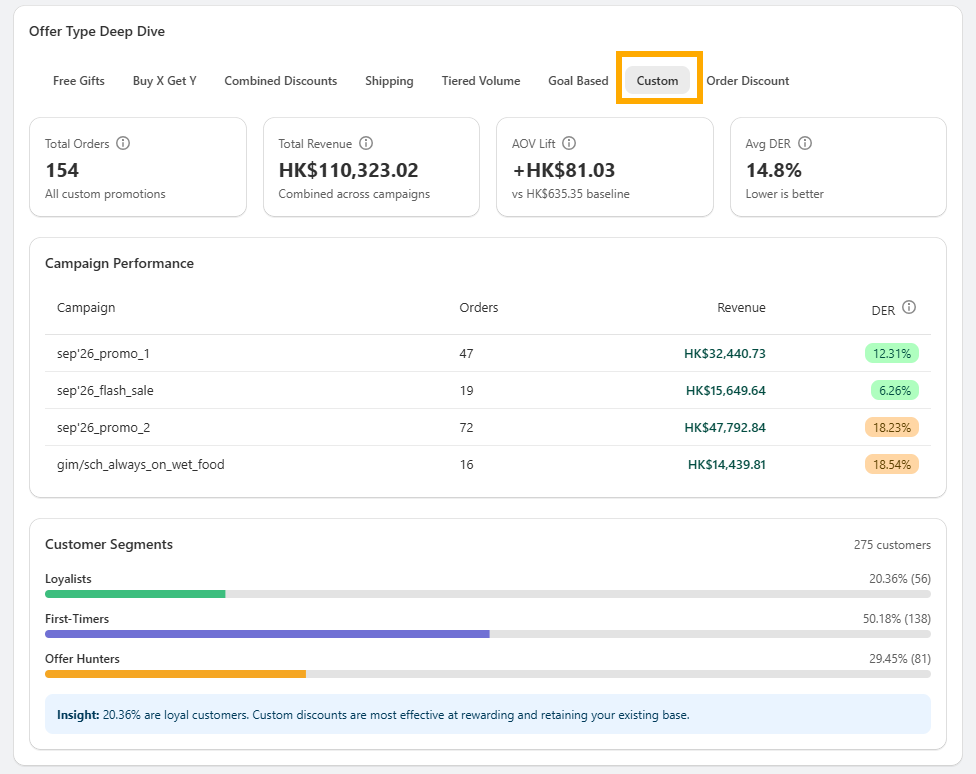
Custom Discounts allow merchants to run multiple independent, rule-based discount branches at the same time. Each rule can target different customer segments or product conditions and apply its own reward.
Kite helps merchants evaluate each rule separately so that underperforming branches do not get hidden by aggregate campaign performance.
DER per Rule Branch (Rule Efficiency) shows which individual rules are contributing enough revenue to justify their discount cost. Audit each rule regularly and make sure its conditions are specific enough to prevent discounts from applying too broadly. Pause rules that consistently show high DER and low revenue contribution.
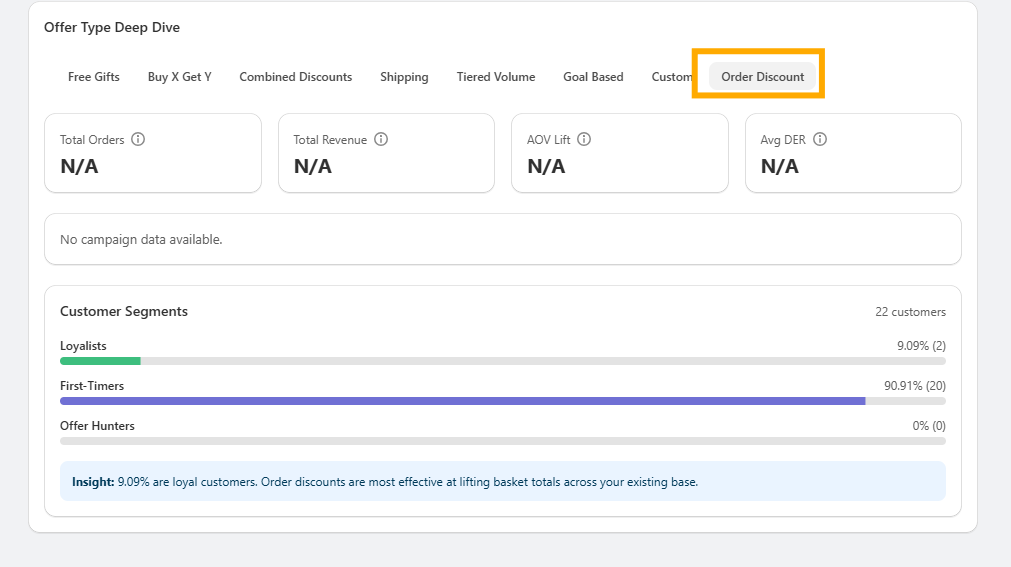
Order Discounts apply a percentage or flat amount off the entire order. They are commonly used for time-limited promotions, win-back campaigns, acquisition, and discount-code campaigns.
Because there is no qualifying purchase behavior, merchants need to monitor whether the discount is generating additional orders or simply reducing revenue on purchases that would have happened at full price.
DER (Discount Bleed Risk) is the key metric because order discounts have no qualifying behavior that requires customers to increase their purchase before receiving the discount. Use them in targeted, time-limited contexts such as win-back campaigns, exclusive segment codes, or flash sales, and avoid open-ended site-wide discounts that can increase unnecessary discount costs.
The purpose of discount analytics is not simply to monitor campaign performance. The real value comes from using those signals to make specific changes to your offer structure, thresholds, incentives, and customer journeys.
Kite Analytics helps you identify where your promotions are falling short and what you can change to improve their performance. Here are some common promotion problems you can diagnose using your store’s analytics:
If Revenue Collected is lower than expected, start by looking at Orders With Offers and Average Order Value. A low number of promotional orders may indicate weak offer adoption, while a healthy order count with low AOV may suggest that customers are not adding enough products.
Review the offer type, qualifying conditions, product selection, and placement to identify where customers may be dropping off.
When AOV is not increasing as expected, compare it with your normal order value. For threshold-based promotions, check whether customers are getting close to the qualifying amount but not reaching it.
You can then test a different threshold, product combination, or incentive structure to make the next purchase step more achievable.
A high DER means a larger percentage of revenue is being given back through discounts. This does not automatically mean the promotion is unsuccessful, but it does mean the incentive needs closer evaluation.
Compare DER with Revenue Collected and AOV. If discount costs are increasing without a meaningful improvement in order value or revenue, consider reducing the discount or changing the offer structure.
A low threshold hit rate can indicate that customers are not getting close enough to the qualifying amount. Review the threshold against your typical AOV and product prices.
If the gap is too large, customers may not see enough value in adding more products. A lower threshold or stronger product recommendations may make the offer more attainable.
A high Gift Hunter Rate can show that customers are strongly motivated by the free gift. That can be useful when the gift also encourages higher-value purchases.
However, if customers are purchasing only to claim the gift without meaningful basket expansion, the offer may need a different threshold, gift, or product combination.
If one promotion generates stronger results than similar campaigns, look beyond its revenue contribution. Compare AOV, DER, Orders With Offers, and customer behavior to understand what is driving the difference.
The winning offer may have a better threshold, product selection, incentive, or placement. Those insights can then inform your next promotion.
If one promotion type consistently outperforms others, investigate why customers respond to that mechanic. For example, Buy X Get Y may work better for products commonly purchased together, while free gifts may work better when customers are motivated by an added incentive.
Use the data to match promotion mechanics with specific products, customer segments, and business goals.
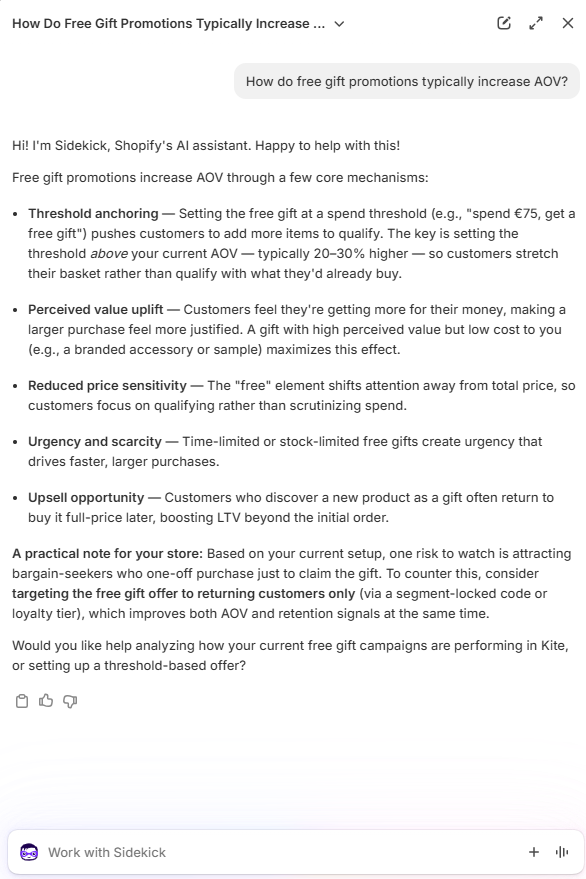
Kite’s integration with Shopify Sidekick makes it easier to investigate promotion performance without manually working through every campaign. Merchants can ask questions about their Kite promotions in natural language and use the resulting analysis to identify opportunities or investigate unexpected changes.
For example, you can ask which promotion generated the most revenue, which offer produced the strongest AOV, or which campaign had the most efficient DER. Sidekick can help surface the relevant performance information, while Kite provides the underlying promotion data and controls.
The workflow is straightforward: review the performance data, use Sidekick to investigate a specific question, make one targeted change, and monitor the result in Kite. This turns discount analytics into an ongoing optimization process rather than a report that is reviewed only after a campaign ends.
Open Kite from your Shopify admin and navigate to strategy analytics. Select the reporting period you want to review, then start with the performance overview before moving into the offer type deep dive and customer segments.

Then, from the right-side dropdown, go to Apps → Kite → Analytics.
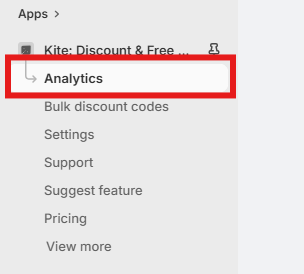
Starting with the overall view gives you the context needed to interpret individual campaigns correctly. You can then move from store-level performance to offer-level results and finally to customer behavior.
Effective promotion management is not about running more discounts. It is about understanding which incentives change purchasing behavior, increase basket value, and generate enough value to justify their cost.
Kite’s discount analytics gives merchants a clearer way to evaluate those trade-offs. By connecting revenue, orders, AOV, DER, offer performance, and customer segments, it helps turn promotion data into decisions that can improve performance over time.

.webp)

Rating

5.0
(
331
)
Using Kite Free Gift you can provide customers with free gifts based on customisable rules. You may encourage higher-value purchases and improve the shopping experience by automatically adding gift items to the customer's cart. You can even offer a free gift when a customer’s cart hits a certain value
Features

Customizable UI in store.
Offer Buy X Get Y (BOGO), free gift with purchase & tiered gift progress bar
Create volume discounts (buy 2 get 10% off) & tiered discounts ($400 - 20% off)
Display a progress bar for shipping, gift & discounts based on cart goals.
Customize discount widgets seamlessly.
Pricing
From $9/month. Free trial available.


.avif)