.svg)
.svg)


%20(1).png)
Our Apps Have Driven
5X AOV | 2X Conversions | $30M+ Additional Revenue
5X AOV | 2X Conversions | $30M+ Additional Revenue
.svg)


5.0 (3000+ Reviews)


Shopify Apps





.svg)

More traffic does not always mean more revenue. Shoppers may leave because a product page does not answer their questions, the mobile experience is difficult to use, or checkout has too many steps. Baymard’s research puts the average online shopping cart abandonment rate at 70.22%, showing how many potential purchases can be lost along the way.
Ecommerce CRO helps businesses find these gaps and improve the shopping experience so more visitors complete a purchase. In this guide, we’ll cover what ecommerce CRO services include, when you may need them, what they cost, and how to choose an agency. We’ll also cover Shopify-specific considerations, common hiring red flags, what to expect in the first 90 days, and how to measure results.
Ecommerce CRO helps stores turn more existing visitors into customers. It focuses on finding friction across the shopping journey and improving the areas that may be stopping shoppers from buying.
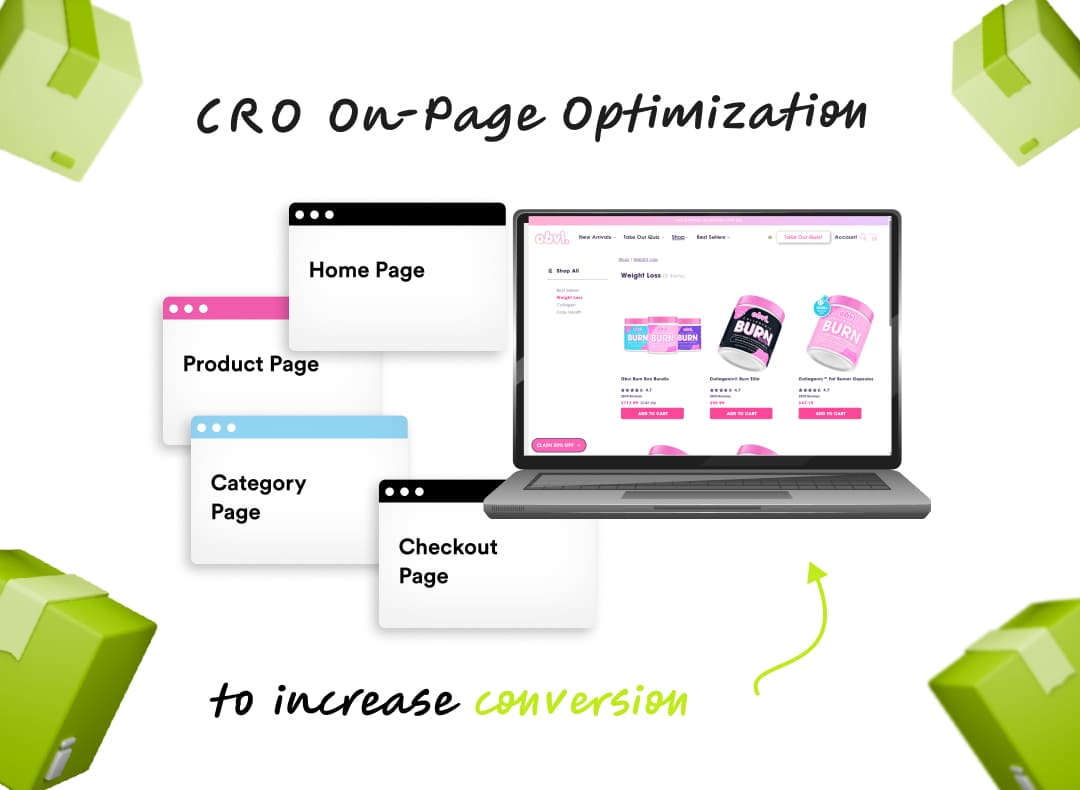
A CRO team looks at everything from landing pages and product discovery to product pages, cart, and checkout. It uses analytics, customer behavior, UX research, and testing to identify what needs to improve.
Ecommerce CRO services cover the key parts of the shopping experience that can influence whether a visitor buys. Depending on the store, this can include:
The value of CRO is not in the number of changes an agency makes. It is in finding the changes that can remove friction, improve the buying experience, and contribute to business growth. A stronger CTA may increase clicks, but a stronger product page that helps more shoppers complete a purchase has a much clearer commercial impact.
Ecommerce CRO becomes more useful when your store has enough customer activity to identify patterns, measure changes, and learn from experiments. But there is no universal traffic threshold that determines when you should start.
Low-traffic stores can still benefit from conversion optimization. Analytics cleanup, UX improvements, customer research, product-page improvements, technical fixes, and merchandising can address obvious friction without requiring large volumes of A/B test data.
If an agency recommends continuous A/B testing, ask how it is determined that your store has enough traffic and conversions. Sample size depends on factors such as your baseline conversion rate, minimum detectable effect, statistical power, and significance level. Evan Miller’s A/B testing calculator uses these inputs to estimate the sample size needed for a test.
For example, a store with a 2% baseline conversion rate, a 20% relative minimum detectable effect, 95% significance, and 80% statistical power would need roughly 21,000 visitors per variation. This is an illustrative calculation, not a universal traffic threshold.
This is why a promise to “run five tests every month” is not necessarily meaningful. If each experiment takes too long to reach a useful sample, the testing schedule can create activity without producing reliable insights.
For lower-volume stores, CRO can still create value. The focus simply shifts toward research, usability, merchandising, funnel analysis, and improvements that do not depend on rapid statistical testing.
There is no universal answer to whether an ecommerce brand should hire an agency. An in-house team can make sense when you already have analytics, UX, design, development, and experimentation capabilities and can keep those people consistently involved.
An agency can bring specialist research, testing experience, development resources, and an outside perspective without requiring a full-time CRO team. A hybrid model can work when your internal team owns implementation while an external specialist handles research, prioritization, experimentation, or strategy.
The key question is not simply “agency or in-house?” It is whether someone has a clear responsibility for turning evidence into tested improvements.
There is no single market rate for ecommerce CRO services. Pricing changes considerably based on testing volume, research depth, development work, traffic, store complexity, and whether the engagement is a one-time audit or an ongoing program.
Published provider pricing gives a useful sense of the range. For example, Aanve lists a $260 CRO audit and a $521/month CRO package, while Mediaverse lists CRO programs at $417 and $834 per month.
CROHound publishes CRO packages ranging from $2,000-$2,500/month to $7,500-$10,000/month, depending on the number of experiments, reporting, strategy support, and testing scope. Invesp, meanwhile, lists its Growth Program from $9,000/month for qualifying brands and also offers a performance-based model.
These are published provider prices, not an industry-wide average. The more useful comparison is what you get for the fee, including research, experimentation, design, development, analytics, reporting, and ongoing strategy.
We, at Skai Lama, also offer a free CRO audit, giving brands a lower-commitment way to identify potential conversion issues before deciding whether a larger CRO engagement makes sense.
Choosing a CRO agency is not just about comparing retainers or the number of tests they promise each month. You also need to understand how they find problems, what they do with the data, and how closely they will work with your team.
A good sales call should leave you with clear answers to those questions. If most of the conversation revolves around generic CRO tactics or promised conversion lifts, it is worth digging deeper.
Start by asking what they look at before recommending a change. A good agency should be able to talk through analytics, funnel data, customer behavior, UX issues, and your business goals rather than immediately suggesting a list of standard CRO fixes. Ask what happens before the first test goes live, too. You want to know that the agency has a clear reason for testing something and is not simply filling a monthly testing quota.
Ask who will handle strategy, design, development, analytics, and test implementation. Some agencies take care of the full process, while others provide recommendations and rely on the client's team to execute them. This becomes particularly important for Shopify stores. Ask whether the agency can work with your theme, apps, tracking setup, and checkout configuration, or whether your developers will need to handle those parts.
Not every test will increase conversion rate, and that is normal. Ask how the agency handles tests that lose, show no meaningful difference, or do not collect enough data to reach a clear conclusion. The reporting should also go beyond clicks and form fills. Depending on your business, you may want to see conversion rate alongside AOV, revenue per visitor, checkout completion, revenue, or margin.
Do not judge a case study by the biggest percentage increase on the page. Ask what the starting point was, what the agency changed, how long the test ran, and how the result was measured. It is also worth asking why that particular change was tested. If the agency cannot explain the problem behind the test or the evidence that led to the hypothesis, the reported lift does not tell you much.
Before signing, agree on who handles approvals, copy, design, development, analytics, testing, and reporting. This sounds basic, but unclear ownership can slow down even straightforward CRO work. The agency should be able to tell you what it needs from your team and what it will handle itself. That gives you a much clearer picture of both the workload and the value of the engagement.
Once you know what to look for in a CRO partner, you can start building a shortlist. Some of the common ecommerce and Shopify CRO agencies include:
These agencies differ in their services, areas of specialization, and engagement models, so use your store’s needs and internal resources to narrow down your options
The first 90 days should establish whether the agency has a useful process, not just produce a pile of recommendations. The exact timeline will vary by store, but the engagement should move from research to prioritized action and then to measurable learning.
The first month should establish a baseline through analytics, funnel analysis, UX review, customer behavior, technical checks, and relevant qualitative research. By the end of this stage, you should have clear priorities rather than dozens of disconnected recommendations.
The second month is where prioritized hypotheses move into design, development, and testing. The exact number of experiments depends on traffic, technical complexity, and the agency’s methodology, so more tests do not automatically mean better CRO.
By the third month, the agency should be able to show what was tested, what happened, what remains uncertain, and what should happen next. You should also have a clearer understanding of which parts of the funnel deserve continued investment.
The exact stack varies by store, but a CRO agency may work across several categories. The tools matter, but the methodology behind how they are used matters more.
Common tools include Google Analytics 4, Shopify Analytics, Google Tag Manager, and the analytics capabilities built into experimentation platforms. These help identify traffic sources, funnel behavior, product performance, checkout drop-offs, and conversion trends.
Tools such as Microsoft Clarity, Hotjar, FullStory, and Crazy Egg can help identify scrolling behavior, clicks, rage clicks, navigation patterns, and other behavioral signals. These tools are particularly useful when quantitative analytics tells you where a problem exists but not why.
VWO, Optimizely, and other experimentation platforms can be used to run controlled tests, depending on the store's technical setup and traffic. The testing platform matters less than whether the agency has a sound testing methodology.
Aanve, for example, publicly lists GA4, GTM, VWO, Optimizely, Hotjar, Clarity, FullStory, Crazy Egg, Typeform, Qualaroo, and SurveyMonkey among its CRO tools. The point is not to use every platform, but to choose tools that answer specific research and testing questions.
Surveys, customer interviews, usability testing, on-site polls, and customer-support data can add context that analytics alone cannot provide. A strong CRO team uses these sources selectively rather than collecting data simply because a tool is available.
Do not evaluate an agency case study based on the biggest percentage on the page. Start with the baseline, because a percentage lift means little without understanding the original conversion rate, traffic, audience, seasonality, and test duration. You should primarily look for five things:
CROHound, for example, publishes case studies with baseline-to-result conversion figures and revenue outcomes rather than only describing the work performed. You should still treat agency case studies as selected examples rather than guarantees of what your store will achieve.
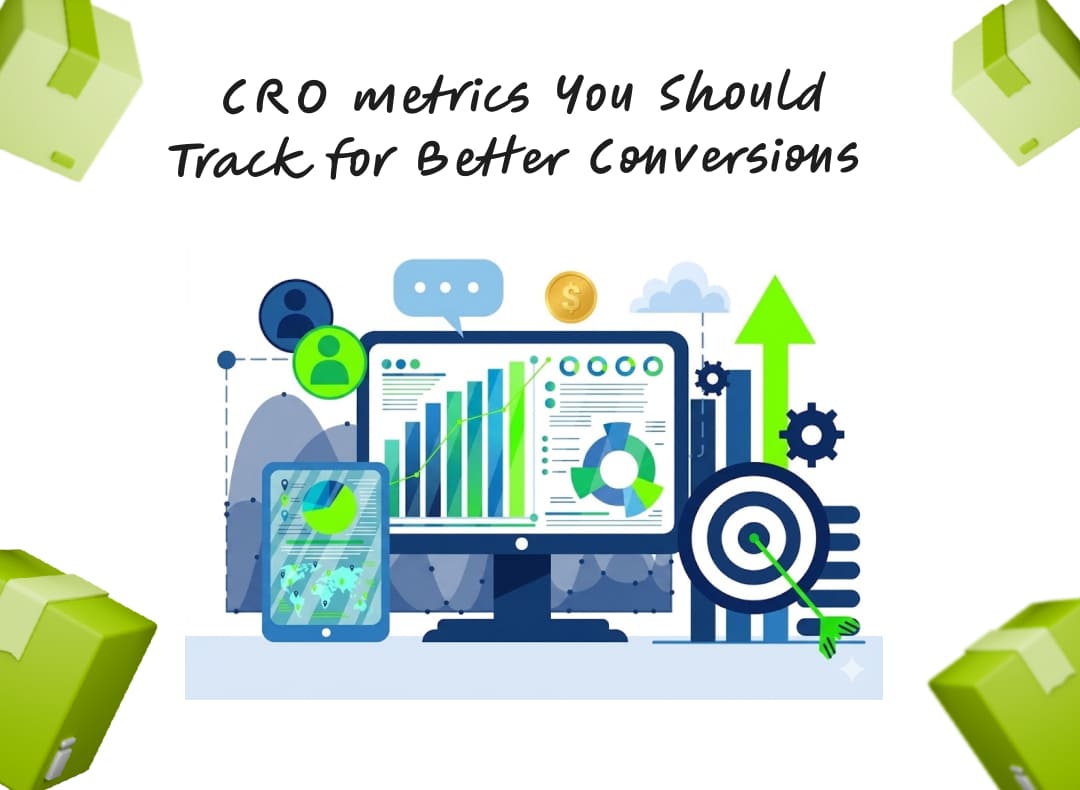
Ecommerce conversion rate is important, but it should not be the only number you watch. Depending on your business model, useful metrics can include conversion rate, revenue per visitor, average order value, checkout completion, cart-to-checkout rate, product-page engagement, repeat purchase rate, gross margin, and experiment-level revenue impact.
The right measurement framework should reflect what your business is trying to improve. For example, an experiment that increases conversion rate but attracts lower-value orders may not be commercially attractive.
Likewise, a change that improves AOV while slightly reducing conversion could still deserve attention if total contribution improves. The agency should help you understand that trade-off rather than reporting a single percentage as the final answer.
A good ecommerce CRO is not about changing more elements on a website. It is about making better decisions about where to focus, what to test, and what the results actually mean.
Before hiring an agency, look at its research process, technical capabilities, testing methodology, reporting, pricing, and relevant case studies. If the agency can explain why a change is worth testing and how success will be measured, you have a much stronger basis for evaluating the engagement.
For Shopify stores, technical knowledge matters just as much as CRO strategy. Theme architecture, apps, checkout capabilities, analytics, and implementation constraints can all affect what an agency can realistically test. Start with the evidence, then decide how much CRO your store actually needs.