.svg)
.svg)

.svg)
.svg)



Our Apps Have Driven
5X AOV | 2X Conversions | $30M+ Additional Revenue
5X AOV | 2X Conversions | $30M+ Additional Revenue
.svg)


5.0 (3000+ Reviews)


Shopify Apps





.svg)

Product bundle examples that lift AOV: The 12 stores in this guide average 15 to 30% higher order values than single-item purchases, driven by offer structure and UX mechanics, not discount size alone.
Start discounts at two items: Every high-performing product bundle example here activates the first saving tier at two items, not three or five, so shoppers enter savings mode on their very second pick.
Match structure to catalog type: Guided two-step flows work for apparel pairings, open pick-and-mix grids suit collectibles and hobby kits, and subscription-first layouts outperform one-time offers for daily consumables.
Discount is the reward, not the reason: OMY Laboratoires lifts basket size with no discount at all. Max Effort uses free swag and membership status. The offer frame matters more than the percentage.
Live price updates close the loop: Every product bundle example here shows a real-time total with the original price struck through, removing "should I add one more?" doubt at the exact moment the shopper is deciding.
These 12 product bundle examples come from real Shopify stores. Each one is broken down by catalog logic, offer design, and the exact UX mechanics that get shoppers to add more. Whether you sell skincare, supplements, apparel, or craft kits, the patterns in these product bundle examples are worth copying.
Brands that offer product bundles report average order values 15 to 30% higher than single-item purchases,[1] and Easy Bundle Builder merchants across Shopify have collectively generated over $30M in additional revenue through bundling.[2] The common thread in the best product bundle examples is not the size of the discount. It is the structure: the product selection logic, the offer framing, and the real-time mechanics that make buying one more item feel like the obvious next step.
A good product bundle example does one thing clearly: it makes buying more feel like the rational choice rather than the indulgent one. The best examples do this through three levers, all covered in detail in our complete guide to product bundling for Shopify stores. First, product selection logic: the catalog is organized so shoppers naturally want several items (by outcome, by character, by routine step) rather than one. Second, offer framing: the saving is shown in real time, before the cart, as a visible reward for each item added. Third, structure: the layout matches how the products are actually used, a guided two-step flow for a paired outfit, an open grid for a pick-and-mix, a subscription-first layout for a daily consumable.
The 12 product bundle examples below cover beauty, supplements, apparel, craft, grooming, and licensed-apparel categories. Each breakdown identifies the best-for use case, the catalog selection strategy, how the discount is structured, and the UX mechanics that do the conversion work. All 12 were built on Shopify using Easy Bundle Builder.
Best for: Skincare and beauty stores with a broad catalog and a gifting use-case, where the goal is to lift order value through curation rather than discounting.
OMY Laboratoires is a strong product bundle example for beauty brands that want to raise average order value through curation instead of discounts, because it frames its builder as a gift set the shopper assembles rather than a "bundle." That naming shifts the mindset from hunting for a deal to building something personal and giftable, and the page drops shoppers straight into a clean product grid with a persistent set-builder panel beside it.
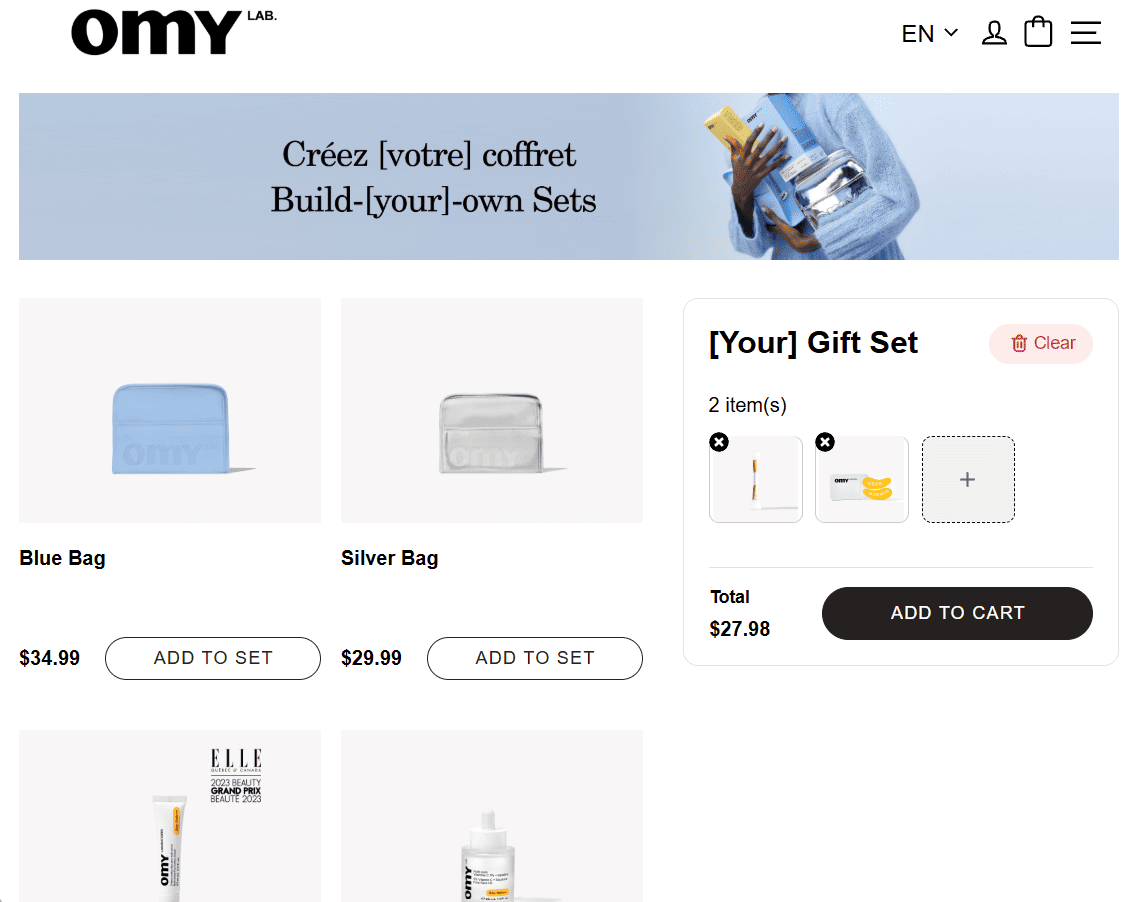
The assortment is mixed across two layers. Packaging items, a Blue Bag ($34.99) and Silver Bag ($29.99), sit first in the grid, so the opening decision is the vessel, which primes the "I'm building a set" frame. Behind that is the full skincare range: award-flagged heroes (the eye contour cream carries an ELLE 2023 badge), routine staples like exfoliating gel and serums with inline "Choose Options" variants, and targeted treatments such as the spot gel and lip balm. The mix ladders up to what OMY sells overall, personalized routines, so a self-built set acts as a sampler of the full regimen that seeds future purchases.
Instead of a stacked discount, the incentive is the curated gift format plus a post-build play. Items group into one gift box (each line shows "Box: 1" at checkout), and the real margin lever appears after the bundle: checkout surfaces a "Complétez votre routine" module with discounted subscription add-ons (Instant-Lift eye patches at CA$42.50 from CA$49.99, Hydra-Thermal water at CA$13.60 from CA$15.99). The set drives AOV through composition; the discount is reserved to convert one-time buyers into subscribers at peak intent.
This is a single-step, open build. The right-hand panel does the cognitive work: three dashed "+" slots frame a soft target of three items so empty slots read as "not done yet," without hard-capping additions. A live count and running total update on every click, each item shows as a removable thumbnail, and a Clear button lowers the risk of experimenting. A branded "Preparing Bundle" state reassures shoppers the custom set is being assembled. Built natively with the Easy Bundle Builder, it lets a varied catalog of bags, variant-driven serums and heroes live in one coherent builder, nudging shoppers from "should I buy this product?" to "is my set complete?"
Takeaway: Name the bundle after the outcome the shopper wants, put the packaging decision first to set the frame, and save your discount for a post-build subscription upsell rather than diluting the set.
Built using Easy Bundle Builder.
Best for: Supplement and consumable stores with a single-format catalog in a similar price band, where the goal is to move shoppers from one product to a full multi-product routine.
NutriPeak is a textbook product bundle example for supplement brands that want to turn single-product buyers into routine buyers, because it pairs goal-based products with a visible discount ladder that rewards every extra item added. The "Build your own bundle" page opens with "Create your personalized bundle to live your best," and three reassurance badges (a 30-day guarantee, "Save up to 20% more with subscription," and "Update or cancel anytime") answer the main objections to committing to several supplements at once.
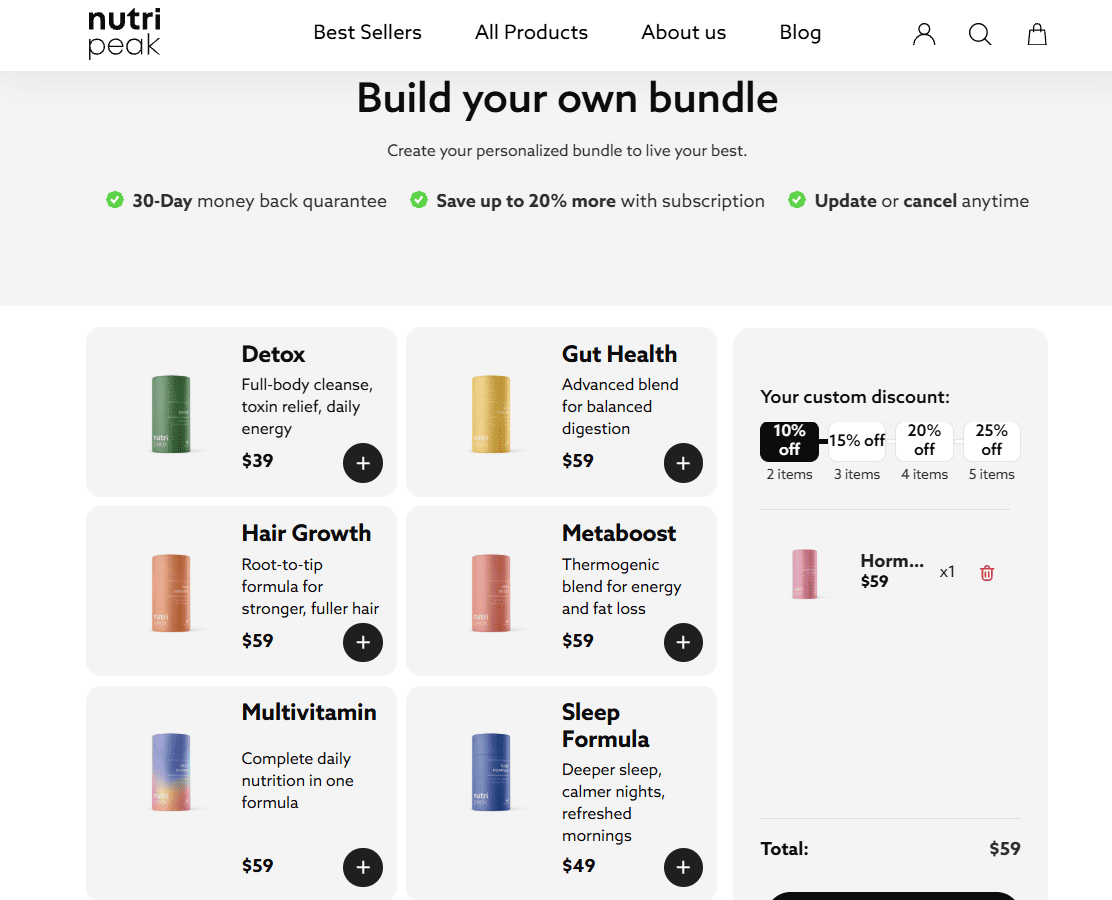
Every product is named for its outcome, not its ingredient: Detox, Gut Health, Hair Growth, Sleep Formula, Stress Relief, Testo Boost, Hormonal Balance and more, each with a one-line benefit. Organized by goal, shoppers instinctively build a stack covering several things they care about rather than comparing similar products and picking one. The catalog is also format-consistent, single-serve tubs in a tight band ($39 to $68), which keeps mixing intuitive and the discount math simple. This is effectively the brand's core offer, a personalized daily routine, expressed as a self-assembled kit.
The pricing logic only makes sense once you see how NutriPeak sells a single product. On any product page, the discounts reward buying multiples of the same bottle (two save 8%, three save 17%) or subscribing (about 9%). That leaves a gap: the shopper who needs one bottle each of several different goals pays full price on every line because they never stack quantity on one SKU. The build-your-own bundle captures exactly that shopper. Its ladder, 10% off two items up to 25% off five, extends the brand's quantity-discount logic sideways across the catalog instead of vertically within one product, rewarding breadth the way stock-up buyers are rewarded for depth. At 25%, the top tier beats both the three-bottle and subscription discounts, so the brand spends its best price on the behaviour it wants most: multi-formula adoption.
This is a single-step, open build, which suits interchangeable goal-based products. The persistent panel lists each item with an editable quantity stepper and one-tap delete, so adjusting never feels final. The discount ladder sits at the top of that panel, keeping the reward for "one more" permanently in view, and the active tier highlights as achieved tiers stay marked, turning savings into a progress bar. The total shows the original price struck through with a live percentage badge ($166 to $141 at three items), replacing "am I overspending?" with proof of savings. Built natively with the Easy Bundle Builder, it handles per-item quantities, real-time tiered pricing and subscription toggles in one embedded module.
Takeaway: Name products by outcome so shoppers want several, then keep a tiered discount ladder that starts at two items in permanent view so every addition visibly climbs them toward a bigger saving.
Built using Easy Bundle Builder.
Best for: Apparel and outdoor lifestyle brands with strong category pairings (a hat and a pair of shorts, a top and a bottom), where the goal is to sell a complete look and lift order value by pairing two complementary categories.
Back Down South is a clean product bundle example for apparel brands that want to sell an outfit rather than a single item, because it guides shoppers through a two-step "build your look" flow that pairs the brand's two hero categories. The builder opens on a progress slider with two clearly labelled stages, "Pick Your Hat" and "Pick Your Shorts," so the shopper immediately understands they are assembling a coordinated outfit, not browsing a catalog. The whole flow leans on the brand's outdoor identity, reinforced lower on the page by trust signals like "Hand-packed in Texas" and "Trusted by 150,000+ customers, rated 4.7/5."
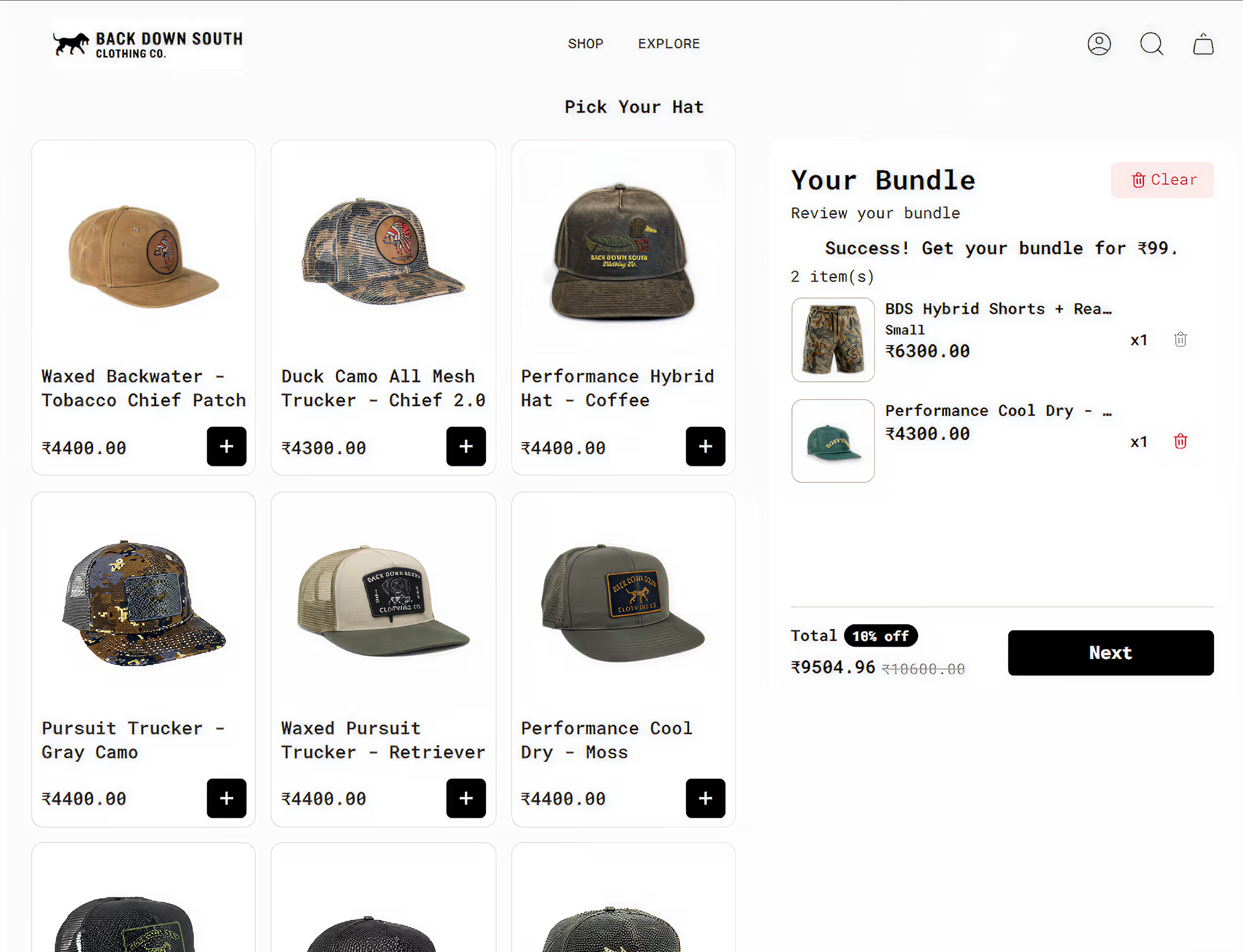
This is a fixed-composition pairing of two complementary categories rather than an open multi-item builder, and that constraint is the point. Step one presents the full hat range, waxed caps, mesh truckers and performance styles such as the Waxed Backwater, Duck Camo Trucker and Performance Cool Dry, all in the same price band. Step two presents the BDS Hybrid Shorts in multiple colorways (Realtree Camo, Black, Sage) with an inline size selector. By limiting each step to one category, the brand removes decision paralysis and ensures every completed bundle is a genuine outfit that maps to how the customer actually dresses for the outdoors. It also pairs a lower-priced accessory (the hat) with a higher-priced apparel piece (the shorts), so the bundle reliably attaches an add-on category to the anchor purchase rather than two interchangeable items.
The incentive is a fixed bundle price that is lower than buying the two pieces separately, surfaced before the shopper commits. The panel headline reads "Pick Your Hat and Shorts to Bundle and Save," with the discounted bundle total shown up front, so the saving is framed as the reward for completing the look rather than a coupon applied later. The logic behind clubbing these specific categories is margin and attachment: a hat alone is a low-ticket impulse buy and shorts are the higher-value anchor, so pairing them turns a single-item order into a two-piece order while the modest bundle discount costs less than the gained basket value. Because the discount only unlocks when both steps are completed, it actively pulls accessory-only shoppers up into a full outfit purchase.
This is a guided two-step flow, which suits a curated pairing far better than an open grid. The progress slider sets expectations up front (two decisions, then done), and a persistent "Your Bundle" panel reviews the running selection with each item, its price and a remove control. Step one ends in a clear "Next" button rather than a final checkout, so advancing feels low-commitment, and step two ends in "Add To Cart," giving the flow a satisfying beginning, middle and end. Inline size and color options are handled inside each step, so the shopper never leaves the builder to a separate product page. Built natively with the Easy Bundle Builder, the two-step sequence, per-step product feeds and variant selectors run inside one embedded module, which is what lets a simple outfit pairing feel like a guided styling experience.
Takeaway: When two categories naturally go together, force a short guided flow with one category per step and show the bundle saving up front, so a low-ticket accessory reliably pulls the shopper into buying the higher-value anchor piece too.
Built using Easy Bundle Builder.
Best for: Supplement and consumables brands with a wide same-format catalog and a community-driven identity, where the goal is to turn a single-product buyer into a multi-product stack buyer and ideally a subscriber, using gamified status and free gifts rather than discount alone.
Max Effort Muscle is one of the more advanced product bundle examples for consumables brands, because it layers a membership game, a free-gift reward and a subscription upsell on top of a simple "Build A Stack" builder. The page leads with its rules in plain language: "Mafia Membership = Additional 20% off," "2 Products = Silver Member," "3+ Products = Gold Member." That framing turns adding products into leveling up a status rather than spending more, which fits the brand's loud, community-first personality (reinforced by a "What are you training for?" goal quiz that points shoppers toward the right stack).
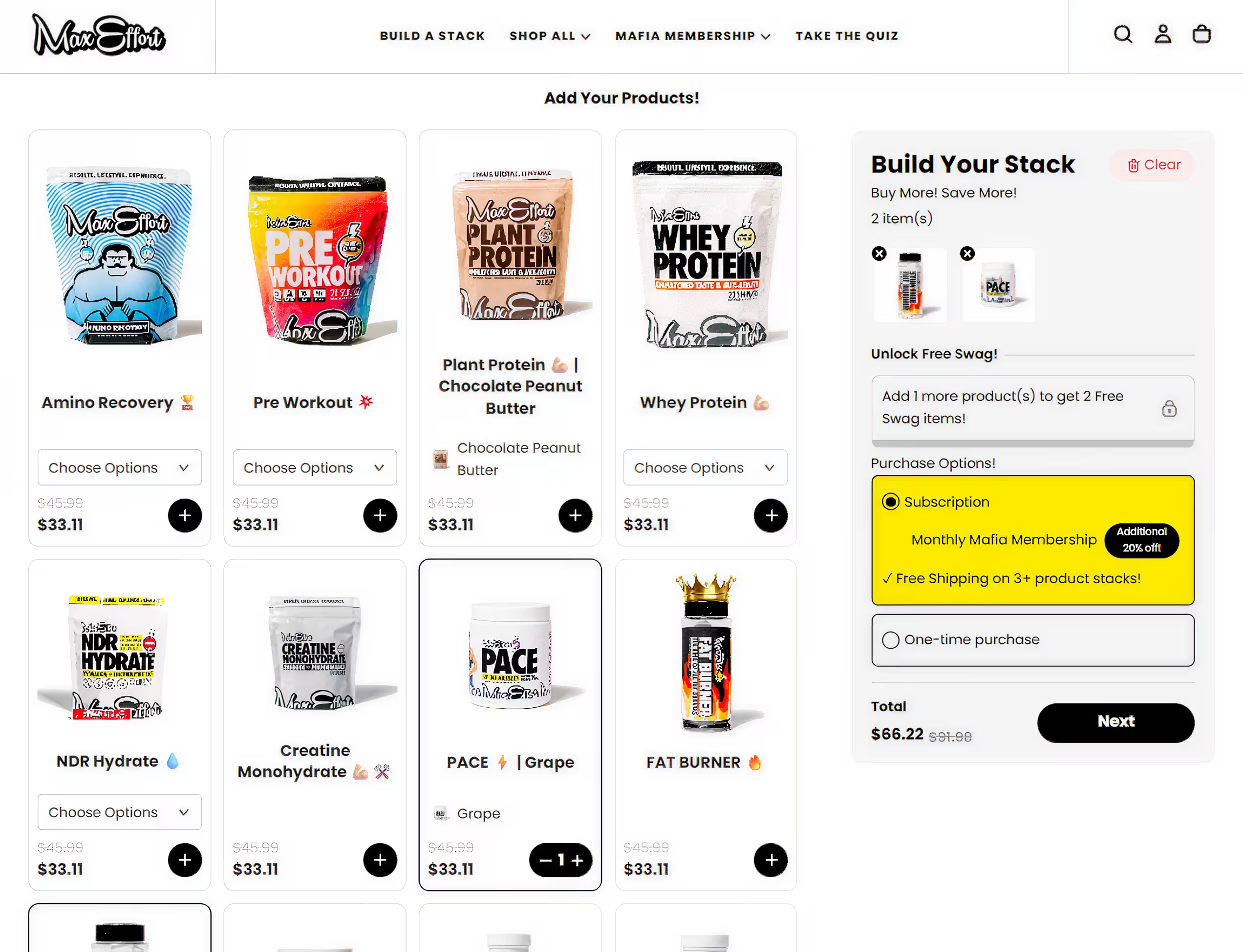
The builder draws from the brand's full supplement range: proteins (whey and plant), pre-workout, amino recovery, creatine, hydration, fat burner, greens and vitamins, all in a single tub or pouch format and all priced identically. Because every item is interchangeable in price and format, shoppers feel free to mix across goals (a protein plus a pre-workout plus a recovery) rather than comparing similar items and choosing one. The catalog is the brand's entire core lineup, so the stack is effectively a self-assembled supplement regimen, which both raises basket size now and seeds repeat purchases of the individual SKUs later. Flavor variants are chosen inline via a "Choose Options" selector so the assortment's complexity never forces a detour to a product page.
The pricing logic stacks three distinct incentives, which is what makes it work. First, every product in the builder is already marked down from $45.99 to $33.11, so the shopper is in savings mode on the very first item, not just at a quantity threshold. Second, hitting 3 products unlocks 2 free swag items, a tangible gift reward layered on top of the price cut, which gives a concrete reason to climb from a 2-item Silver stack to a 3-item Gold one. Third, choosing the subscription option (Monthly Mafia Membership) adds another 20% off plus free shipping on 3+ stacks. The reason these products are clubbed and priced this way is conversion sequencing: the flat per-item discount removes the entry objection, the free-swag threshold pulls the basket to three items, and the membership discount converts that one-time stack into recurring revenue, each lever solving a different drop-off point.
This is a two-step flow signalled by a progress slider ("Choose Your Products!" then "Add Your Free Swag Item(s)!"), so the free gift is visible as a destination from the start. The persistent "Build Your Stack" panel does the heavy lifting: it shows item count, thumbnails with one-tap remove, a live total with the original price struck through ($137.97 down to $99.33 at three items), and a dynamic "Unlock Free Swag" bar that counts down "Add 1 more product to get 2 Free Swag items" until it flips to a green "Congrats, you've unlocked 2 Free Swag items." That real-time progress and reward confirmation is the core CRO mechanism: it converts "should I add another?" into "I'm one step from a reward." The subscription versus one-time choice sits right in the panel so the recurring option is considered at the moment of commitment. Built natively with the Easy Bundle Builder, the membership tiers, per-item pricing, free-gift threshold, variant selectors and subscription toggle all run inside one embedded module.
Takeaway: Reframe "buy more" as "level up" by attaching membership status and a free-gift threshold to item count, keep a live progress bar to the reward in permanent view, and place the subscription option inside the builder so the one-time stack converts to recurring revenue at the point of decision.
Built using Easy Bundle Builder.
Best for: Brands selling a durable "system" plus a repeat-purchase consumable (a device and its refills, a base kit and its add-ons), where the goal is to lock in the hardware cheaply and get the shopper choosing the consumables that drive repeat orders.
PINX is a smart product bundle example for brands built on a razor-and-blades model, because it runs the bundle inside a single product page rather than a separate builder: the "Ultimate Kit" is a fixed-price hardware set that the shopper personalizes and expands by choosing their own nail designs. The page opens with strong proof (a 4.9 rating and "10,000+ Happy Customers") plus three benefit lines ("Salon-quality manicure," "Lasts 2+ weeks," "Easy removal with no nail damage"), so the value case is made before any selection begins.
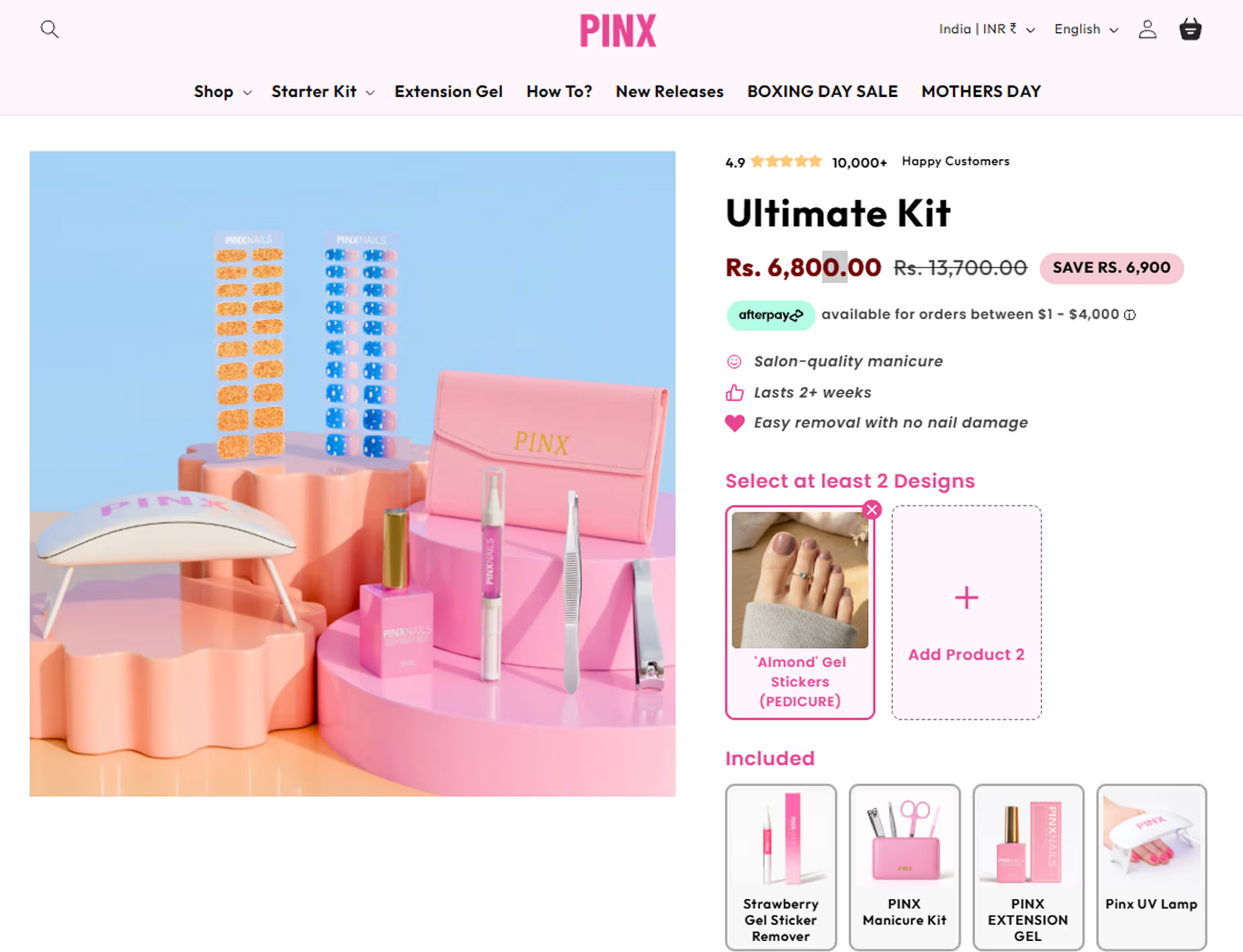
The kit cleanly separates two product types. The "Included" block is the fixed, durable hardware that always ships: the UV lamp, extension gel, manicure tool kit and gel sticker remover, the equipment a customer only needs to buy once. The expandable part is the consumable: gel nail sticker designs ('Acorn', 'Adore', 'Affair' and dozens more, including pedicure variants) that the shopper picks via "Add Product" slots. This split is the whole strategy. By bundling the one-time tools with the customer's first designs, PINX gets the hardware into the home while letting the shopper self-select the exact looks they want, which both personalizes the purchase and introduces the repeat-purchase catalog they will come back to. The categorization maps directly to how the product is actually used: tools plus the designs you apply with them.
The pricing works on two layers that reinforce each other. The base kit is anchored hard against buying the components separately, shown as roughly half price with a prominent "SAVE" callout, which makes acquiring the full hardware system feel like a one-time bargain. Then, inside the design picker, a threshold incentive ("Add 2 products to get an extra discount") rewards the shopper for loading up on designs, the consumable that determines lifetime value. The logic is classic razor-and-blades economics: the durable tools are discounted aggressively to remove the barrier to entry, because the real margin lives in the designs the customer will reorder for years. The bundle's job is to make the first design purchase generous and easy so the reorder habit starts immediately.
This is a single-page, expandable bundle rather than a multi-step wizard, which suits a fixed kit with optional additions. The "Add Product" slots sit right under the price, and clicking one opens a full design drawer with imagery, names and prices, so choosing designs feels like shopping a lookbook rather than configuring a product. A floating bar in that drawer keeps a running total and item count visible with a clear "Done" button, and a banner at the top of the drawer counts the shopper toward the extra-discount threshold, turning "add one more design" into a visible reward. The persistent "Add to cart" button and the always-visible "Included" hardware reassure the shopper exactly what they are getting at every moment. Built natively with the Easy Bundle Builder, the fixed-kit-plus-expandable-designs structure, the design picker drawer and the threshold offer all live inside the product page, which is what lets a PDP double as a personalized bundle builder.
Takeaway: If you sell hardware plus consumables, bundle them on one product page with the durable items discounted hard as the hook and the consumables chosen by the shopper, then add a threshold discount on the consumables so the first reorder-driving purchase is generous and the habit starts on day one.
Built using Easy Bundle Builder.
Best for: Hobby, craft and collectible brands with a catalog of similarly priced themed items, where the goal is to turn a single-item purchase into a multi-item haul by tapping the collector instinct and rewarding volume.
Willy Wölle is a charming product bundle example for hobby and craft brands, because it lets beginners assemble their own package of crochet kits inside a single product page and rewards them for picking more. The page is positioned squarely at newcomers and promises everything in one parcel, with step-by-step videos and the brand's own beginner-friendly yarn. The benefit bullets keep it simple and reassuring (easy, sustainable and best quality, perfect for beginners), and an explicit "how it works" note tells shoppers they can choose as many kits as they like and build the parcel exactly to their taste.
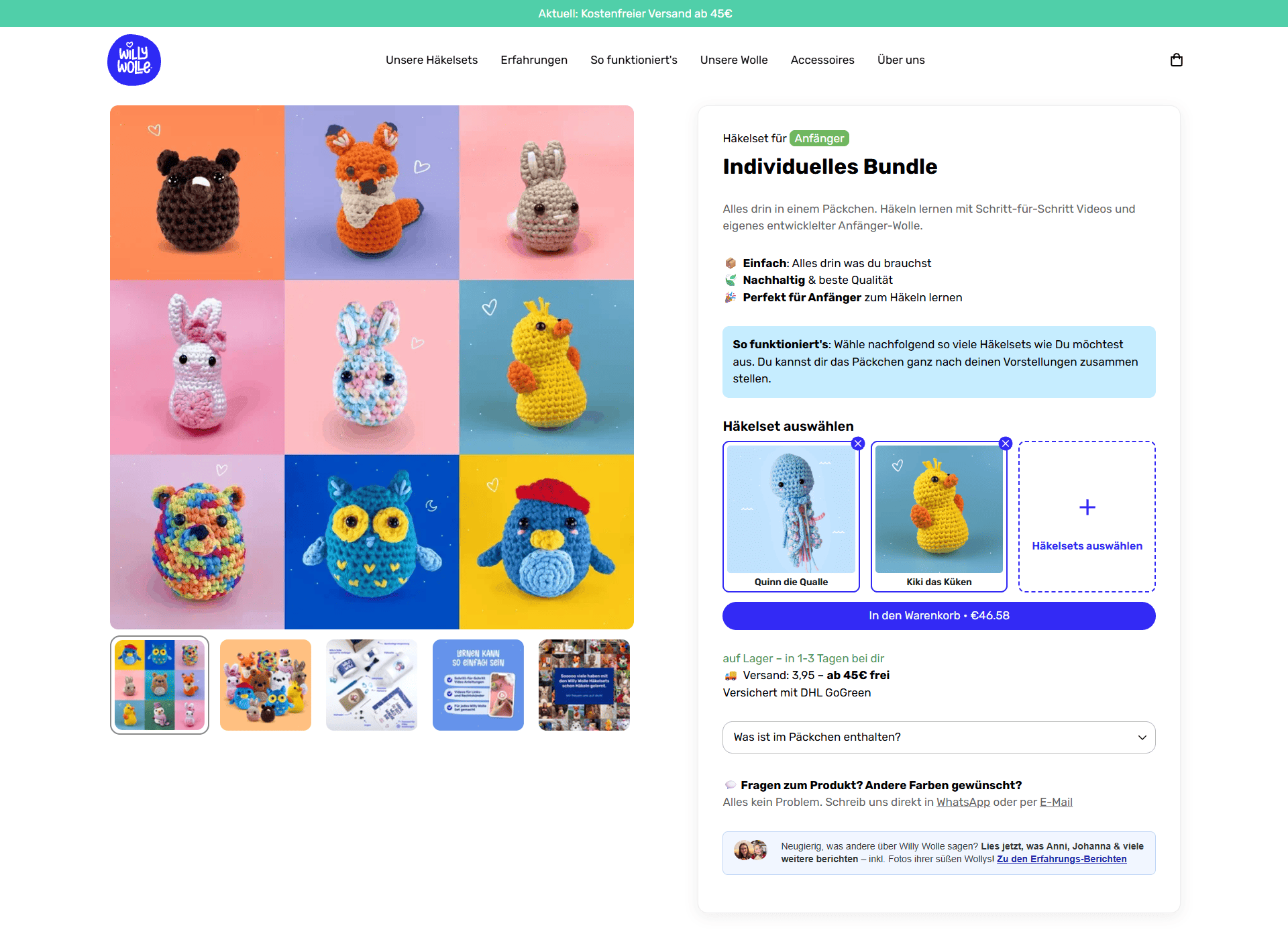
The builder pulls from the brand's range of themed amigurumi animal kits, each a self-contained beginner project: Bella the bear, Bruno the little bear, Emil the polar bear, Emma the owl, Felix the fox, a series of bunnies and more. Every kit sits at the same price point (around €28.40, with the odd premium design like a €34.50 option), and some offer variants such as a scarf in red or green. The selection logic is built around the collector instinct: because the kits are cute, characterful and uniformly priced, a shopper rarely wants just one. Uniform pricing also keeps the discount math intuitive and makes every "add one more" feel like an equal-sized, low-risk decision. The catalog is the brand's core product expressed as a pick-and-mix, so the bundle is really the natural way to shop the whole range at once.
The incentive is a tiered volume discount stated plainly at the top of the picker: "From 2 kits you save 18%, from 5 even 35%." The reason these specific items are clubbed and priced this way is that they are interchangeable, single-serving projects, so the brand has nothing to lose by encouraging breadth and a lot to gain in basket size. Starting the discount at just 2 kits puts the shopper in savings mode the moment they pick a second character, and the jump to 35% at five gives a strong reason to keep going. A free-shipping threshold (over €45) sits just above a two-kit order, nudging shoppers who are close to it to add another kit to clear both the discount tier and free delivery at once. The math is engineered so that buying a small collection always feels meaningfully better value than buying one.
This is a single-page, expandable bundle with a selection drawer rather than a multi-step flow, which fits a pick-and-mix of equal items. Clicking the "Select crochet kit" slot opens a visual grid where each kit shows its photo, name, price and a select button that turns into a quantity stepper once chosen, with a checkmark and highlighted border confirming the pick. A floating bar stays pinned with the live count and the discounted total shown against the struck-through original (for example €56.80 reduced to €46.58 at two kits), so the saving is proven in real time as the shopper builds. The discount headline sits permanently above the grid, keeping the "pick more, save more" promise in view. Built natively with the Easy Bundle Builder, the selection drawer, per-kit quantities, variant options and tiered pricing all run inside the product page, which lets a simple craft catalog behave like a playful collection builder.
Takeaway: When your catalog is full of similarly priced, collectible items, let shoppers pick and mix them on one page and start a tiered discount at just two items, so the collector instinct and a visible live saving turn a single purchase into a multi-item haul.
Built using Easy Bundle Builder.
Best for: Supplement and natural-health stores whose catalog spans multiple product types and formats, where the goal is to lift order value by letting shoppers combine across species and formats while a tiered discount rewards volume.
Tyroler Glückspilze is a well-built product bundle example for natural-health brands with a multi-format range, because it wraps a "build your own bundle" in a time-bound campaign and a transparent discount ladder. The builder is framed as a "Power Up Week" promotion ("Create your bundle and save up to 25%"), which adds gentle urgency and an occasion to act. A clean three-step explainer (choose products, the discount is applied automatically, add to cart) removes any doubt about how the saving works, so even a less tech-comfortable customer understands the deal before they start.
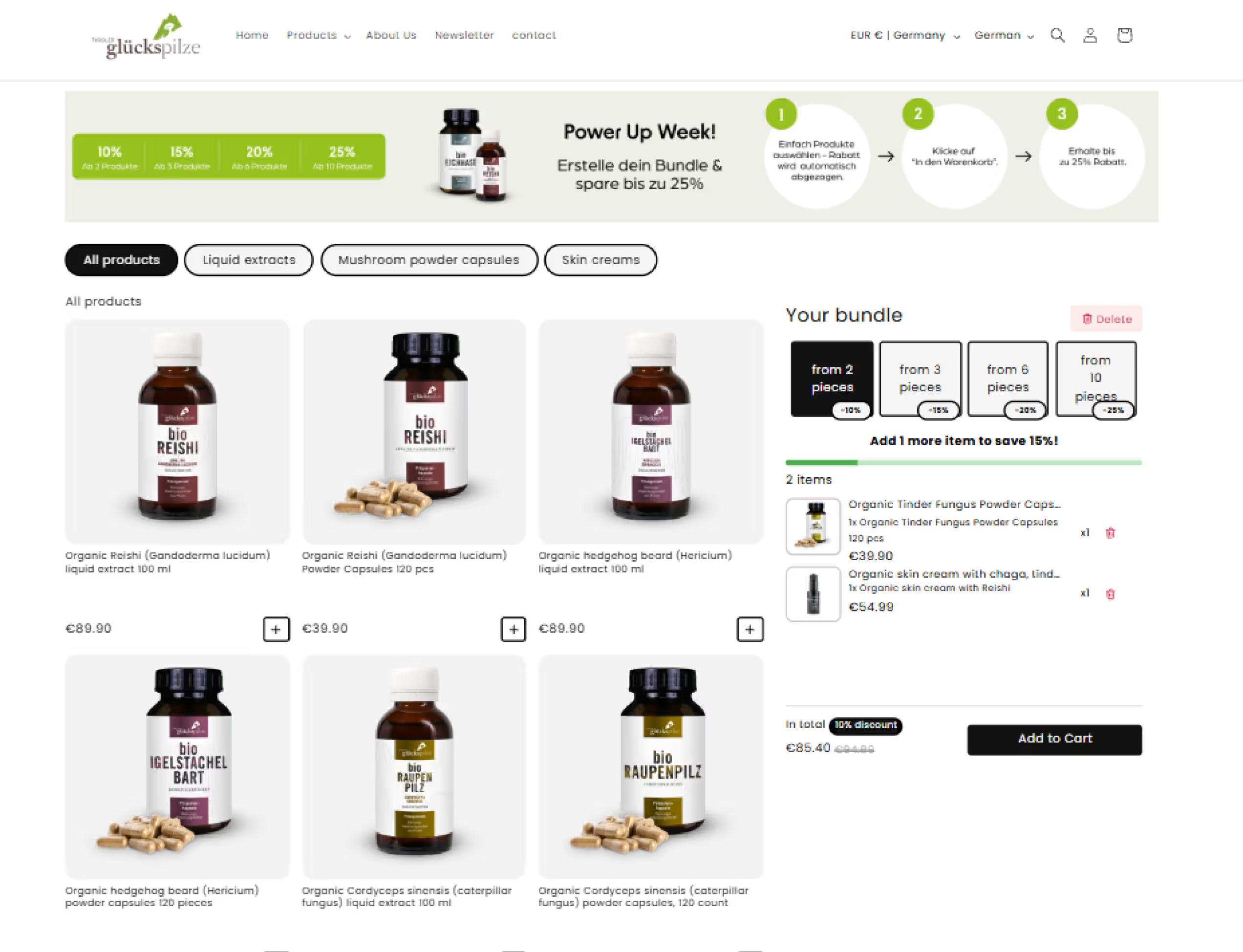
The catalog is organized two ways at once, by mushroom species and by format, and the builder surfaces both. Category tabs across the top (All Products, Liquid Extracts, Mushroom Powder Capsules, Skin Creams) let shoppers filter by the form they prefer, while the products themselves cover the brand's medicinal-mushroom range: Reishi, Hericium (Lion's Mane), Cordyceps and more. Crucially, each species appears in two formats, a liquid extract (around €89.90) and a powder-capsule version (around €39.90), so the catalog naturally invites combination rather than a single pick. A customer interested in Reishi might take both the extract and the capsules, or pair Reishi capsules with Hericium capsules, and the category tabs make assembling either kind of bundle effortless. The structure maps onto how these supplements are actually used, by goal and by preferred format, so the bundle reads as a personalized protocol.
The incentive is a four-step volume discount: 10% from 2 items, 15% from 3, 20% from 6 and 25% from 10. Because items range from roughly €39.90 capsules to €89.90 extracts, the discount tiers do real work across very different basket sizes, and starting at just 2 items means a shopper pairing one extract with one set of capsules is already saving. The wide gap up to the 6 and 10-item tiers is aimed at heavier users and gifting or stock-up buyers, who can combine several species and formats into one larger order. The campaign framing ("Power Up Week," up to 25% off) gives the whole ladder a reason-to-buy-now, and the dual-format catalog ensures there are always enough complementary items to climb it.
This is a single-step, open builder with category filtering, which fits a broad multi-format catalog better than a forced sequence. The persistent "Dein Bundle" panel shows the four discount tiers as cards with their percentages, the active tier highlighted, plus a dynamic progress line and bar that count the shopper toward the next saving ("Add 1 more item to save 15%"). Each selected product appears with a quantity stepper and a one-tap delete, and the total updates live with the original price struck through and a percentage-off badge (for example €129.80 reduced to €116.82 with a "10% Rabatt" flag at two items). That live "almost at the next tier" prompt is the core conversion lever: it makes adding one more bottle feel like reaching for a reward rather than spending more. Built natively with the Easy Bundle Builder, the category tabs, per-item quantities, tiered pricing and live progress messaging all run inside one embedded module.
Takeaway: When your range spans multiple formats of the same products, add category tabs so combining is effortless and pair a tiered discount with a live "add one more to reach the next tier" prompt, so shoppers naturally build a multi-format protocol instead of buying one bottle.
Built using Easy Bundle Builder.
Best for: Personal-care and grooming brands whose catalog covers a complete routine across several categories, where the goal is to convert a single-product trial into a full-shelf replacement and ideally a subscription.
HygieneLab is a polished product bundle example for grooming and personal-care brands, because it frames the build-your-own bundle as assembling a physical "Box" and rewards shoppers for filling it. The header is direct: "Build Your Bundle, the more you buy, the more you save," with "Save up to 30% off" stated plainly and a seasonal campaign (a Father's Day promo) layered on top for urgency. A "What are you shopping for today?" prompt (Body, Hair, Face, Everything) helps the shopper orient toward the part of the routine they care about.
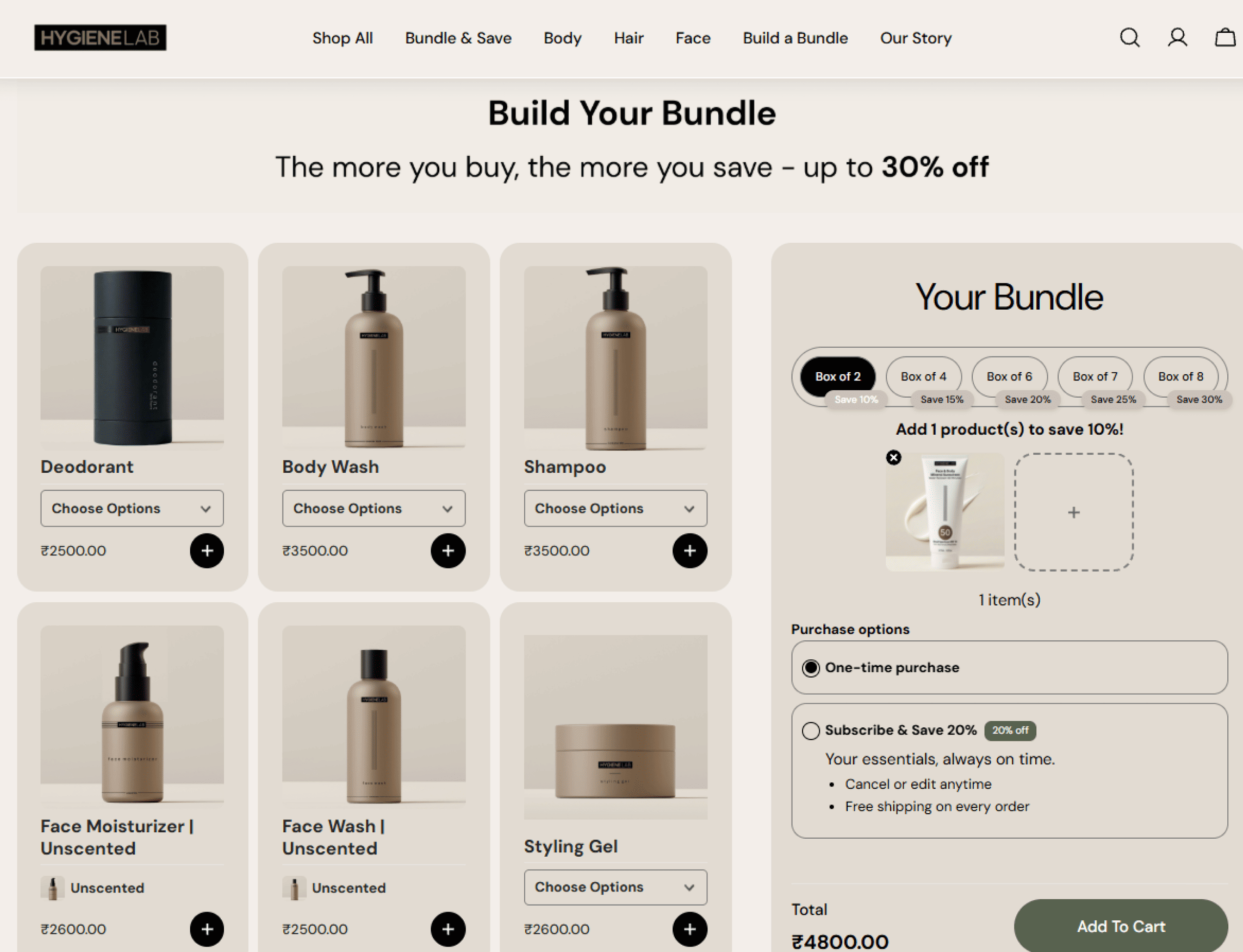
The builder spans the brand's entire grooming routine across three clear categories: Body (deodorant, body wash, body lotion, shave cream), Hair (shampoo, conditioner, styling gel) and Face (face moisturizer, face wash), all available unscented with scent variants via "Choose Options." Prices sit in a consistent band, so no single item dominates the box. The selection logic is a full-shelf replacement: because the catalog covers head-to-toe care, a shopper assembling a box naturally recreates their entire bathroom shelf in one order rather than buying a single product. Organizing by routine category makes it obvious what's missing (have a shampoo, no conditioner yet?), which quietly encourages completeness.
The incentive is a tiered discount expressed as box sizes rather than a plain percentage ladder: Box of 2 (save 10%), Box of 4 (save 15%), Box of 6 (save 20%), Box of 7 (save 25%) and Box of 8 (save 30%). Framing the tiers as "boxes" reinforces the physical-kit metaphor and makes each tier feel like a defined product to aim for rather than an abstract threshold. Running alongside is a Subscribe and Save 20% option with free shipping on every order, which is the strategically interesting part: at 20%, the subscription out-discounts the smaller boxes, nudging a two or four-item shopper toward recurring delivery instead of a one-off box. The box ladder grows the one-time basket while the subscription captures lifetime value, each aimed at a different buyer.
This is a single-step, open builder with a fixed-slot visual, which suits a routine catalog. The "Your Bundle" panel shows the box tiers as selectable chips with their savings, the active box highlighted, and the slots fill with product thumbnails as items are added, reinforcing the sense of packing a real box. A dynamic line counts the shopper toward the next box ("Add 2 more products to save 15%"), and the total updates live with the original price struck through and a percentage-off badge. The one-time versus Subscribe and Save choice sits directly in the panel so recurring delivery is weighed at the moment of decision. Built natively with the Easy Bundle Builder, the box tiers, category-spanning product feed, variant selectors, live progress and subscription toggle all run inside one embedded module.
Takeaway: Frame your tiers as physical "boxes" to aim for rather than abstract percentages, span the builder across a full routine so shoppers replace their whole shelf, and price your subscription to beat the smaller boxes so undecided buyers convert to recurring delivery.
Built using Easy Bundle Builder.
Best for: Single-product consumable brands (drinks, snacks, daily supplements) sold in multi-unit packs, where the goal is to remove flavour-commitment risk, scale order size by pack count, and convert a trial into a recurring subscription.
Neutonic is a focused product bundle example for single-SKU consumable brands, because rather than bundling different products it bundles volume and variety of one product, the productivity drink, while steering hard toward subscription. The page opens with the value case made up front (premium nootropics, 120mg natural caffeine, zero sugar) and benefit tags for Focus, Mental Performance, Energy and Alertness, then breaks the purchase into two clean numbered steps: "1. Choose Your Flavours" and "2. Subscribe or One-Time Purchase." That structure turns a simple multipack into a guided, personalized build.
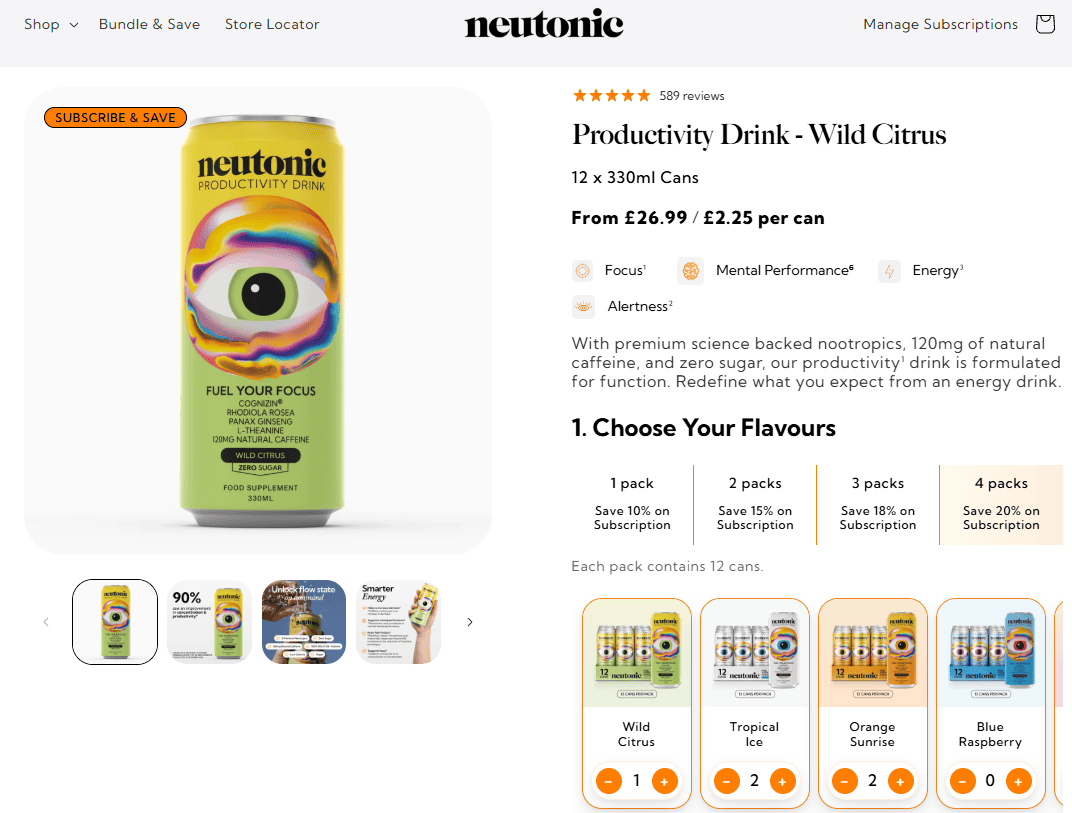
Because the catalog here is essentially one product in several flavours (Wild Citrus, Tropical Ice, Orange Sunrise and more), the "selection" is a flavour mix-and-match within a fixed 12-can pack. Each flavour has its own plus and minus stepper, so the shopper composes a pack from whatever blend they like rather than committing all 12 cans to a single taste. For a repeat consumable, the biggest objection to buying in volume is "what if I don't like a whole case of one flavour?" Letting the shopper spread a pack across flavours removes that risk entirely and makes a 12-can commitment feel safe. The pack itself is the unit of categorization, and stacking multiple packs is how the bundle scales.
The pricing is built around pack count and subscription rather than a generic item ladder. Pack tiers escalate the subscription saving: 1 pack saves 10%, 2 packs 15%, 3 packs 18% and 4 packs 20%, so buying more packs deepens the recurring discount. Neutonic marks Subscription as "Best Value," layers on a free Focus Pouch gift on the first order, and reassures with "skip, pause or cancel anytime" to defuse commitment anxiety. Even the one-time price carries a discount (for example £29.99 shown reduced to £26.99), so there is no full-price option, while subscription always wins on value. The whole offer is engineered to make recurring delivery the obvious, lowest-risk choice.
This is a guided two-step build on a single product page rather than a multi-product builder, which suits a one-SKU, flavour-driven catalog. Step one presents the pack tiers as a clear row with their savings ("each pack contains 12 cans"), then the flavour cards with steppers let the shopper compose the case visually. Step two presents Subscription versus One-time as two large selectable cards, with the subscription card pre-selected, badged "Best Value," and carrying its benefits, a frequency dropdown ("every 4 weeks") and the free-gift callout, so the recurring option is both the default and the most attractive. A single sticky "Add to Cart" button shows the live price with the original struck through, keeping the saving visible at the moment of decision. Built natively with the Easy Bundle Builder, the flavour-mix steppers, pack tiers, subscription toggle and free-gift logic all run inside the product page.
Takeaway: If you sell one consumable in multiple flavours, let shoppers mix flavours within a pack to remove the "what if I don't like it" risk, scale the discount by pack count, and make a subscription the pre-selected "best value" with a first-order gift so trials convert straight into recurring revenue.
Built using Easy Bundle Builder.
Best for: Licensed, fandom-driven, or graphic-apparel brands with a wide catalog of similarly priced designs across many franchises, where the goal is to turn a single-shirt purchase into a multi-shirt haul by tapping fan enthusiasm and rewarding volume.
Contenders Clothing is a strong product bundle example for fandom and licensed-apparel brands, because it lets shoppers assemble their own pack of officially licensed tees and rewards them for going bigger. The page leads with "Build A Bundle And Save" and a panel headed "Bundle More, Save More!," set against hero imagery spanning recognizable properties (The Godfather, WWE, Muhammad Ali). The brand's whole identity, "officially licensed apparel we all love," is built on nostalgia and fandom, and the bundle leans directly into that by inviting fans to grab several favorites at once.
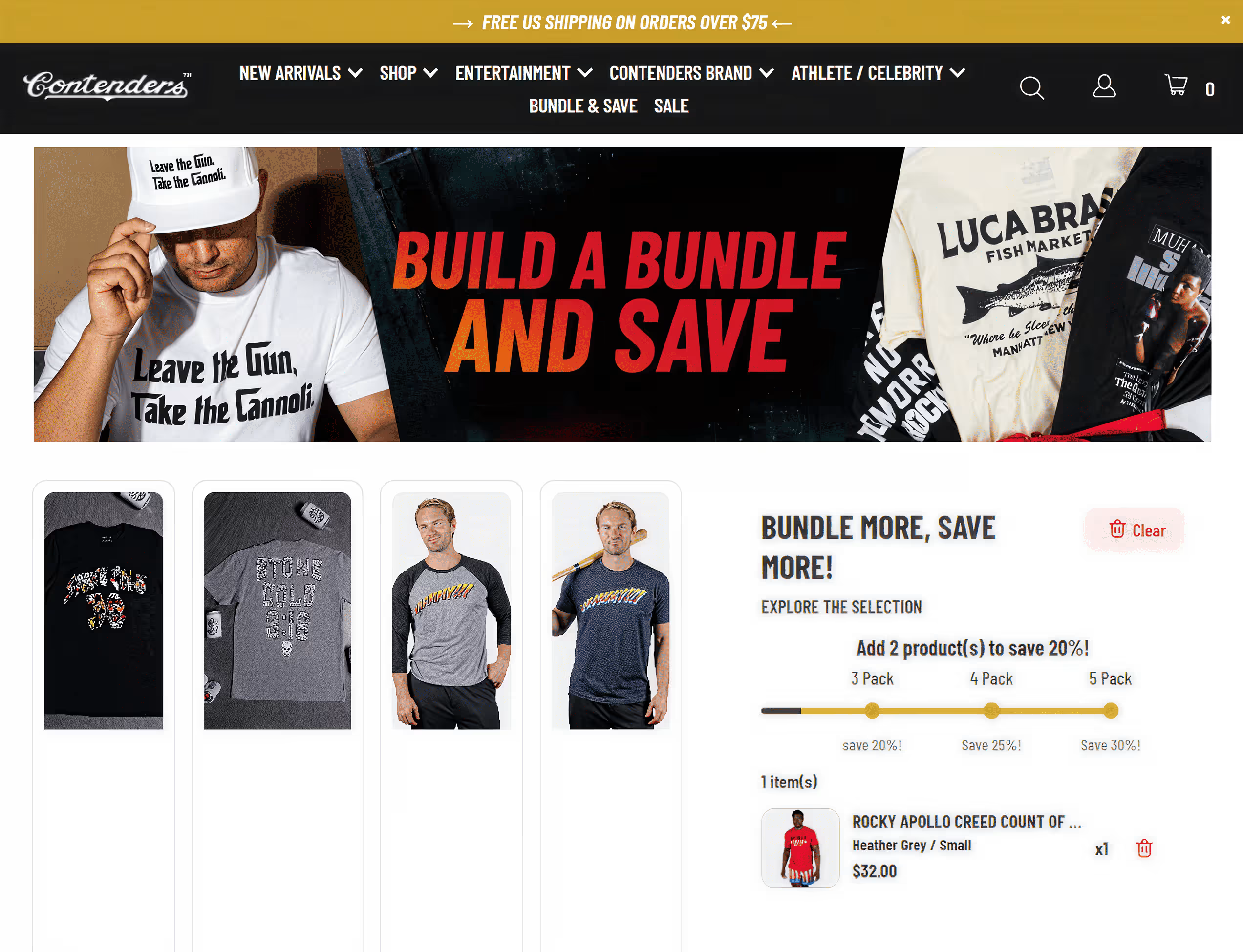
The builder pulls from the brand's deep catalog of licensed graphic tees across many different franchises: WWE (Stone Cold 3:16), Rocky (Apollo Creed), Muhammad Ali, Anchorman, The Godfather and more, in both standard and raglan styles. Prices cluster tightly (mostly $22 to $38), so no single shirt dominates the pack and mixing across franchises feels frictionless. The selection logic taps the collector and multi-fandom instinct: a shopper rarely loves just one property, so presenting WWE next to Rocky next to Ali invites them to build a pack that spans their interests rather than buying a single tee. Sizing is handled inline through a per-product option selector, so the catalog's variant complexity never forces a detour.
The incentive is a tiered discount that starts higher up the ladder than most: 3-Pack saves 20%, 4-Pack saves 25%, and 5-Pack saves 30%. Starting the first tier at three shirts is a deliberate choice for apparel: it pushes past the typical one or two-item order straight to a genuine multi-shirt haul, which is where the margin and the average-order-value lift live. Because licensed tees are interchangeable in price and emotionally easy to add (one more favorite character is a low-friction yes), a steep volume discount rewards exactly the behavior fans are already inclined toward. A free-shipping threshold over $75 sits right around a typical three-shirt pack, so reaching the first discount tier often clears free delivery at the same time, stacking two wins for going to three.
This is a single-step, open builder, which suits a broad pick-your-favorites catalog better than a forced sequence. The persistent "Bundle More, Save More!" panel anchors the experience with a horizontal progress slider marking the 3, 4 and 5-Pack tiers and their savings, so the next reward is always visible as a target. A dynamic message counts the shopper toward it ("Add 1 more product to save 25%") and flips to a celebratory "Congrats!" when a tier is hit, while the total updates live with the original price struck through and a percentage-off badge (for example $102.00 reduced to $81.60 with a "20% off" flag at three shirts). Each selected tee appears in the panel with its size, quantity and a one-tap delete, and sizes are chosen inline as items are added. Built natively with the Easy Bundle Builder, the tiered slider, multi-franchise product feed, inline size variants and live progress messaging all run inside one embedded module.
Takeaway: For fandom or graphic apparel, price your designs in one tight band so adding another favorite is effortless, then start your discount ladder at three items with a visible progress slider, so fan enthusiasm and a clear next-tier reward turn a single tee into a multi-shirt haul.
Built using Easy Bundle Builder.
Best for: Activewear and apparel stores with a deep catalog of separates (bras, tops, bottoms) where customers naturally need to buy several coordinated pieces, not just one.
Senita Athletics is a strong product bundle example for apparel brands that sell separates and want to lift units-per-order by getting shoppers to build a full outfit instead of buying one piece at a time. The whole experience is framed as a "Starter Kit," which reframes the discount as wardrobe-building advice rather than a markdown, and that framing does a lot of quiet work for the brand.
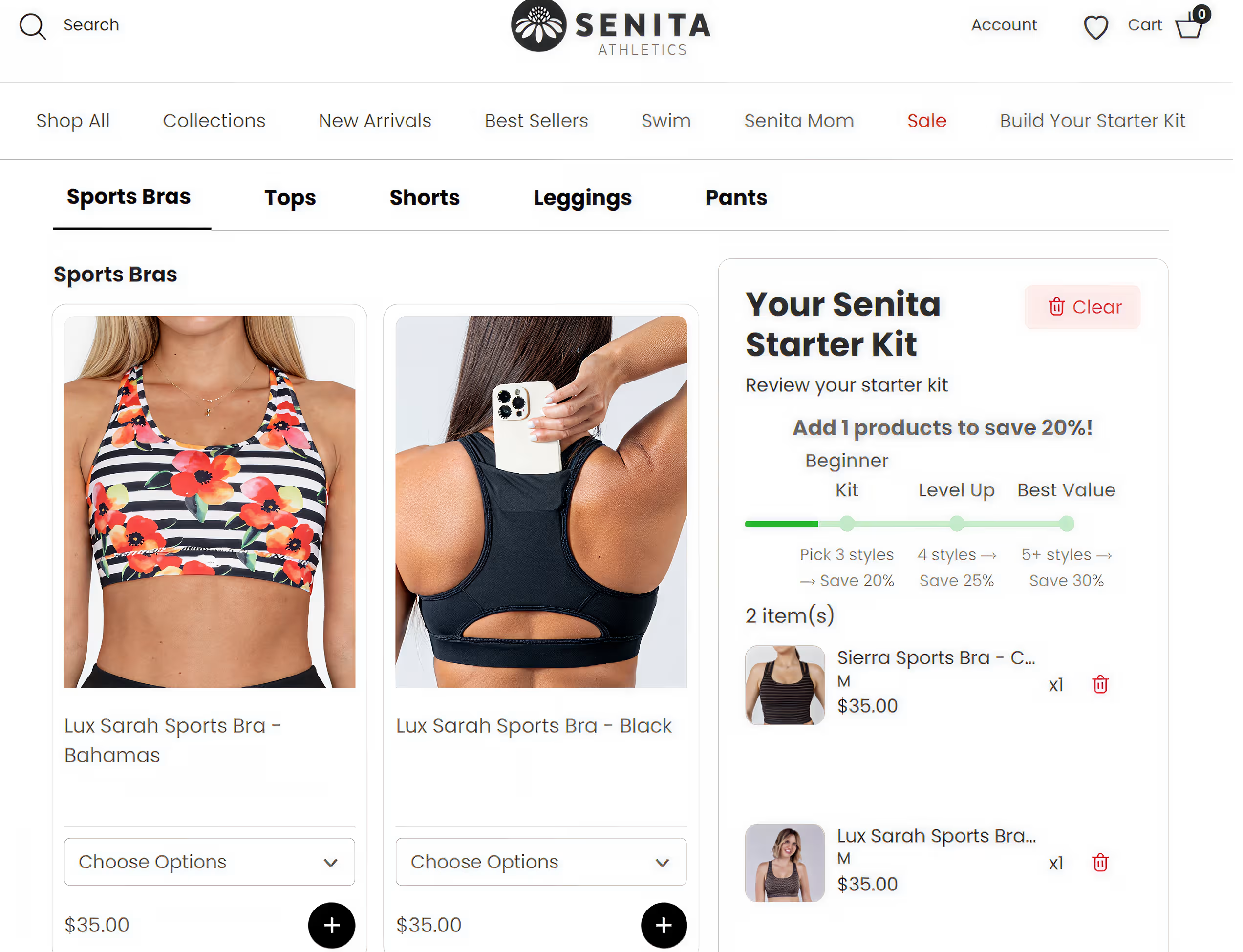
The builder pulls from Senita's core ready-to-wear catalog and organizes it into the same tabs the customer already shops by: Sports Bras, Tops, Shorts, Leggings, and Pants. Nothing is curated down to a "bundle-only" subset. The shopper sees the real range with live variant selectors (size and color), and items that are sold out in a given size simply drop out of the dropdown. Categorizing by garment type, rather than by collection or color story, steers people toward picking one of each, which is exactly how you assemble an outfit. That mirrors the store's broader 113-product best-seller range, where bras, bottoms, and tops are all sold as standalone separates.
The kit runs a flat tiered discount: 3 styles save 20%, 4 styles save 25%, and 5 or more styles save 30%, with the discount applying across whatever mix the customer chooses. Almost everything lands between roughly $40 and $55 (sports bras and shorts at the low end, leggings and joggers at the top), so any three-piece combination produces a similar cart value and a predictable margin. Because the pieces are close in price and meant to be worn together, the brand can club any bra plus any bottom plus any top into one offer without worrying about a customer gaming it with five cheap items. The tiers then push past the natural "one outfit" stopping point: three pieces is a complete look, but the jump to 25 and 30 percent makes adding a fourth and fifth piece feel like the smart move.
This is a single-page builder with a persistent kit summary pinned to the right. The strongest CRO element is the progress bar labeled Beginner Kit, Level Up, and Best Value, paired with a live countdown message. At two items it reads "Add 1 product to save 20%," and the instant the third lands it flips to a "Congrats" state showing the struck-through total beside the discounted price and a "20% off" badge, then immediately points at the next tier: "Add 1 more product to save 25%." Keeping product selection, variant choice, running total, and savings goal all in one view removes the back-and-forth of hunting through collections, and the named tiers turn a discount table into a sense of progression the shopper wants to complete. Built natively with the Easy Bundle Builder, it handles garment-type tabs, variant selectors, tiered pricing and live progress in one embedded module.
Takeaway: When your catalog is separates that are meant to be worn together and priced in a tight band, categorize the builder by garment type and set tiers just past the "complete outfit" count, so the natural stopping point becomes the floor rather than the ceiling.
Built using Easy Bundle Builder.
Best for: Beauty and consumable-goods stores selling a wide library of low-cost, interchangeable SKUs that customers buy repeatedly and tend to stock up on.
Olive & June is a clean product bundle example for beauty brands that sell affordable, repeat-purchase items and want to convert a one-or-two-design impulse buy into a stockpile order. The builder is framed as "Build Your Set and Save," which positions the discount as a reason to stock up on looks rather than a clearance signal, fitting a brand whose whole pitch is at-home, salon-quality nails.
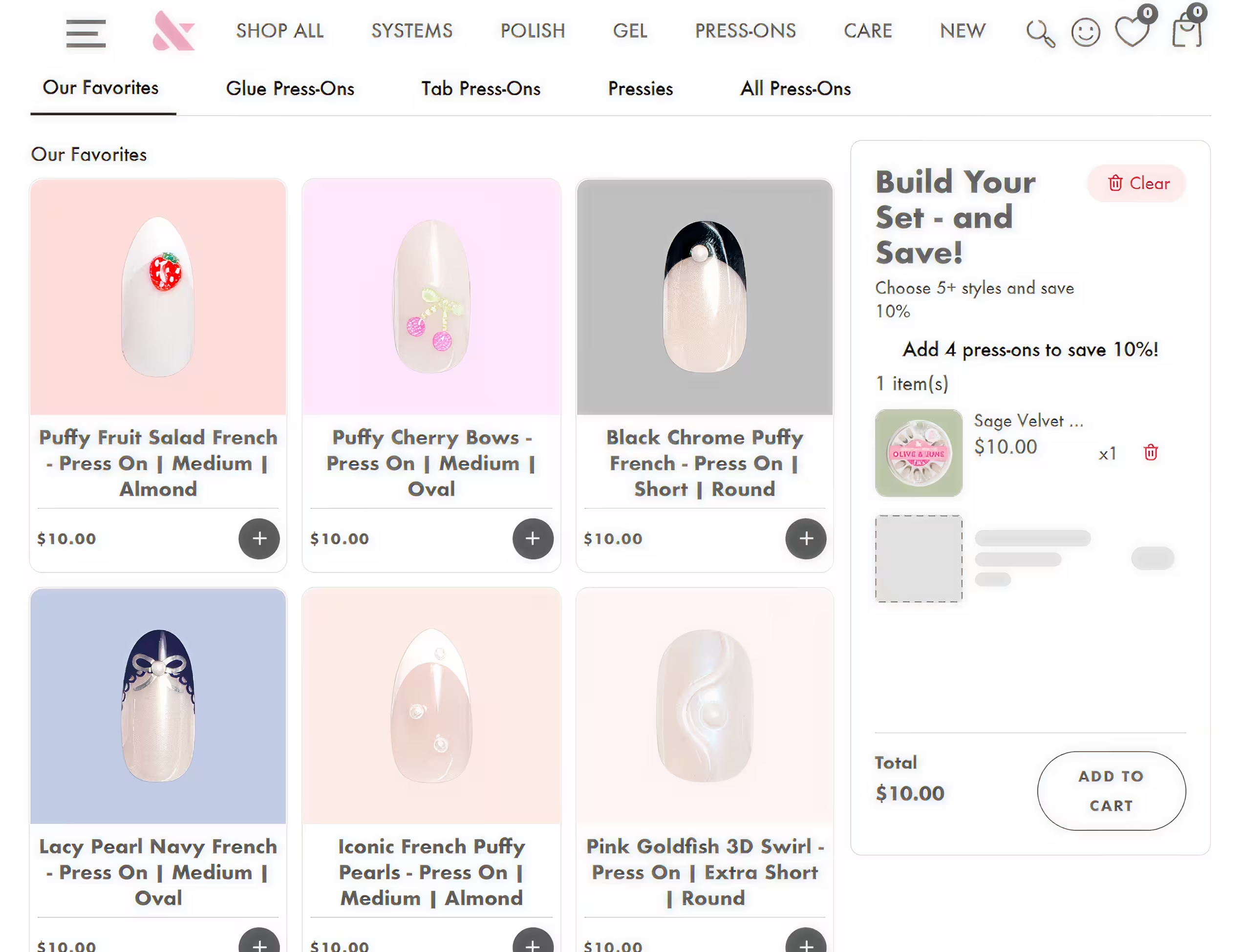
The builder draws exclusively from the press-on range and organizes it by how the nails attach and by curation: Our Favorites, Glue Press-Ons, Tab Press-Ons, Pressies, and All Press-Ons. It deliberately leaves out the brand's polish, gel, and full mani systems, so the set stays inside one product world. Each tile is a finished design shown on a single nail, with the style, length, and shape baked into the product name rather than chosen through variant dropdowns, which keeps adding to the set effortless. That focus ladders up neatly to the wider catalog, where press-ons sit alongside polish and gel systems but are the most natural candidate for buying several at once.
A single flat tier: choose 5 or more styles and save 10% across the set. Most press-ons sit at $10, with premium gem and detail designs at $16, so a five-style set is a roughly $50 to $80 cart, and a flat 10% keeps margin predictable no matter which designs a shopper mixes in. Because press-ons are a consumable that wears off and gets reapplied, a customer left alone usually buys one or two designs for a single occasion. Setting the threshold at five pushes them to buy a rotation of looks in one trip, which raises the order value now and front-loads several future occasions worth of purchases. A single tier rather than a ladder suits a catalog this cheap and this uniform, where the real win is simply crossing from "a design or two" into "a whole set."
This is a single-page builder with the set summary fixed to the right of the grid. Tapping the plus on any tile drops it straight into the set with no variant step, and the panel keeps a live count with a goal message. At three items it nudges "Add 2 press-ons to save 10%," and the moment the fifth lands it flips to a celebratory "Yay! You're getting 10% off your press-ons" with the struck-through $50 beside the $45 total and a "10% off" badge. Removing variant friction matters here because the appeal is browsing designs visually and grabbing the ones you like, so the flow protects that impulse while the running count quietly steers toward the five-style threshold. Built natively with the Easy Bundle Builder, the design grid, threshold logic and live count all run inside one embedded module.
Takeaway: For cheap, interchangeable consumables, drop the variant friction and set one simple "buy this many, save" threshold just above the typical basket, so a casual one-or-two pickup becomes a stock-up set in a single visit.
Built using Easy Bundle Builder.
Across beauty, supplements, apparel and craft, the best product bundle examples here share three patterns. First, they match the bundle structure to how the catalog is actually used: a two-step guided flow for outfit pairing, an open pick-and-mix grid for collectibles, a subscription-first layout for daily consumables. Second, they start the first discount tier at two items, not three or five, so the shopper enters savings mode from the very first addition rather than feeling pushed. Third, they show the saving in real time, as a live total with the original price struck through, so "add one more" is always visibly rewarding rather than a vague promise of a better deal later.
The other thread running through these product bundle examples is that the discount is rarely the main mechanic. OMY Laboratoires uses curation and gifting framing with no discount at all. Max Effort uses membership status and free swag. PINX uses a hardware-plus-consumables model. In each case, the bundle is built around the product logic first, and the saving is the reward for following it, not the reason to engage.


.avif)